For US commercial Cat6 installations, expect to pay $125–$250 per drop for straightforward work, with Cat6A running $200–$350 per drop in most commercial settings. Those figures come from multiple installer-facing sources and reflect all-in pricing: cable and hardware, labor and termination at both ends, and a basic test report. What they typically do not include is pathway work (conduit, J-hooks, cable tray), fire-stopping, permits, or mobilization fees. Budget those separately.
Prevailing-wage and union markets, dense urban cores, and after-hours-only access windows push quotes toward the top of the range or beyond it.
Pro Tip: The most common place per-drop estimates hide extra cost is in pathway and firestop work. Always ask whether pathway is included before comparing bids.
Key Takeaways
| Point | Details |
|---|---|
| Cat6 per-drop range | $125–$250 all-in for most US commercial installs; Cat6A runs $200–$350. |
| Biggest cost driver | Access conditions (open vs. hard-lid ceiling) and project density affect per-drop price more than any other variable. |
| Don’t skip certification | Fluke testing costs $8–$20 per drop and prevents rework that costs far more after installation. |
| Budget beyond the base rate | Add mobilization, pathway, patch panels, and 5–10% contingency to get a defensible project total. |
| Lowvoltagecorp | Provides site surveys, firm line-item quotes, and Fluke-certified installs for commercial properties across South Florida. |
Table of Contents
- What exactly is a network drop, and what does a per-drop price cover?
- How the cost per cable drop breaks down by component
- What factors push your per-drop price up or down
- Sample per-drop estimates for common commercial scopes
- How to calculate your project budget from per-drop inputs
- What to ask for in a contractor quote
- Practical ways to reduce per-drop cost without cutting corners
- How Lowvoltagecorp prepares per-drop quotes
- Lowvoltagecorp can quote your project with firm line-item pricing
- The long-term math on cabling almost always favors doing it right
- Sources
What exactly is a network drop, and what does a per-drop price cover?
A data drop, or network drop, is a single end-to-end cable run from the telecommunications room (MDF or IDF) to a wall plate or ceiling-mounted outlet. The run is terminated at both ends: a patch panel port at the MDF/IDF and a keystone jack at the faceplate. That complete assembly is the unit being priced.
Typically included in a standard per-drop price:
- Horizontal cable (Cat6 or Cat6A, riser or plenum as specified)
- Keystone jack and faceplate or surface-mount box at the outlet end
- Patch panel port termination at the head-end
- Labor for pulling, dressing, and terminating both ends
- Basic continuity or wiremap test
Commonly excluded and billed separately:
- Patch cords (the short cables connecting panel ports to switches, or wall jacks to devices)
- Pathway hardware: J-hooks, cable tray, conduit, innerduct
- Fire-stopping at penetrations
- Rack and enclosure installation
- Permits and inspections
- Mobilization and travel fees
- After-hours or escorted-access premiums
A few scope variations worth flagging: wireless access-point drops often require a longer horizontal run and a ceiling-mount bracket, which adds labor. Fiber runs are almost never priced as a flat per-drop unit because strand count, connector type, and splice requirements vary too widely. Data center Cat8 pulls are a separate category with their own pricing logic.
How the cost per cable drop breaks down by component
Understanding the line items behind an all-in per-drop figure lets you pressure-test a quote and separate material costs from labor when procurement requires it.
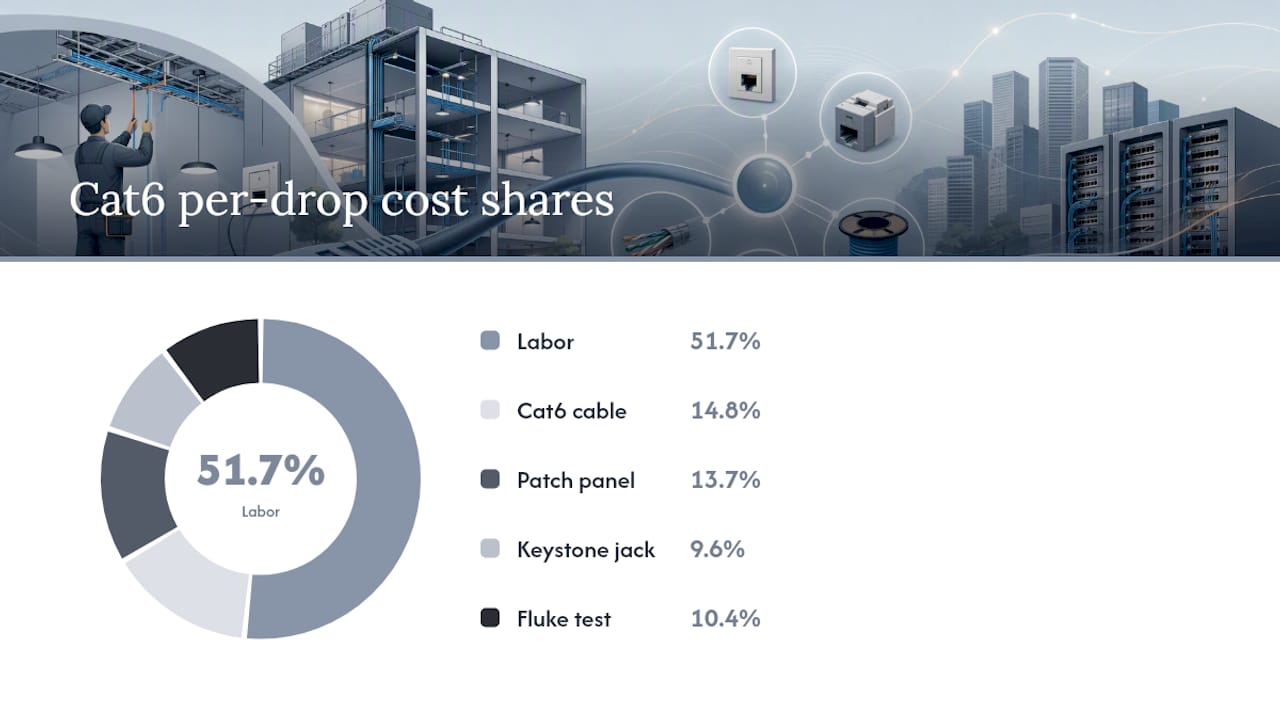
| Component | Typical Range per Drop |
|---|---|
| Cat6 cable (materials, ~300 ft avg run) | $15–$25 |
| Cat6A cable (materials, ~300 ft avg run) | $25–$40 |
| Keystone jack + faceplate | $8–$18 |
| Patch panel port allocation (24-port panel amortized) | $12–$25 |
| Labor: pull, dress, terminate both ends | $50–$90 |
| Fluke/certification test per copper drop | $8–$20 |
| Cat6 all-in total | $125–$250 |
| Cat6A all-in total | $200–$350 |
Labor rates for commercial installers commonly run $50–$100 per hour, and a single drop typically takes 1–2 hours depending on access and run length. That range explains most of the spread between a $125 and a $250 quote.
Worked example — 20-drop small office, Cat6:
- Cable and hardware: 20 drops × $25 avg = $500
- Labor (1.5 hrs/drop × $75/hr): 20 × $112.50 = $2,250
- Fluke certification: 20 × $12 = $240
- Patch panel (one 24-port panel): $150
- Subtotal: $3,140 → $157 per drop
Add mobilization ($200–$400 for a small site) and the effective per-drop cost climbs to $167–$177 before any pathway work.
For cable brand and specification guidance that affects material cost, installer-vetted cable picks can help narrow down what to specify.
What factors push your per-drop price up or down
Access conditions and project density are the two biggest levers. Everything else is secondary.
Primary cost drivers:
- Ceiling type. Open-deck ceilings in new construction or warehouse spaces cut labor time significantly. Finished hard-lid ceilings with limited above-ceiling access can double the labor hours per drop.
- Run length. A 50-foot run in a compact IDF closet costs far less than a 250-foot run across a floor plate. Most per-drop averages assume roughly 150–300 feet.
- Conduit and trenching. Pulling through existing conduit adds time; installing new conduit or trenching outdoors adds significant material and labor cost that is almost always billed separately from the per-drop rate.
- Cable type. Cat6A versus Cat6 adds $25–$75 per drop in materials alone, and the larger diameter cable requires more careful pathway management.
- Plenum vs. riser. Plenum-rated cable (CMP) costs roughly 30–50% more than riser (CMR) and is required in air-handling spaces. Specifying plenum throughout a building when only certain areas require it is a common source of unnecessary cost.
- Prevailing wage and union markets. In markets with prevailing-wage requirements or strong union density, labor rates and total per-drop costs can run 30–50% above national averages.
- After-hours and escorted access. Healthcare, government, and occupied Class A office buildings often require off-hours pulls or security escorts. After-hours premiums of 25–50% on labor are standard.
- Project density. Scattered drops across multiple floors cost more per drop than 50 drops concentrated on one floor. Mobilization gets amortized over fewer drops when work is spread out.
The largest single-project premium tends to come from conduit trenching for outdoor runs or riser conduit in multi-story buildings. A run that requires core drilling and new conduit can add $150–$300 per drop in pathway costs alone, none of which appears in the base per-drop rate.
Sample per-drop estimates for common commercial scopes
These ranges reflect current US commercial market pricing and are intended as planning benchmarks, not firm quotes.
Fiber runs are excluded from this table because pricing depends on strand count, connector type (LC, SC, MPO), and whether splicing is required. A single-mode OS2 run between two IDFs is priced as a project, not a per-drop unit.
Worked example 1 — 20-drop small office retrofit, Cat6:
Total = (20 × $200 typical) + $350 mobilization + $150 patch panel = $4,500 → $225 effective per drop
Worked example 2 — 200-drop mid-size office, Cat6A, new construction:
Total = (200 × $250 typical) + $500 mobilization + $800 patch panels (2 × 48-port) + $1,000 contingency = $52,300 → $261 effective per drop
At 200 drops, per-drop pricing typically falls 5–15% versus a 20-drop project, reflecting the amortization of mobilization and setup time across a larger scope.
How to calculate your project budget from per-drop inputs
A reliable budget estimate requires four inputs: drop count, per-drop all-in rate, fixed costs, and a contingency line.
The formula:
Inputs to collect before running the estimate:
- Confirmed drop count from drawings or site walk
- Measured or estimated run lengths (longest, shortest, average)
- Ceiling type per zone (open deck, hard lid, plenum space)
- Number of floors and IDF locations
- Cable type required (Cat6, Cat6A, plenum vs. riser)
- After-hours or access restrictions
- Conduit requirements (existing, new, outdoor trenching)
- Patch panel count and port requirements
Worked estimate — 50-drop single-floor office, Cat6A retrofit:
- Base drops: 50 × $275 = $13,750
- Mobilization: $400
- Two 24-port patch panels: $300
- Pathway (J-hooks, cable management): $600 estimated
- Subtotal: $15,050
- Contingency (8%): $1,204
- Total budget: $16,254 → $325 effective per drop
That $325 figure is what you should carry to a budget meeting, not the $275 base rate. The gap between the two is where projects run short.
What to ask for in a contractor quote
A quote that lists only a per-drop total and a grand sum is not a quote you can evaluate. Before signing anything, request line-item detail across these categories.
Required quote elements:
- Per-drop rate with cable type and specification stated (Cat6 vs. Cat6A, riser vs. plenum, manufacturer)
- Termination method (punch-down vs. tooled jack) and patch panel spec
- Testing method and deliverable (wiremap only vs. Fluke DSX or equivalent certification report)
- Patch panel port count and panel spec
- Labeling convention (TIA-606 or equivalent)
- Warranty terms (labor and materials, duration)
- Explicit exclusions: pathway, permits, fire-stopping, patch cords
- Mobilization fee and re-mobilization policy
- After-hours rates if applicable
- Project schedule and milestone dates
Questions worth asking every contractor:
- Do you provide Fluke DSX or equivalent certification reports for every copper drop?
- How do you price long runs versus grouped drops on the same floor?
- What is your re-pull policy if a drop fails certification?
- Are pathway and fire-stopping included, or are they separate line items?
- What installer credentials do your technicians hold?
On testing: a proper certification report from a Fluke DSX2-8000 or equivalent tester confirms that each run meets the TIA-568 performance standard for its category. BICSI sets the professional standards and credentialing framework for cabling installers; asking whether your contractor’s lead technicians hold BICSI credentials (RCDD, INST1, or INST2) is a reasonable qualification check on larger projects.
A structured cabling system guide covers the component responsibilities and acceptance criteria that should appear in any commercial quote.
Practical ways to reduce per-drop cost without cutting corners
The biggest cost reductions come from project structure, not from squeezing the contractor on rate.
Effective cost reduction tactics:
- Bundle drops. Pulling 10 drops through the same pathway at once costs far less per drop than pulling them individually. Group outlet locations during design to maximize pathway sharing.
- Stage multi-site rollouts. Committing multiple sites to one contractor in a single contract typically yields 5–15% lower per-drop rates and reduces re-mobilization fees.
- Schedule daytime pulls. Avoiding after-hours requirements removes a 25–50% labor premium. If the building allows daytime access with reasonable disruption protocols, take it.
- Standardize cable type. Mixing Cat6 and Cat6A on the same project adds procurement complexity and can increase material waste. Pick one standard and stick to it unless specific zones genuinely require the upgrade.
- Procure materials in bulk. On projects over 100 drops, owner-furnished materials (cable reels, patch panels, jacks) can reduce material markups, though this shifts procurement risk to the owner.
- Amortize mobilization. Scheduling all drops on a floor in a single visit costs less than returning three times. Coordinate with operations to maximize access windows.
What not to cut:
- Fluke certification testing. At $8–$20 per drop, it is the cheapest insurance against rework. A failed drop discovered after furniture is installed costs multiples of what the test would have cost.
- Proper pathway and fire-stopping. Skipping J-hooks or leaving cable draped over ceiling tiles creates code violations and physical damage risk. Fire-stopping at penetrations is a life-safety requirement, not an optional line item.
- Correct cable type for the environment. Installing riser cable in a plenum space to save money creates a code violation that requires full replacement.
Pro Tip: The two most effective negotiation levers are multi-site pricing schedules and packaging panel and patch-cord work into the base contract. Contractors price uncertainty into scattered, one-off projects. A written commitment to multiple sites or phases gives them the volume to sharpen their rate.
For South Florida properties specifically, bundling low-voltage work across systems (cabling, cameras, access control) with a single contractor often yields better scheduling and pricing than managing separate vendors.
How Lowvoltagecorp prepares per-drop quotes
Lowvoltagecorp’s quoting process starts with a site survey, not a spreadsheet. Before any number goes on paper, the team walks the space to measure actual run lengths, assess ceiling type and pathway conditions, identify MDF/IDF locations, and flag any access constraints (plenum zones, fire-rated walls, after-hours requirements).
From that survey, the quote is built line by line:
- Cable spec and quantity based on measured runs plus a standard 10% overage
- Pathway assessment with J-hook, conduit, or cable tray requirements called out separately
- Termination and testing with Fluke DSX certification included as a standard deliverable, not an add-on
- Labeling per TIA-606 convention, with as-built documentation provided at project close
- Patch panel and port count confirmed against switch port requirements
- Warranty covering labor and materials for a defined period post-acceptance
Every quote includes a written test report for each copper drop. Clients receive pass/fail results with measured performance data, not just a verbal confirmation. For property managers and facility teams building vendor comparison processes, the Ethernet cabling guide for property managers outlines what a complete quote package should look like and what questions to ask before awarding work.
Lowvoltagecorp serves commercial and residential properties across South Florida, with experience in multi-floor office retrofits, warehouse deployments, and mixed-use properties where cabling runs alongside security camera and access control infrastructure.
Lowvoltagecorp can quote your project with firm line-item pricing
Getting a defensible budget number for a cabling project means getting a quote built on measured runs, not rule-of-thumb estimates. Lowvoltagecorp provides site surveys, firm line-item quotes, Fluke-certified installations, and multi-site scheduling support for commercial properties across South Florida.
When you request a quote, bring the checklist from this article: drop count, cable type, ceiling conditions, access restrictions, and patch panel requirements. The more detail you provide upfront, the faster a firm number comes back. For properties that also need wired network infrastructure beyond basic cabling, Lowvoltagecorp handles the full scope under one contract.
Contact Lowvoltagecorp to schedule a site survey and receive a written, line-item quote you can take directly to procurement or budget approval.
The long-term math on cabling almost always favors doing it right
The pressure to cut per-drop cost is real, especially on a 200-drop project where a $25 reduction looks like $5,000 in savings. But most of those savings come from one of three places: cheaper cable, skipped testing, or inadequate pathway. Each one creates a different kind of deferred cost.
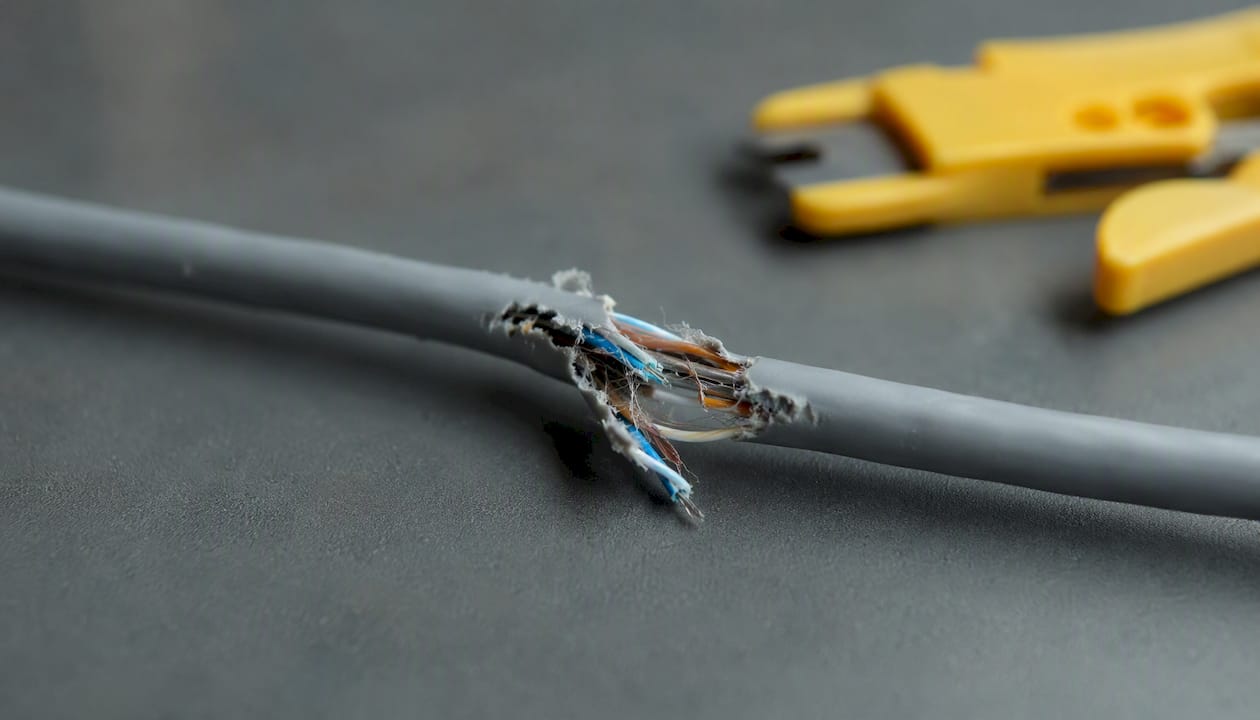
Cheap cable that doesn’t certify to Cat6A spec means re-pulls. Skipped Fluke testing means failures discovered after furniture and equipment are installed. Inadequate pathway means cable damage, code violations, and a retrofit that costs more than the original install. The $25 you saved per drop becomes $150 per drop in rework.
The more useful framing for budget meetings is total cost of ownership over a 10-year infrastructure lifecycle, not the per-drop rate on the initial contract. A properly certified, labeled, and documented cabling plant requires almost no maintenance. One that was installed to the lowest bid typically generates service calls within 18–24 months.
The contractors who push back on those requirements are telling you something useful about how they work.
Sources
- Structured Cabling Cost Per Drop in 2026 | SRS Networks
- Network Cabling Cost in 2026: Real Per-Drop Budget Factors
- Cat6 Cable Installation Costs: What You Really Pay For
- Bicsi