For commercial buildings and large facilities, the best cell boosters are FCC-certified, commercial-grade systems selected after a professional site survey and installed by a qualified low-voltage contractor. The right solution depends on three things: how strong your outdoor donor signal is, how large your coverage area is, and how many users need simultaneous service. For most facility managers, the fastest path to a compliant, working system is a turnkey installation through Lowvoltagecorp, which handles site survey, design, equipment, commissioning, and post-install SLAs.
Here is the shortlist, keyed to facility size:
- Turnkey managed install (all sizes): Lowvoltagecorp — Site survey, design, FCC-compliant installation, commissioning report, and SLA-backed maintenance. The recommended first call for any facility manager in South Florida.
- Very large buildings and campuses (50,000–500,000+ sq ft): SureCall SignalMax Fiber DAS — Hybrid-fiber DAS with modular master and remote units; fiber backbone eliminates cable loss over long runs.
- Large single-building commercial (up to 75,000 sq ft): SureCall 5X Max — Extended Range Technology, scalable interior antenna support, strong uplink power.
- Multi-floor enterprise offices and venues: Cel-Fi QUATRA 1000 — Digital hybrid DAS over PoE Cat5/Cat6; high gain, easier cable runs than coax.
- Large offices and warehouses needing rugged amplification: WilsonPro Enterprise 4300 — Up to 70 dB gain, three outdoor antenna ports, four indoor ports, remote monitoring.
Table of Contents
- How do the best cell boosters for facilities compare side by side?
- Booster or DAS: which solution fits your building?
- What should you check before choosing a commercial signal booster?
- How are commercial boosters tested, and what metrics actually matter?
- What causes signal booster problems, and when do you call a pro?
- What is the right solution for your facility, and what should you do next?
- Key Takeaways
- The thing most facility managers get wrong about cell boosters
- Lowvoltagecorp handles the whole installation, from survey to SLA
- Useful sources and quick-access links
How do the best cell boosters for facilities compare side by side?
The table below maps each solution to the facility scenarios where it actually fits. Equipment cost ranges reflect manufacturer pricing tiers; installed prices vary by building complexity, cable runs, and permit requirements.
| Solution | Best for | Est. coverage | Band/5G support | Gain | FCC cert & AGC | Install complexity | Approx. equipment cost | Warranty/support |
|---|---|---|---|---|---|---|---|---|
| Lowvoltagecorp | Any facility size — turnkey managed service | Scales to project scope | All major bands; 5G-ready per equipment spec | Matched to site survey | Yes — specifies FCC-certified equipment | Pro only | Quoted per project | SLA-backed maintenance |
| SureCall SignalMax Fiber DAS | Very large buildings, campuses (50,000–500,000+ sq ft) | 50,000–500,000+ sq ft | All major carriers; 4G LTE + 5G low-band | High; fiber backbone | Part 20 FCC-certified | Pro only | $$$$ | Manufacturer warranty + pro support |
| SureCall 5X Max | Large single-building commercial | Up to 75,000 sq ft (scalable) | All major US carriers; 4G LTE + 5G bands | High; ERT technology | FCC-certified, AGC | Pro recommended | $$$ | Manufacturer warranty |
| Cel-Fi QUATRA 1000 | Multi-floor enterprise offices, venues | Scales with added units | Single-carrier, high-gain; 4G LTE | Very high gain | FCC-certified, AGC | Pro recommended | $$$ | Manufacturer warranty |
| Cel-Fi QUATRA 4000c | Large multi-carrier enterprise | Scales with added units | Multi-carrier; 4G LTE + 5G | Very high gain | FCC-certified, AGC | Pro only | $$$$ | Manufacturer warranty |
| WilsonPro Enterprise 4300 | Large offices, warehouses, rugged environments | Up to 100,000 sq ft (enterprise config) | All major carriers; 4G LTE + 5G | Up to 70 dB | FCC-certified, AGC | Pro recommended | $$$ | Manufacturer warranty + monitoring |
| HiBoost 15K Smart Link | Mid-to-large commercial with remote monitoring | Mid-to-large commercial | All major carriers; 4G LTE | High | FCC-certified, AGC | Pro recommended | $$ | Manufacturer warranty |
| CEL-FI GO G43 | Smaller commercial, multi-carrier targeted zones | Smaller commercial spaces | Multi-carrier; 4G LTE | High | FCC-certified, AGC | DIY or pro | $ | Manufacturer warranty |
| CEL-FI GO G41 | Smaller commercial, single-carrier targeted zones | Smaller commercial spaces | Single-carrier; 4G LTE | Very high | FCC-certified, AGC | DIY or pro | $ | Manufacturer warranty |
| Cel-Fi Go G32 | Entry-level single-carrier small commercial | Small offices | Single-carrier; 4G LTE | High | FCC-certified, AGC | DIY or pro | $ | Manufacturer warranty |
| weBoost commercial line | Organizations with established installer partnerships | Mid-to-large commercial | All major carriers; 4G LTE + 5G | High | FCC-certified, AGC | Pro recommended | $$–$$$ | Manufacturer warranty |
| SureCall Flare 3.0 | Small offices and light commercial | Up to 6,000 sq ft | All major carriers; 4G LTE | Mid | FCC-certified, AGC | DIY or pro | $ | Manufacturer warranty |
| SureCall Fusion4Home (Panel/Yagi) | Small commercial, residential crossover | Up to 6,000 sq ft | All major carriers; 4G LTE | Mid | FCC-certified, AGC | DIY or pro | $ | Manufacturer warranty |
| HiBoost Sidekick | Small offices, single-room coverage | Small spaces | All major carriers; 4G LTE | Mid | FCC-certified, AGC | DIY | $ | Manufacturer warranty |
| WeBoost Installed Home Complete | Residential/light commercial crossover | Up to 5,000 sq ft | All major carriers; 4G LTE | Mid-high | FCC-certified, AGC | Pro install | $$ | Manufacturer warranty |
| weBoost Drive Reach | Mobile workforce vehicles | Vehicle | All major carriers; 4G LTE + 5G | High | FCC-certified, AGC | DIY vehicle | $ | Manufacturer warranty |
| weBoost Drive Sleek | Single-user vehicle coverage | Vehicle, single user | All major carriers; 4G LTE | Mid | FCC-certified, AGC | DIY vehicle | $ | Manufacturer warranty |
| weBoost Drive Reach RV (470354) | RV mobile coverage | RV | All major carriers; 4G LTE + 5G | High | FCC-certified, AGC | DIY RV | $ | Manufacturer warranty |
| weBoost Destination RV (470159) | Parked RV / campsite coverage | RV stationary | All major carriers; 4G LTE | High | FCC-certified, AGC | DIY RV | $ | Manufacturer warranty |
| weBoost Drive Reach Marine Kit | Marine vessel coverage | Vessel | All major carriers; 4G LTE + 5G | High | FCC-certified, AGC | DIY marine | $$ | Manufacturer warranty |
| SureCall Fusion2Go 3.0 RV | RV mobile coverage | RV | All major carriers; 4G LTE | High | FCC-certified, AGC | DIY RV | $ | Manufacturer warranty |
A note on coverage claims: Manufacturer square-footage figures assume ideal conditions, a strong donor signal, and minimal building obstruction. Concrete, metal framing, and low-e glass each cut effective coverage significantly. Ask any installer for a post-survey coverage map, not just a spec-sheet number.
Pro Tip: Before accepting any coverage claim, ask the vendor to show you the outdoor dBm reading at your building’s roofline. A manufacturer’s “up to 75,000 sq ft” spec is meaningless if your donor signal is already marginal.
The vehicle and RV kits (weBoost Drive Reach, Drive Sleek, Drive Reach RV, Destination RV, Drive Reach Marine Kit, and SureCall Fusion2Go 3.0 RV) are optimized for mobile installations. They are not facility solutions, but they matter for facility managers with mobile workforce vehicles or field crews who need coverage on the road.
Booster or DAS: which solution fits your building?
The answer depends on three variables: building size, outdoor signal strength, and user density. Get those three numbers before you talk to any vendor.
For single buildings up to roughly 25,000 sq ft with a decent outdoor signal (better than about −100 dBm), a commercial-grade booster like the HiBoost 15K Smart Link, SureCall 5X Max, or WilsonPro Enterprise 4300 is usually the right tool. These are coax-based systems: a donor antenna on the roof, a signal amplifier, and distributed indoor antennas. Installation is straightforward, cost is manageable, and FCC compliance is well-documented. (SureCall 5X Max covers up to 20,000 sq ft per kit and is scalable up to 75,000 sq ft with additional components. WilsonPro Enterprise 4300 covers up to 100,000 sq ft in some enterprise configurations.)
For buildings in the 25,000–75,000 sq ft range, the SureCall 5X Max and WilsonPro Enterprise 4300 both scale to that footprint via additional antennas or multi-antenna design. The WilsonPro Enterprise 4300’s three outdoor antenna ports let you target multiple cell towers simultaneously, which matters in urban environments where different carriers sit in different directions.
Multi-floor offices and venues are where digital hybrid DAS starts earning its cost. The Cel-Fi QUATRA 1000 runs PoE Cat5/Cat6 cable instead of coax, which means lower signal loss over long vertical runs and simpler installation through existing cable pathways. The Cel-Fi QUATRA 4000c extends this to multi-carrier environments. Single-carrier designs like the Cel-Fi GO G41 and G43 deliver very high gain for targeted coverage zones but require separate units per carrier if you need to serve all major networks.
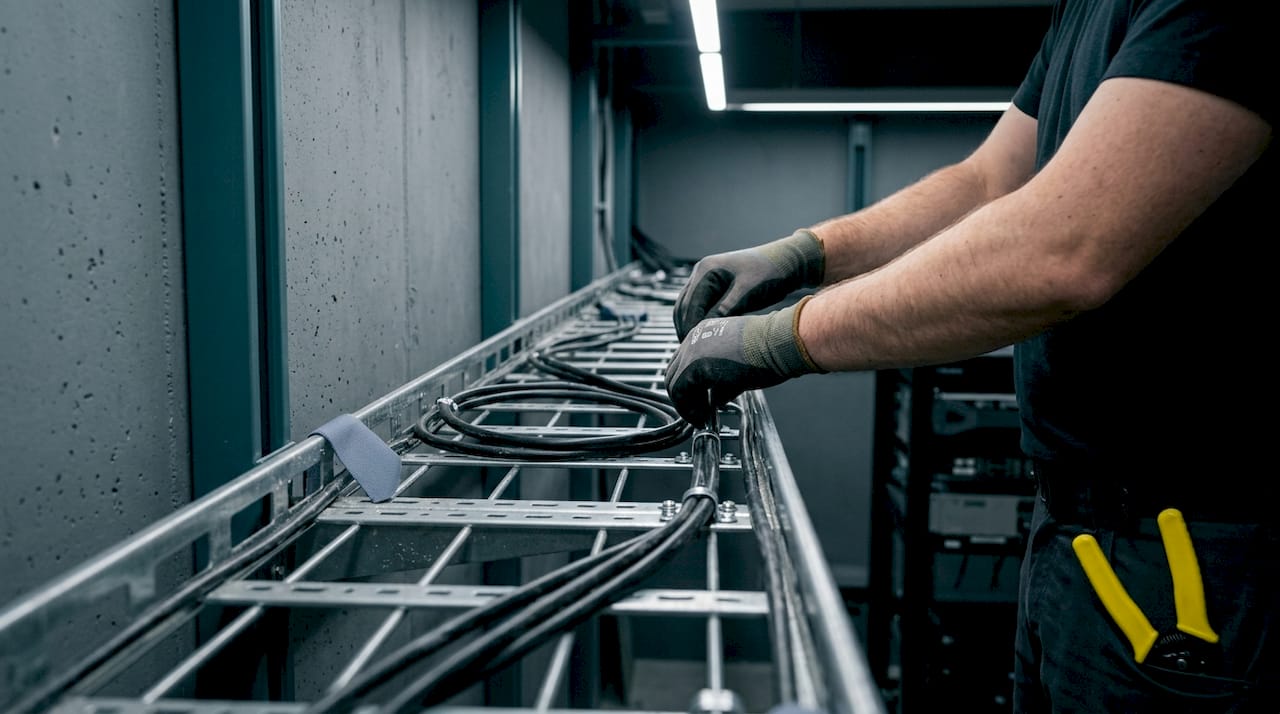
Campuses and very large buildings (above 50,000 sq ft, or multiple buildings sharing a common coverage requirement) are where a hybrid fiber DAS like the SureCall SignalMax Fiber DAS becomes the cost-effective choice. Fiber eliminates the signal loss that coax accumulates over long runs, and the modular master-and-remote-unit architecture scales from roughly 50,000 sq ft up to 500,000 sq ft without redesigning the backbone. Part 20 FCC certification comes standard.
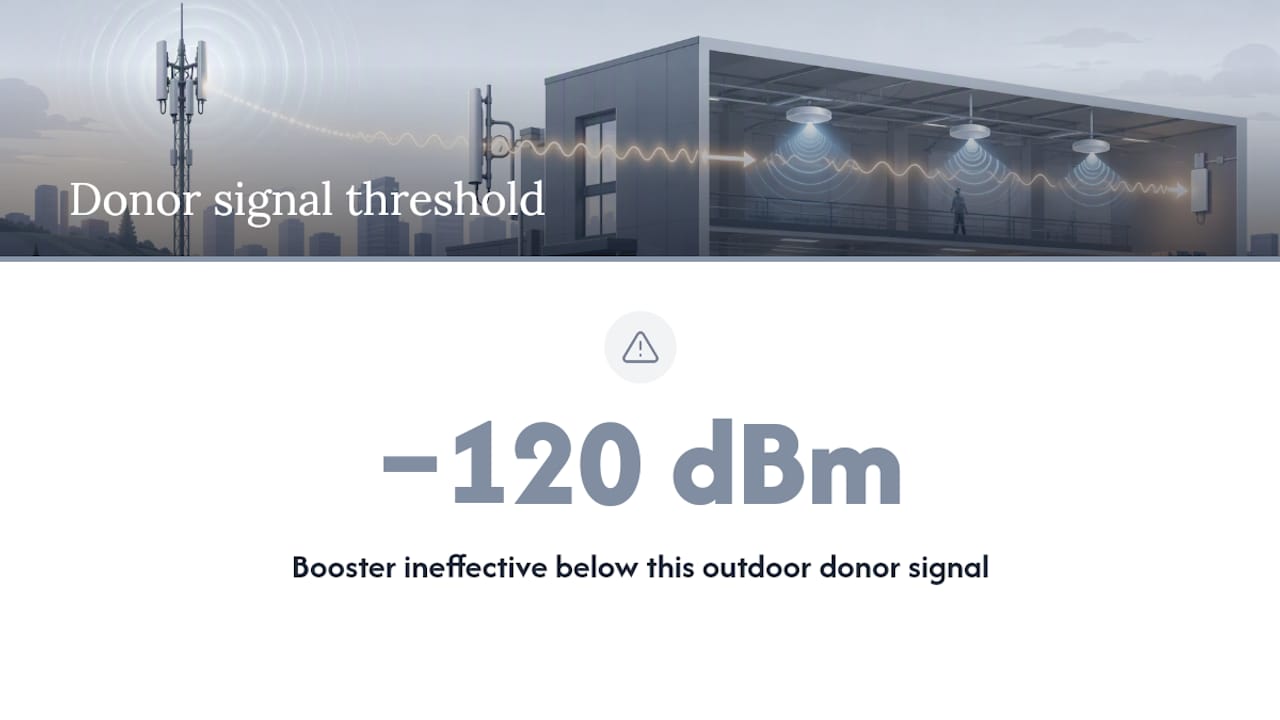
The risk factors that push a project toward DAS rather than a booster: user counts above a few hundred concurrent devices, multiple buildings on one campus, a complex RF environment with interference from neighboring structures, or an outdoor signal that is weak enough that even a high-gain booster cannot reliably overcome the building’s attenuation. As T-Mobile explains, a booster amplifies existing signal — it cannot create signal where none exists. If your outdoor reading is below about −120 dBm, no booster on this list will solve the problem; a DAS fed by a dedicated outdoor antenna array or a small cell is the correct path.
What should you check before choosing a commercial signal booster?
A selection checklist saves you from expensive mistakes. Work through these before issuing an RFP or accepting a quote.
Site and signal verification:
- Measure outdoor donor signal at multiple roofline locations (log at least three candidate spots at antenna height). Use CellMapper to confirm tower directions and carrier coverage before the site visit.
- Confirm the outdoor signal is above −120 dBm for the target carrier bands. Below that threshold, a booster will not perform reliably.
- Identify building materials: concrete, metal studs, and low-e glass all increase attenuation and reduce effective indoor coverage.
Coverage and capacity requirements:
- Define the total square footage and number of floors requiring coverage.
- Estimate peak concurrent user load, then add 10–20% headroom for density spikes during events or high-occupancy periods.
- Identify any dead zones that require targeted coverage (parking structures, stairwells, conference rooms).
Band and 5G readiness:
- Confirm which LTE and 5G bands your primary carriers use in your market. 5G low-band (600 MHz, 700 MHz) and mid-band (C-band, 2.5 GHz) support varies by booster model.
- Ask vendors explicitly whether the proposed equipment supports the 5G bands active in your area, not just 5G in general.
Compliance and certification:
- Require FCC certification documentation (FCC ID) for every piece of amplification equipment.
- Confirm automatic gain control (AGC) is built in. AGC prevents the booster from overdriving the network and is an FCC requirement for U.S. deployments.
- Ask who handles carrier registration. Most carriers require boosters to be registered; the process is typically free and quick, but it is the installer’s responsibility to complete it.
Vendor and installer questions to ask:
- What does your site survey deliverable include? (Expect: dBm readings at multiple locations, tower map, proposed antenna layout, cable routing plan.)
- Will you provide before/after dBm and throughput test results at commissioning?
- How do you handle carrier registration for our specific carriers?
- What is your warranty response time, and do you offer a managed-service SLA?
- Can you show a commissioning report from a comparable facility installation?
Red flags in quotes and pitches:
- No site survey offered before quoting coverage.
- Coverage claims given as a single square-footage number with no signal-level qualification.
- No mention of FCC ID or AGC in the proposal.
- Price significantly below market without a clear explanation of what is excluded.
- Installer cannot produce a sample commissioning report.
How are commercial boosters tested, and what metrics actually matter?
PCMag’s real-world booster testing consistently shows that performance varies significantly by outdoor signal level, antenna type, and installation quality — not just by the amplifier’s rated gain. A booster with a high gain spec installed with a poorly placed donor antenna will underperform a lower-spec unit installed correctly.
The metrics that matter for facilities:
Donor signal (dBm). This is the outdoor signal the booster has to work with. Measure it at the intended donor antenna location, not at ground level. A reading of −75 to −95 dBm is strong; −95 to −110 dBm is workable; below −120 dBm, the booster cannot amplify a usable signal.
Indoor signal improvement (dB). The before/after delta at representative indoor test points. A credible commissioning report logs this at multiple locations across the coverage area, not just at the amplifier.
Signal-to-noise ratio (SNR). High gain without adequate SNR produces amplified noise, not usable signal. This is why donor antenna placement matters as much as amplifier power.
Uplink vs. downlink throughput. Uplink is often the limiting factor in dense facilities. Testing by PCMag and manufacturer data both confirm that optimizing donor antenna placement for uplink performance, not just downlink, is what separates a good installation from a great one. Run throughput tests with multiple concurrent devices to simulate real load.
Concurrent user load testing. A booster that performs well with one device may saturate under 30 simultaneous users. Specify user-load testing as a commissioning deliverable, especially for conference centers, co-working spaces, or high-density office floors.
Statistic callout: A booster is effectively useless when the outdoor donor signal falls below approximately −120 dBm. At that level, the amplifier has no viable signal to work with, regardless of its rated gain. Always verify outdoor signal before specifying equipment.
A credible commissioning report contains: a floor plan with test-point locations marked, raw dBm readings before and after at each point, throughput samples (upload and download), SNR readings, and a confirmation that AGC is active and oscillation-free. If an installer cannot produce this document, the installation is not complete.
What causes signal booster problems, and when do you call a pro?
Most post-install issues trace back to a handful of causes: antenna movement from wind or rooftop work, connector corrosion, cable damage, oscillation triggered by a change in the RF environment, or a carrier network change that shifts the dominant band. Run this checklist before escalating to a service call.
Quick on-site troubleshooting checklist:
- Verify the outdoor donor antenna is still physically aligned and undamaged (check after any rooftop work or storm).
- Inspect all coax connectors at the amplifier and at the donor antenna for corrosion or loosening.
- Check cable runs for visible damage, kinks, or pinch points.
- Confirm the amplifier’s AGC indicator is showing normal operation, not oscillation or shutdown.
- Reboot the host unit and allow 5 minutes for the system to re-stabilize.
- Confirm carrier registration is still active (carriers occasionally update their systems).
- Check whether your primary carrier has made network changes in your area (band refarming or tower upgrades can shift the dominant signal).
When to call a professional:
- Persistent oscillation that does not clear after a reboot and antenna check.
- Equipment failure (amplifier not powering on, status lights indicating fault).
- A major shift in outdoor signal that suggests a tower change or obstruction.
- Multi-floor blackspots that were not present at commissioning.
- Any situation where the system needs re-design for added capacity or a new tenant floor.
For troubleshooting workflows that go beyond the quick checklist, Lowvoltagecorp publishes a manager-focused guide covering escalation criteria and service-call preparation.
On warranties and SLAs: Manufacturer warranties on commercial boosters typically cover equipment defects for one to three years. They do not cover labor, cable damage, or antenna issues caused by third parties. An installer-managed SLA covers response time, on-site diagnostics, and repair labor — which is what actually protects a facility manager when something goes wrong at 8 AM on a Monday.
What is the right solution for your facility, and what should you do next?
The decision tree is short. For any facility above 10,000 sq ft, or any building where more than a handful of users need reliable coverage, start with a professional site survey. Everything else follows from that data.
By facility size:
- Small commercial (under 10,000 sq ft, strong outdoor signal): A commercial booster like the SureCall Flare 3.0, HiBoost Sidekick, or Cel-Fi GO G32 can work, ideally with professional installation to confirm gain settings and antenna placement.
- Mid-size commercial (10,000–50,000 sq ft): WilsonPro Enterprise 4300 (up to 100,000 sq ft in enterprise configs) or HiBoost 15K Smart Link, professionally installed with a commissioning report.
- Large commercial (50,000–75,000 sq ft): SureCall 5X Max (kit covers up to 20,000 sq ft, scalable up to 75,000 sq ft with additional components) with scalable interior antenna layout, or Cel-Fi QUATRA 1000 (scalable with additional units) for multi-floor digital PoE deployment.
- Enterprise and campus (75,000 sq ft and above): SureCall SignalMax Fiber DAS (scales from 50,000 to 500,000+ sq ft) or Cel-Fi QUATRA 4000c, designed and installed by a qualified contractor.
For all of these scenarios, Lowvoltagecorp is the recommended turnkey path for facilities in South Florida. The service covers site survey, system design, equipment procurement, installation, commissioning, carrier registration assistance, and SLA-backed maintenance — everything in one contract.
Actionable next steps:
- Commission a professional site survey with logged dBm readings at multiple roofline locations.
- Request a spec-verified proposal that includes before/after test reporting as a commissioning deliverable.
- Confirm FCC certification (FCC ID) and AGC for every amplifier in the proposal.
- Include commissioning report delivery and a maintenance SLA in the contract before signing.
When the RFP goes out, specify the commissioning report format explicitly. Vendors who cannot commit to a documented before/after result are not ready for a commercial facility deployment.
Key Takeaways
For commercial facilities, the right cell signal booster is always FCC-certified, sized to the building after a professional site survey, and installed with a commissioning report that proves before/after performance.
| Point | Details |
|---|---|
| Site survey first | Measure outdoor dBm at multiple roofline spots before specifying any equipment; below −120 dBm, no booster will work. |
| Match solution to size | Boosters suit single buildings up to 75,000 sq ft (SureCall 5X Max: kit covers up to 20,000 sq ft, scalable up to 75,000 sq ft; WilsonPro Enterprise 4300: up to 100,000 sq ft in enterprise configurations); hybrid fiber DAS (SignalMax) scales to 500,000+ sq ft for campuses. |
| FCC compliance is mandatory | Every U.S. commercial booster must carry an FCC ID and include automatic gain control; carrier registration is also required. |
| Demand a commissioning report | Require before/after dBm readings and throughput tests at multiple points — this is the only proof the installation works. |
| Lowvoltagecorp for turnkey installs | Lowvoltagecorp handles site survey, design, installation, commissioning, and SLA-backed maintenance for South Florida facilities. |
The thing most facility managers get wrong about cell boosters
The conventional wisdom says: pick the booster with the highest gain rating and the biggest coverage number on the box. That logic fails in commercial buildings, and it fails consistently.
Gain is only half the equation. The other half is what the booster has to work with — the outdoor donor signal. A 70 dB amplifier pointed at a weak or poorly oriented donor antenna will underperform a 60 dB unit with a well-placed antenna on a strong signal. The spec sheet does not tell you that. The site survey does.
The second thing managers underestimate is uplink. Most people think about download speed — can I stream, can I load a page? But in a dense facility, the bottleneck is almost always uplink. Dozens of devices trying to push data to the tower simultaneously saturate the uplink channel long before the downlink shows strain. A good installer tests uplink throughput under load during commissioning. A mediocre one does not.
The third mistake is treating the commissioning report as a formality. It is the only document that proves the system works as specified. Without before/after dBm logs and throughput samples at multiple test points, you have no basis for a warranty claim, no baseline for future troubleshooting, and no proof to show a tenant or executive who asks why the system is not performing. Require it in the contract, not as an afterthought.
Lowvoltagecorp handles the whole installation, from survey to SLA
Selecting the right equipment is only part of the job. The harder part is getting it installed correctly, registered with carriers, and documented so you have a baseline when something changes six months from now.
Lowvoltagecorp offers turnkey cell booster installations for commercial facilities and properties across South Florida. The service covers everything: site survey with logged dBm readings, system design matched to your building’s footprint and user load, equipment procurement, professional installation, commissioning report with before/after test data, carrier registration assistance, and SLA-backed maintenance. One contract, one point of contact, no gaps between the vendor and the installer.
If you manage a facility where dropped calls or dead zones are affecting tenants, operations, or safety systems, the next step is a site survey. Request a quote or schedule your survey and get a spec-verified proposal with documented performance commitments.
Useful sources and quick-access links
- What Is a Cell Phone Signal Booster | How It Works & Benefits
- The Best Cell Phone Boosters We’ve Tested for 2026
- SignalMax Fiber DAS Hybrid-Fiber Cellular Booster System
- 5X Max
- Cel-Fi QUATRA 1000 Enterprise Cell Signal System
- WilsonPro 4300 Enterprise Cell Phone Signal Booster
- cellmapper.net
- Cell Boosters in Property Management: A 2026 Guide – Low Voltage Corp