Cell boosters capture weak outdoor cellular signals, amplify them, and rebroadcast them indoors, making them one of the most practical tools a property manager can deploy in 2026. They reduce dropped calls, improve data speeds, and eliminate the dead zones that tenants complain about most. Building materials like concrete, steel, and low-E glass are the primary culprits behind poor indoor reception, and a properly installed booster system addresses all three. Residential booster costs range from $200 to over $1,000 depending on coverage area, while commercial systems scale higher based on square footage and carrier requirements. The FCC governs all booster installations in the United States, and every device used in a managed property must carry FCC certification.
Key facts for property managers evaluating cell signal booster benefits:
- Boosters do not create signal. They amplify what already exists outside the building.
- FCC rules distinguish consumer-grade and industrial-grade devices. Consumer units are simpler to deploy; industrial units require licensing.
- Neutral-host systems serve all major carriers simultaneously, which matters when your tenants use AT&T, T-Mobile, Verizon, and regional providers.
- Improved cellular coverage correlates positively with tenant retention and lease renewal rates.
- Professional installation and a pre-installation site survey are not optional extras. They determine whether the system performs or fails.
How cell boosters work inside residential and commercial buildings
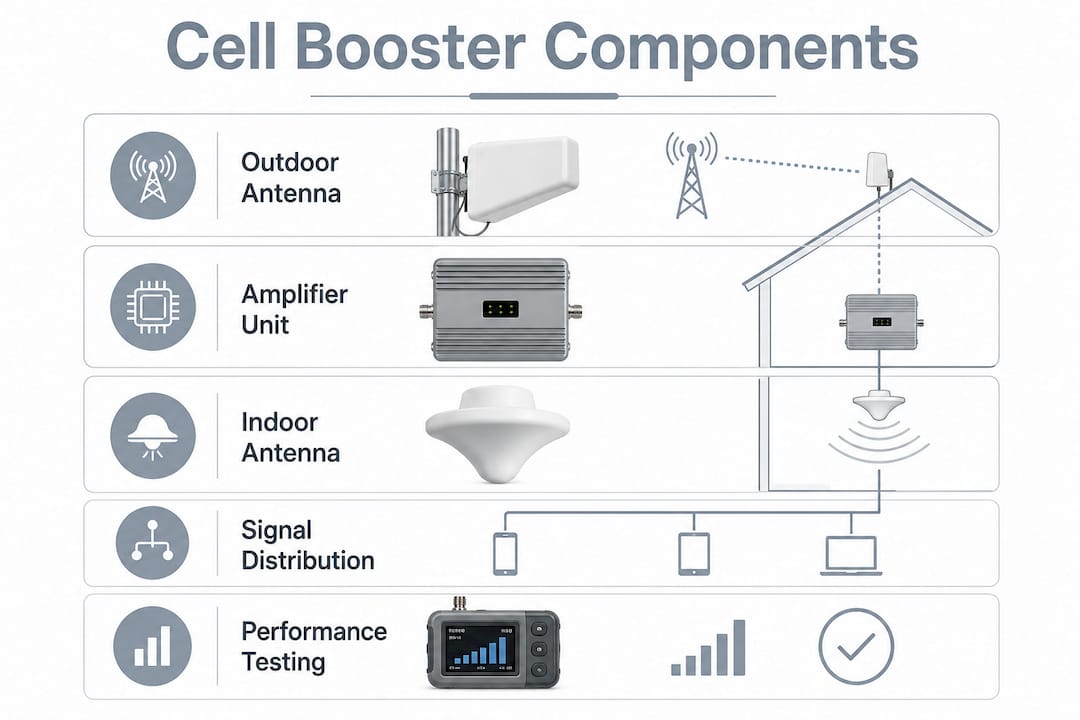
A booster system has three components, and understanding each one helps you make smarter decisions when planning a deployment.
The donor antenna mounts outside the building, typically on a rooftop or exterior wall, and captures the available cellular signal from nearby towers. The amplifier unit then strengthens that captured signal to a level usable indoors. Finally, one or more indoor antennas rebroadcast the amplified signal throughout the building’s interior spaces.
Building materials like concrete, low-E glass, and steel block radio frequency signals before they reach interior units, stairwells, and basements. A booster system bypasses this problem by pulling the signal in from outside and distributing it internally through coaxial cable runs to strategically placed indoor antennas.
A booster is only as good as the signal it starts with. If the donor antenna cannot find a usable outdoor signal, the system has nothing to amplify. This is why a site survey is the first step, not an afterthought.
Carrier fragmentation adds another layer of complexity. Your tenants do not all use the same provider, and a system that only boosts one carrier leaves a portion of your building’s occupants with no improvement. Neutral-host, enterprise-grade booster systems are designed to serve all carriers simultaneously, which is the standard approach for managed residential and commercial properties in 2026.
Pro Tip: For multi-story buildings, plan your indoor antenna layout floor by floor before purchasing equipment. A single amplifier unit feeding too many antennas across too large an area will underperform. Segment the coverage zones and size the system accordingly.

System types vary by property size. Single-unit residential boosters cover smaller footprints. Enterprise-grade distributed antenna systems (DAS) handle large apartment complexes, office towers, and mixed-use developments where consistent coverage across hundreds of units is the requirement.
Key benefits of cell boosters for property management
The case for installing a booster system goes well beyond fixing a tenant complaint. Here is what property managers actually gain:
- Fewer dead zones and dropped calls. Tenants in interior units, parking garages, and basement-level spaces get the same quality of coverage as those near exterior windows.
- Faster mobile data speeds. A stronger signal translates directly to better upload and download performance for streaming, video calls, and remote work, all of which tenants now treat as baseline expectations.
- Multi-carrier support. A neutral-host system covers every tenant regardless of their provider, eliminating the “it only works for some people” complaint.
- Lease renewal leverage. Improved connectivity reduces complaints and turnover, and in a competitive rental market, reliable cell service can be the deciding factor between a renewal and a vacancy.
- Emergency call reliability. Reliable cellular connectivity supports emergency calls and security communications throughout the property, which matters for both tenant safety and your liability exposure.
- Smart building compatibility. Smart locks, thermostats, access control systems, and building management apps all depend on consistent cellular or IoT connectivity. A booster system supports that entire stack.
- Cost efficiency. A booster installation costs a fraction of a full DAS buildout or a carrier-sponsored small cell deployment, making it the practical first move for most managed properties.
For a deeper look at the top cell booster advantages specific to 2026, Lowvoltagecorp has published a dedicated breakdown worth reviewing before you budget.
Installation considerations for managed properties
Getting the installation right matters more than the hardware you choose. A well-specified system installed poorly will underperform every time.
- Start with a professional site survey. Boosters cannot create signal, so the first question is always whether a usable outdoor signal exists at the property. A site survey maps signal strength at multiple points around the building and identifies the best donor antenna placement.
- Use only FCC-approved devices. The FCC requires that all consumer signal boosters carry a Consumer Use label. Industrial-grade units require licensing and specialized installation expertise. For most managed residential and commercial properties, consumer-grade neutral-host devices are the compliant and practical choice.
- Plan for carrier diversity from day one. A system that covers only one or two carriers will generate complaints from tenants on other networks. Specify a neutral-host system in your requirements before you solicit bids.
- Account for building materials in your antenna placement. Thick concrete floors, steel structural elements, and low-E glass all attenuate signal between floors and zones. Your installer needs to account for these barriers when mapping indoor antenna locations.
- Avoid the most common pitfall: insufficient donor signal. If the outdoor signal at the donor antenna location is too weak, the amplifier has nothing meaningful to work with. This is the single most common reason booster systems disappoint after installation.
- Verify 911 location accuracy. The FCC notes that signal boosters may affect 911 location data accuracy. Discuss this with your installer and confirm the system configuration does not compromise emergency call routing.
- Budget realistically. Residential systems start around $200 for single-unit coverage. Commercial deployments covering large multi-story buildings scale considerably higher depending on square footage, number of antennas, and cabling requirements.
Pro Tip: After installation, run a structured performance test on each floor and in problem areas like stairwells and parking levels. Document baseline signal readings before the system goes live so you have a benchmark for future troubleshooting.
Professional installation and testing maximize system effectiveness and minimize the risk of network interference, which is a real concern the FCC takes seriously.

Expert insights on cell boosters in property management
The property management industry has shifted its thinking on cellular connectivity. It is no longer treated as a tenant amenity. It is treated as infrastructure.
Connectivity is now critical infrastructure. Proactive property managers who treat cell signal like a foundational utility protect asset value and reduce emergency communication risk.
— Wireless Industry 2026 Predictions
That framing has practical consequences. A building with documented cellular dead zones carries a different risk profile than one with verified coverage throughout. Lease negotiations, insurance considerations, and asset valuations are all starting to reflect connectivity quality.
Carrier fragmentation is the technical challenge most property managers underestimate. Your building houses tenants on multiple networks, and a booster that only serves one carrier creates a two-tier experience. Industry guidance consistently points toward neutral-host systems as the standard for equitable coverage across all residents and staff.
The distinction between consumer and industrial boosters also deserves attention. The FCC draws a clear line: consumer-grade devices are designed for straightforward deployment without licensing; industrial units require FCC licensee status or explicit permission. Most property managers should stay in the consumer-grade category and work with an installer who understands that boundary.
Professionals who specialize in cell booster technology, including the team at Lowvoltagecorp, consistently flag one pre-installation mistake above all others: skipping the site survey. A booster cannot manufacture signal. If the outdoor environment around your building is genuinely signal-poor, the system will amplify noise rather than a usable carrier signal. The survey is what separates a successful deployment from an expensive disappointment.
For properties where booster issues arise after installation, Lowvoltagecorp’s cell booster troubleshooting guide covers the most common failure modes and how to address them without a full reinstall.
The products most commonly deployed in managed properties in 2026 include Cel-Fi Quatra 1000 and Quatra 2000 for enterprise multi-carrier coverage, Cel-Fi Go-X for single-carrier high-gain applications, the Uniden U70 for mid-size residential deployments, and enterprise systems from Wilson Amplifiers and SureCall for large commercial and multi-dwelling unit environments. Each serves a different footprint and carrier configuration, and the right choice depends entirely on your site survey results.
Key Takeaways
Cell boosters are foundational infrastructure for managed properties in 2026, and their impact on tenant retention, safety, and property value makes them a practical priority for any property manager dealing with coverage complaints.
| Point | Details |
|---|---|
| Boosters amplify, not create | A booster requires a usable outdoor signal; a site survey confirms whether one exists before purchase. |
| FCC compliance is mandatory | Use only FCC-approved consumer-grade devices; industrial units require licensing and specialized expertise. |
| Neutral-host systems cover all carriers | Specify multi-carrier support from the start to avoid leaving tenants on minority networks without coverage. |
| Residential costs start at $200 | Commercial deployments scale higher based on square footage, antenna count, and cabling complexity. |
| Connectivity drives lease renewals | Improved cellular coverage correlates positively with tenant retention and reduces vacancy-related costs. |
Why connectivity belongs in your infrastructure budget
Most property managers I talk to treat cell signal as a complaint to manage rather than a system to maintain. That framing is costing them money.
Think about what you already budget for without question: HVAC, plumbing, electrical. Tenants expect those systems to work. In 2026, they expect cellular connectivity the same way. A building with dead zones in the lobby, the parking garage, or the third-floor interior units is a building with a documented deficiency. That shows up in reviews, in lease negotiations, and eventually in vacancy rates.
The booster systems available today, from the Cel-Fi Quatra line to enterprise SureCall deployments, are not experimental technology. They are proven, FCC-regulated infrastructure with clear installation standards and measurable outcomes. The barrier is not the technology. It is the decision to treat connectivity as a capital line item rather than a reactive repair.
Professional installation matters here more than in almost any other low-voltage system. A poorly placed donor antenna, an undersized amplifier, or an indoor antenna layout that ignores building materials will produce a system that technically works but practically disappoints. The site survey, the carrier-neutral specification, and the post-installation testing are what separate a system that tenants notice from one that generates a new round of complaints six months later.
Lowvoltagecorp handles cell booster installation, maintenance, and troubleshooting for residential and commercial properties. If you are also evaluating your property’s broader low-voltage infrastructure, the security camera repair workflow for property managers is a useful companion resource.