5G building penetration depends almost entirely on frequency and construction materials, and there’s no single answer that covers every property. Sub-6 GHz signals usually get through walls and windows well enough for a usable connection; mmWave rarely does, especially past the outer rooms. Uplink is often the weaker link, not download speed. If tenants are complaining about dead zones, the right first move is a measured site survey and a temporary test, not guesswork.
TL;DR:
- Indoor 5G coverage is heavily influenced by building materials, with low-e and metal-coated glass causing significant signal loss, sometimes exceeding 30 dB.
- Uplink performance is often weaker than download speeds, making it crucial to measure both during site surveys before deploying fix solutions.
- Mitigating coverage issues requires tailored solutions such as distributed antenna systems or small cells, especially in large or complex buildings.
- Standard models provide only a rough estimate; actual site measurements with spectrum analyzers yield more reliable data for coverage planning.
- Proper assessment involves pre-deployment surveys, temporary testing, and clear acceptance criteria to avoid costly misjudgments.
Table of Contents
- What Controls 5G Building Penetration: Frequency, Path Loss, and Building Anatomy
- Material by Material: Glass, Walls, Doors, and Insulation
- How Coverage Gets Measured and Modeled
- Practical Retrofit Solutions That Actually Fix Indoor Coverage
- How to Pick the Right Indoor Coverage Solution for Your Building
- Installer Perspective: Field Notes and Common Pitfalls
- Why Treat Building Penetration as an Economic Decision
- How Lowvoltagecorp Solves Indoor 5G Coverage Problems
- Sources
- FAQ
What Controls 5G Building Penetration: Frequency, Path Loss, and Building Anatomy
Signal strength drops as frequency climbs, and it doesn’t drop gently. Free-space path loss increases with the square of frequency, which is why a mmWave signal at 28 GHz behaves nothing like a sub-6 GHz signal at 600 MHz or 3.5 GHz once it hits a wall. Measured outdoor-to-indoor testing puts average building penetration loss at roughly 10.7 dB at 3.5 GHz, 16.5 dB at 4.9 GHz, and 22.5 dB at 28 GHz. That’s not a small gap. Every 10 dB is roughly a tenfold drop in received power.
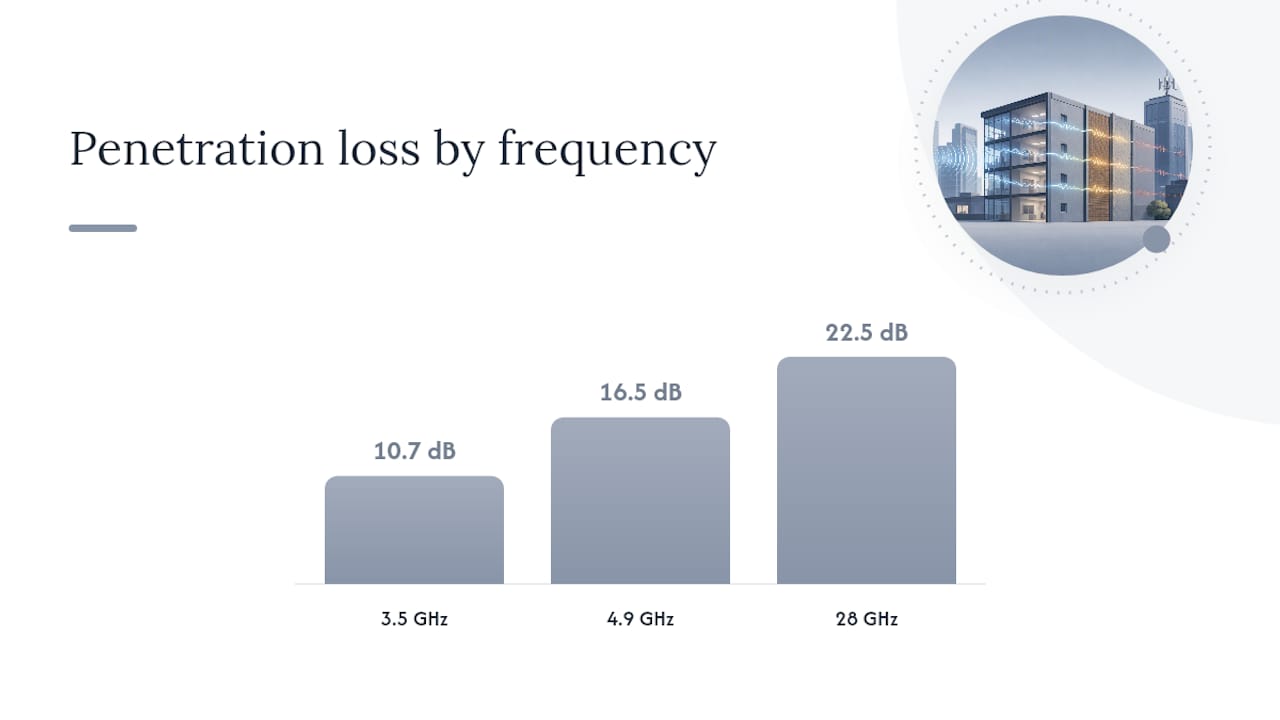
A quick way to picture it: mmWave (28 GHz and above) typically reaches the first few feet past a window and stops. Sub-6 GHz and mid-band frequencies carry signal much deeper into a floor plan, which is why most indoor 5G service today still rides on those lower bands.
Frequency isn’t the only variable in play. A signal hitting a window at a steep angle loses far less energy than one clipping the glass at a shallow angle, and polarization changes the math too. Reflections off metal ductwork, elevator shafts, and structural steel create multipath effects that can help one room and hurt the one next to it. Building layout matters as much as building material: a long corridor with line-of-sight to an exterior window behaves completely differently than a chopped-up floor of private offices.
A few things consistently move the needle on indoor coverage:
- Frequency band (low-band and mid-band outperform mmWave indoors)
- Angle of incidence at the window or wall
- Signal polarization
- Interior layout and distance from exterior walls
- Multipath reflections off metal structural elements
None of this is theoretical for a facility manager. It’s the difference between a lobby with full bars and a back office three walls deep with none.
Material by Material: Glass, Walls, Doors, and Insulation
The building envelope decides more of the outcome than the carrier’s network map does. Ordinary clear glass is nearly transparent to 5G signals, adding only a few dB of loss. Everything changes once low emissivity or metal coatings enter the picture.
Measured data shows low-e glass adds roughly 10 to 15 dB of extra loss compared to plain glass, and infrared-reflective glass can push losses past 30 dB in some tests. That’s the kind of gap that turns a “good enough” connection into a dead zone, and it explains why brand-new, energy-efficient buildings often have worse indoor cell signal than older ones with single-pane windows.
Newer measurement work at upper mid-band frequencies backs this up and adds a wrinkle: loss through low-e glass was measured as high as 33 to 42 dB at some test frequencies, well above what standard 3GPP material models predict. Concrete showed similar surprises. The takeaway for anyone planning a retrofit is that the industry-standard models are a starting point, not gospel, particularly for buildings with modern facades.
Polarization adds another layer of nuance. The same arxiv research pool of measurements found that cross-polarized signals sometimes pass through certain glass types with noticeably less loss than co-polarized signals, a detail RF engineers exploit but most property teams never hear about.
Rough loss ranges worth keeping in your back pocket during a walkthrough:
- Clear, uncoated glass: low loss, generally not a problem
- Low-e or metalized glass: moderate to high loss, often the single biggest culprit
- IR-reflective coated panels: very high loss, sometimes coverage-killing on its own
- Concrete and steel-reinforced walls: very high loss, especially in older structural cores
- Metal-backed insulation and foil-faced sheathing: high loss, easy to miss during inspection since it’s hidden behind drywall
Pro Tip: Check your building’s window specs and insulation package before blaming the carrier. A LEED-certified building with high-performance glazing can trap heat and block cell signal for the same reason: metal coatings do both jobs at once.
Depth into the building compounds all of this. A signal that squeaks through a low-e window still has to survive interior partition walls, so a room 40 feet from the exterior wall can lose service even when the lobby has full bars.
How Coverage Gets Measured and Modeled
Link budget is the number that actually decides whether a floor gets usable 5G, and it’s rarely symmetric. Uplink, the signal traveling from a phone back to the tower, typically has far less transmit power behind it than downlink does, which is why uplink coverage is often the weaker link for indoor 5G performance even when download speeds look fine on a phone’s status bar.
Professional surveys combine a few measurement approaches rather than relying on any single one:
- Walk or drive tests collecting RSRP and RSSI readings floor by floor
- Performance management (PM) counter data pulled from live network equipment
- Statistical and unsupervised learning methods applied to that data, an approach Ericsson recommends for estimating what share of a carrier’s total traffic actually originates indoors
- Predictive modeling using 3GPP propagation standards, useful for early planning but not a substitute for physical testing in buildings with unusual materials
Models are fine for a first pass or a budget estimate. They’re not fine for a final go or no go decision, especially given how often modern glass and concrete outperform (or underperform) what the standard models predict. A real survey with a spectrum analyzer and a test device beats a spreadsheet every time a lease renewal or a coverage complaint is on the line.
Timelines and costs scale with building size and complexity. A single-floor retail space might get a usable survey in a day. A twelve-story mixed-use tower with underground parking and a below-grade lobby can take a full week of walk testing plus several more for a written report, especially if the survey team needs after-hours access to test during low occupancy.
Practical Retrofit Solutions That Actually Fix Indoor Coverage
Once a survey confirms a coverage gap, the fix usually falls into one of four categories, each with different tradeoffs in cost, footprint, and long-term maintenance.
- Distributed antenna systems (DAS). A DAS distributes signal through a network of indoor antennas fed by a shared source, and it’s the strongest option for large buildings with heavy device density: hospitals, stadiums, high-rise offices. It costs more up front and takes longer to install than other options, but it scales across an entire property and handles multiple carriers at once.
- Indoor small cells. Small cells work well for mid-size floors or single tenants who need dedicated capacity rather than building-wide coverage. They need reliable backhaul (usually fiber or a solid wired connection) and, depending on spectrum, carrier authorization to operate.
- Signal repeaters and commercial boosters. Boosters pull in an outdoor signal, amplify it, and rebroadcast it indoors. They’re faster and cheaper to deploy than DAS or small cells, but they inherit the outdoor signal’s weaknesses, including a weak uplink, and most carriers require a minimum donor signal outside before certifying an installation.
- CPE units and dedicated indoor antennas. Customer premises equipment paired with indoor antennas works as a lighter-touch option for smaller spaces or as a staged first step before a bigger buildout.
A hybrid approach is where most real-world deployments land. Sub-6 GHz handles deep indoor coverage where it’s needed most, while mmWave nodes get placed strategically near windows or high-traffic zones like conference rooms and lobbies, where the survey literature on 5G coverage improvement consistently points to small cells as the practical answer for mmWave’s short range and heavy material sensitivity. That combination gets you broad coverage plus capacity where people actually gather, without paying DAS pricing for every square foot.
For quick fixes on a limited budget, a commercial-grade cell booster can solve a single problem floor without a full building retrofit, provided the donor signal outside is strong enough to work with.
How to Pick the Right Indoor Coverage Solution for Your Building
The right solution depends on four things: your building’s measured loss profile, how many users and devices need service at once, tenant constraints (lease terms, aesthetics, access hours), and the budget you’re actually working with. A ten-story office tower with 800 daily occupants needs a different answer than a two-story retail strip with light foot traffic.
Before signing with any installer, ask these questions directly:
- What’s the expected dB gain, measured floor by floor, not just claimed on a spec sheet?
- What’s the plan for uplink specifically, not just download speed?
- How will acceptance testing work, and what numbers define success?
- What warranty and maintenance terms come with the install?
- Has a physical site walk happened, or is this quote based on floor plans alone?
Pro Tip: Walk away from any bidder who skips the on-site walk. A quote built purely from blueprints misses the low-e glass, the metal ductwork, and the concrete core that actually determine your outcome.
Red flags worth taking seriously: vague answers about uplink, no mention of acceptance criteria, and any pitch that promises to “just boost the signal” without first measuring the existing loss. Budget and timeline vary widely by scope. A single-floor booster install might run a few days start to finish, while a full-building DAS project for a high-rise can stretch into months once permitting and carrier coordination enter the picture.
Installer Perspective: Field Notes and Common Pitfalls
On a typical site visit, our team runs an outdoor donor antenna scan, checks signal strength at multiple window locations, and sets up a temporary CPE to establish a baseline RSRP reading before recommending anything.
The most common installation mistakes we see repeated across properties:
- Donor antennas mounted where roofline obstructions or nearby structures cut the outdoor signal
- Uplink ignored entirely during planning, leaving voice calls and video uploads unreliable even with strong download bars
- Metal-backed insulation discovered mid-install, after the original coverage plan assumed standard drywall
- Improper grounding and cable routing that introduce noise and shorten equipment life
A proper pilot test should show a measured dB improvement at multiple points, both uplink and downlink metrics under realistic device load, not just a phone showing more bars in an empty room.
Why Treat Building Penetration as an Economic Decision
Indoor infrastructure pays for itself once you can point to measured indoor traffic volume, not guesswork. If a floor generates heavy data use, a small cell or DAS often costs less over time than chasing coverage with more outdoor sites. Different floors and zones in the same building can reasonably need different fixes.
— Aaron
How Lowvoltagecorp Solves Indoor 5G Coverage Problems
A professional approach is to measure the actual loss profile of your building first, then match the fix to what the data shows instead of guessing by installing a booster and hoping. For property managers, this approach typically means a site survey that checks donor signal, window materials, and uplink strength before anything gets mounted.

A typical engagement with a professional installer starts with a measured survey, moves into a temporary test using real equipment inside the actual space (not a model), enhanced by local screen sharing at full speed to collaborate remotely with RF teams, and only proceeds to a full install once the numbers confirm the approach will work. Acceptance should be measured, not assumed: dB gain at multiple points, uplink and downlink performance under real device load, and a maintenance plan so the fix holds up over time. If your building also needs help with related low-voltage systems, our guides on cell boosters in property management and wired network setup cover the adjacent work we handle too.
If tenants are complaining about dropped calls or dead zones, request a measured site survey and a temporary test before committing to any equipment purchase. That single step avoids the most expensive mistake in this whole process: buying a fix for a problem nobody actually measured.
Sources
For anyone comparing installer quotes or briefing an internal RF team, these sources are worth having on hand:
- Outdoor-to-Indoor Channel Measurement and Coverage Analysis for 5G Typical Spectrums
- Mobility Report: 5G building penetration – Ericsson
- A Survey on 5G coverage improvement techniques: issues and future challenges
- Empowering the connected future: key 5G inventions (Qualcomm)
- Penetration loss measurements for common building materials at 6.75 and 16.95 GHz (arXiv)
FAQ
Do 5G towers affect your health?
No. Major health agencies have found no established link between 5G radio frequency exposure at regulated power levels and adverse health effects; the frequencies used are non-ionizing and far below levels shown to cause tissue damage.
Can 5G affect brain waves?
There’s no credible evidence that 5G signals alter brain wave activity. Concerns along these lines typically confuse RF exposure with ionizing radiation, which operates at a completely different part of the spectrum.
Who are the major players in 5G infrastructure?
Network equipment and planning guidance in this space commonly comes from companies like Ericsson and chipset makers like Qualcomm, both of which publish measurement and deployment research used throughout the industry. Locally, indoor coverage installs and boosters are handled by low-voltage contractors like Lowvoltagecorp.
Why does my new office building have worse cell signal than my old one?
Modern energy-efficient windows and metal-backed insulation that improve thermal performance also block cell signal far more than older glass and drywall, sometimes adding 30 dB or more of extra loss.
Is a signal booster enough to fix indoor 5G coverage?
Sometimes, but only if the outdoor donor signal is strong enough and uplink performance gets tested, not just download speed; for larger buildings with heavy device density, a small cell or DAS is usually the more durable fix.