Fiber optic cables transmit data as pulses of light through glass or plastic cores, while copper cables carry electrical signals through metal conductors. That single physical difference drives every performance gap between the two media. The IEEE 802.3 standard caps copper Ethernet at 100 meters, while single-mode fiber reaches up to 80 kilometers. The ITU and IEEE both recognize these limits in their cabling specifications, and understanding them is the starting point for any serious infrastructure decision. For IT professionals weighing fiber optic vs copper cables, the choice is rarely about picking a winner. It is about knowing where each medium belongs.
How do fiber optic and copper cables compare in speed, distance, and bandwidth?
Speed and distance are where the gap between the two media becomes impossible to ignore. Copper Ethernet tops out at 10 Gbps in practical deployments, and that ceiling is fixed by physics. Electrical signals degrade over distance, which is why the 100-meter copper limit under IEEE 802.3 is not a suggestion. It is a hard boundary.
Fiber optic systems operate in a different category entirely. Fiber supports 100 Gbps and beyond, with theoretical throughput exceeding 50 Tbps on advanced dense wavelength division multiplexing (DWDM) systems. That headroom matters when you are planning for five or ten years of bandwidth growth.
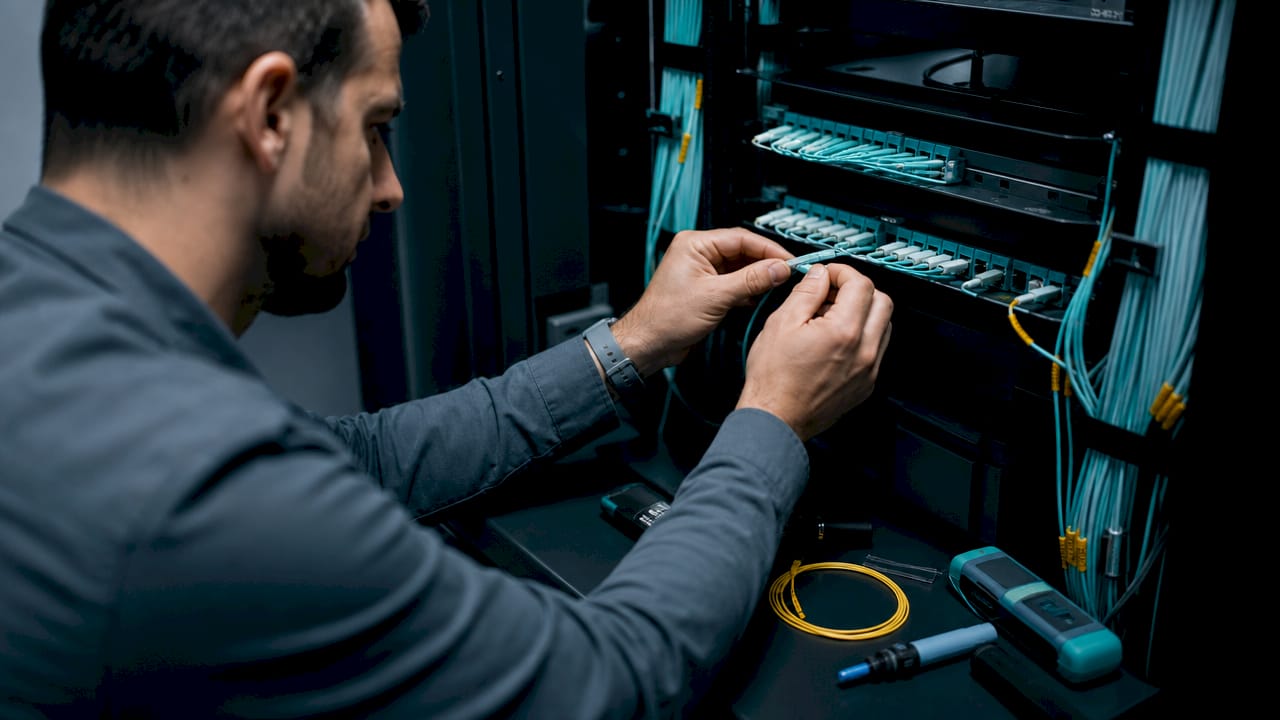
The fiber type you choose also shapes your distance options. Multi-mode fiber suits runs of a few hundred meters, making it practical for intra-building backbone links. Single-mode fiber handles distances from 5 to 80 kilometers, which covers campus and metro connections without repeaters.
| Cable type | Max practical speed | Max distance |
|---|---|---|
| Cat6A copper | 10 Gbps | 100 m |
| Multi-mode fiber (OM4) | 100 Gbps | 400 m |
| Single-mode fiber (OS2) | 100 Gbps+ | 5–80 km |
Pro Tip: Network equipment is the real throughput bottleneck in most installations. A 10 Gbps switch port limits you to 10 Gbps regardless of whether you run Cat6A or OM4 fiber. Upgrade the optics and transceivers alongside the cable.
What are the environmental and physical durability trade-offs?
Physical environment is where fiber optic advantages become decisive in specific settings. The two media respond very differently to electrical noise, temperature, and mechanical stress.
EMI immunity and signal security
Fiber is immune to electromagnetic interference, which makes it the default choice near industrial equipment, generators, HVAC systems, and elevator shafts. Copper cables pick up noise from all of these sources. Shielded twisted pair (STP) and foil twisted pair (FTP) copper reduce EMI, but shielding introduces its own risk. Poorly grounded shielded copper can perform worse than unshielded cable because the shield acts as an antenna when bonding is incorrect. That is a common and expensive mistake.
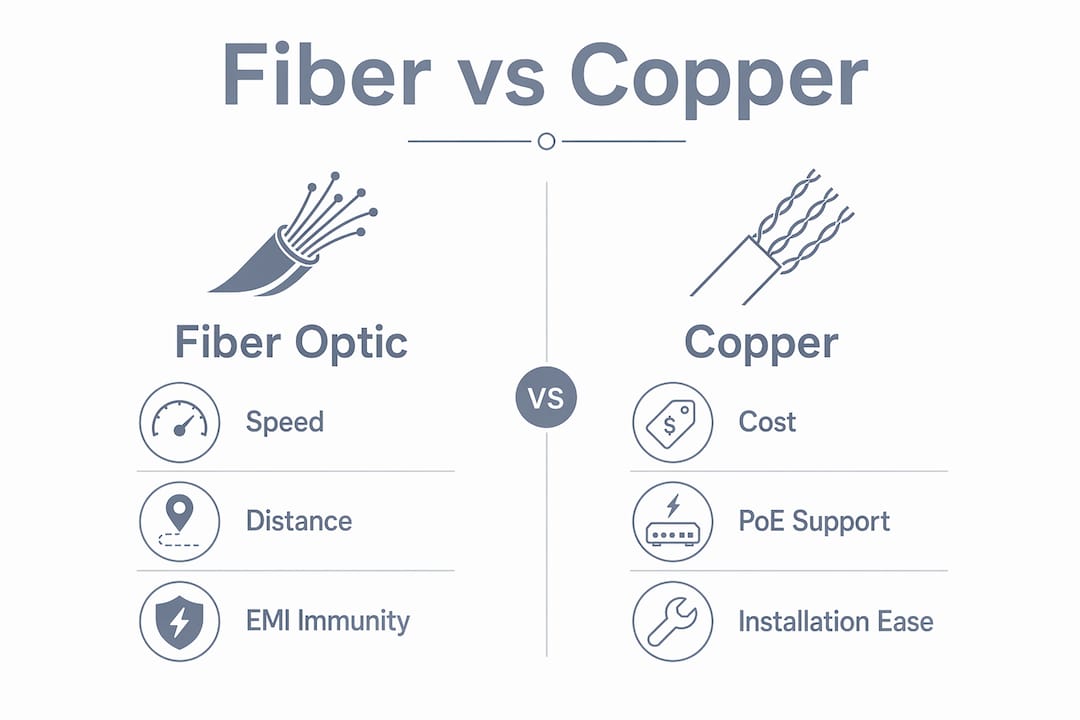
Fiber also wins on security. Fiber cables do not radiate electromagnetic signals, which means tapping the line without detection is extremely difficult. Copper signals can be intercepted with basic induction equipment. For government facilities, financial networks, or any environment with strict data security requirements, that difference is material.
Mechanical strength and installation sensitivity
- Fiber withstands 50–200 lbs of pulling force depending on type, compared to roughly 25 lbs for standard copper patch cables. Fiber is stronger under tension.
- Fiber is brittle under sharp bends. Exceeding the minimum bend radius cracks the glass core and causes signal loss that does not always show up immediately.
- Installation faults, including poor terminations and bend radius violations, cause most network failures blamed on the cable itself.
- Copper termination with RJ45 connectors is faster and requires less specialized tooling than fiber polishing and fusion splicing.
- Fiber connectors (LC, SC, MPO) require clean end faces. Contamination is the leading cause of fiber link failures in the field.
Pro Tip: Always inspect fiber end faces with a fiber inspection microscope before connecting. A contaminated connector degrades a link faster than a bad cable run.
How do deployment roles differ between fiber and copper in enterprise networks?
The most practical answer to the fiber vs copper question is not either/or. Most enterprise networks use fiber for backbone runs and copper at the access layer. That hybrid model is not a compromise. It is the correct architecture for the majority of buildings.
Here is how to think about role allocation in a typical enterprise deployment:
-
Backbone cabling. Fiber connects the main distribution frame (MDF) to intermediate distribution frames (IDFs) on each floor. Single-mode fiber handles inter-building runs. Multi-mode fiber covers intra-building vertical risers where distances stay under 400 meters.
-
Horizontal runs. Copper Cat6A covers the 100-meter horizontal segment from the IDF to each wall port. This is where most endpoints live, and copper handles it cleanly within that distance limit.
-
Power over Ethernet endpoints. IP cameras, access points, VoIP phones, and door controllers all require PoE. Copper supports PoE up to 90W under IEEE 802.3bt. Fiber carries no power. Any PoE device on a fiber run requires a media converter or a copper last-segment connection, which adds cost and a potential failure point.
-
Data center interconnects. Short fiber runs between top-of-rack switches and core switches are standard. MPO trunk cables with 12 or 24 fibers per connector handle high-density patching efficiently.
-
Campus and outdoor runs. Any run exceeding 100 meters requires fiber. Outdoor copper is also vulnerable to lightning-induced surges. Armored single-mode fiber eliminates both problems.
For wired network infrastructure projects, mapping your run distances before purchasing cable saves significant rework cost. A 95-meter run works fine on copper. A 105-meter run needs fiber or an intermediate switch, and that decision changes your budget.
What cost factors and future-proofing considerations matter most?
Upfront cost favors copper, but the full picture is more complicated. Copper costs less initially but requires more frequent replacement and offers limited scalability compared to fiber. That trade-off shifts the math over a 10-year horizon.
Key cost factors to evaluate before committing to a cabling strategy:
- Cable and connector cost. Copper Cat6A cable and RJ45 connectors cost less per foot than fiber cable and LC or SC connectors. The gap narrows at higher speeds.
- Transceiver cost. Fiber requires SFP or QSFP transceivers at each switch port. These add $50–$500 per port depending on speed and reach. Copper uses built-in RJ45 ports with no transceiver cost.
- Labor cost. Fiber termination takes longer and requires certified technicians. Copper installation is faster and uses a wider pool of qualified installers.
- Replacement cycle. Copper infrastructure supporting 1 Gbps today may need full replacement to reach 10 Gbps or 25 Gbps. Fiber infrastructure installed today supports those speeds with transceiver upgrades only.
- Environmental lifecycle. Copper in high-EMI or high-humidity environments degrades faster. Fiber is chemically inert and performs consistently across a wider range of conditions.
The right question is not which cable is cheaper. It is which cable avoids a full rip-and-replace in five years. For South Florida property managers dealing with salt air, humidity, and dense electrical infrastructure, fiber’s durability advantage compounds over time.
Key Takeaways
Fiber optic cables outperform copper in speed, distance, and environmental resilience, but copper remains the correct choice for PoE access-layer connections and short horizontal runs under 100 meters.
| Point | Details |
|---|---|
| Distance limits are fixed | Copper stops at 100 m; single-mode fiber reaches up to 80 km under IEEE 802.3. |
| Speed ceiling favors fiber | Copper tops out at 10 Gbps; fiber supports 100 Gbps and beyond in current deployments. |
| PoE requires copper | Fiber carries no power; PoE endpoints need copper or a media converter on fiber runs. |
| EMI environments favor fiber | Fiber is immune to electromagnetic interference; poorly grounded copper shielding can worsen performance. |
| Hybrid architecture wins | Use fiber for backbone runs and copper at the access layer to balance cost and performance. |
What I’ve learned from deploying both cable types
The debate over fiber vs copper is mostly settled in theory. The hard part is execution, and that is where I see the most expensive mistakes.
The biggest one is treating fiber as a drop-in replacement for copper without accounting for PoE. A building full of IP cameras and wireless access points runs on PoE. If you fiber everything to the edge without planning copper last-segment runs or media converters, you will be pulling cable again within months. Plan your PoE device count before you spec a single fiber port.
The second mistake is grounding. Shielded copper is not automatically better than unshielded. I have seen STP installations perform worse than Cat5e UTP because the shield was bonded at both ends without proper grounding. The ITU and IEEE both publish grounding guidance for a reason. Follow it, or use a certified installer who does.
Fiber installation quality is the other variable that vendor marketing never mentions. A bad termination or a cable kinked past its bend radius will fail intermittently and drive your team crazy chasing a ghost. Most network failures blamed on fiber are actually installation failures. Hire technicians who own a fiber inspection scope and use it.
My honest recommendation: run fiber for every backbone and inter-building link you install today. Run copper Cat6A for every horizontal segment under 100 meters. Budget for PoE switches at each IDF. That architecture gives you a path to 25 Gbps and 40 Gbps without touching the cable plant again.
— Aaron
Network cabling services from Lowvoltagecorp
Choosing the right cable type is one decision. Installing it correctly is another. Lowvoltagecorp specializes in wired and wireless network installation, repair, and maintenance for commercial and residential properties across South Florida.

Whether your project needs fiber backbone runs, Cat6A horizontal cabling, or a full wired network setup, Lowvoltagecorp assesses your environment, run distances, and PoE requirements before recommending a cable type. That means no over-spec’d fiber where copper works fine, and no copper where EMI or distance demands fiber. Contact Lowvoltagecorp to get a site assessment and a cabling plan built around your actual infrastructure needs.
FAQ
What is the main difference between fiber optic and copper cables?
Fiber optic cables transmit data as light pulses through glass or plastic cores, while copper cables carry electrical signals through metal conductors. Fiber supports longer distances and higher speeds; copper supports Power over Ethernet.
Is fiber optic faster than copper?
Fiber is significantly faster. Copper tops out at 10 Gbps in practical use, while fiber supports 100 Gbps and beyond in current enterprise deployments.
Can fiber optic cables replace copper entirely in a network?
Fiber cannot replace copper at PoE endpoints. Copper supports PoE up to 90W under IEEE 802.3bt; fiber carries no power and requires media converters or copper last-segment runs for powered devices.
Which cable is better for environments with electrical interference?
Fiber is the correct choice. Fiber is immune to EMI, while copper requires shielding and proper grounding to manage interference. Improperly grounded shielded copper can perform worse than unshielded cable.
Is fiber optic more secure than copper?
Fiber is harder to tap. Fiber cables do not radiate electromagnetic signals, making undetected interception extremely difficult. Copper signals can be intercepted with basic induction equipment, which makes fiber the preferred choice for high-security environments.