Backup power is the energy supply that activates when your primary grid connection fails, and for homeowners and property managers, it is the difference between a minor inconvenience and a genuine emergency. The national average outage duration in the US reached 11 hours in 2024. That is long enough to spoil refrigerated food, disable security systems, and trigger health risks for vulnerable residents. Understanding why backup power matters means understanding what you stand to lose without it. The two dominant technologies are home battery systems, like the Tesla Powerwall and Enphase IQ Battery, and fuel-powered generators from brands like Generac and Kohler.
Why backup power matters when the grid goes down
Power outages are not rare events. They are increasing in both frequency and duration across the United States, driven by aging grid infrastructure, extreme weather, and growing electricity demand. The 11-hour average outage recorded in 2024 crosses a critical threshold. Health researchers identify outages lasting more than 8 hours as the point where cardiovascular and respiratory emergency hospitalizations rise sharply.
An 11-hour outage is not just an inconvenience. It is a medical risk for anyone in your home who depends on powered medical equipment, climate control, or refrigerated medication.
For property managers, the stakes extend beyond personal health. Security cameras go offline. Motorized gates stop functioning. Wired and wireless networks drop, cutting off communication and access control. Refrigeration fails in units with tenants who store insulin or other temperature-sensitive medications. Heating and cooling systems shut down, which in climates like South Florida can create dangerous indoor temperatures within hours.
The emergency power distinction matters here. Backup power covers convenience loads. Emergency power covers critical safety infrastructure. Security cameras, gate systems, and network equipment fall into the emergency category. They require higher reliability standards and faster transfer times than a standard generator can guarantee.
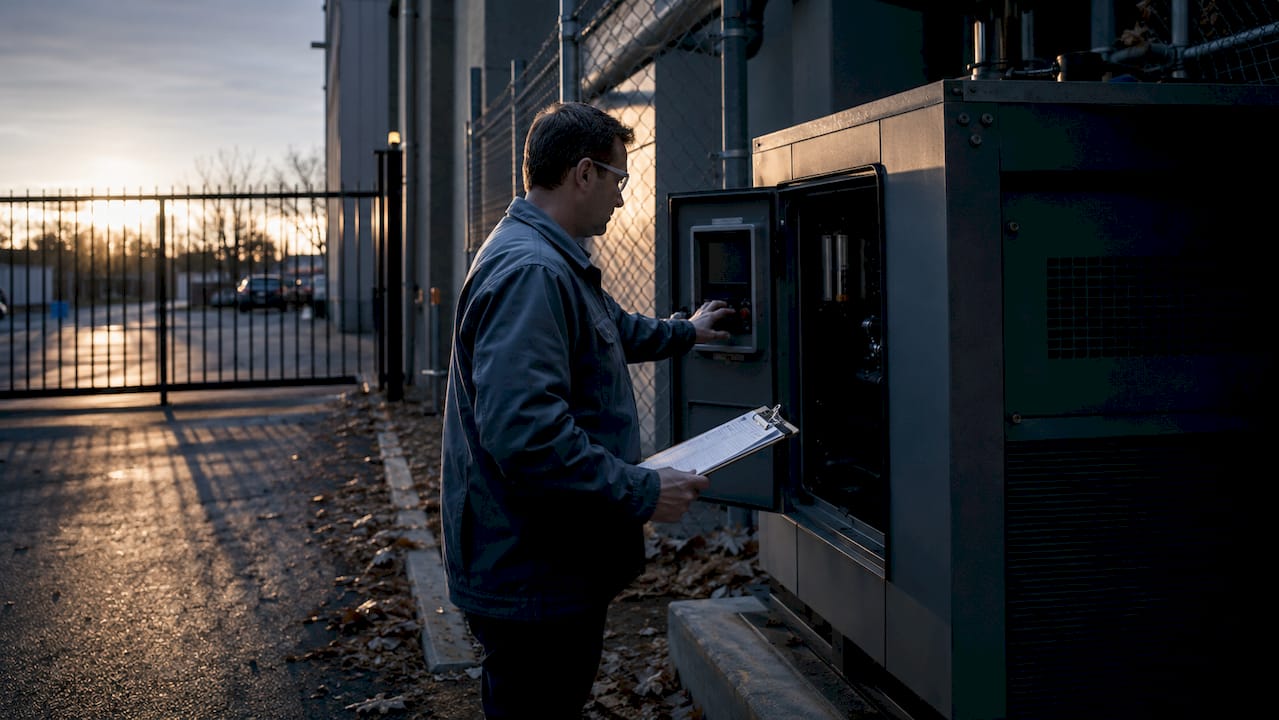
Stress compounds the physical risks. Residents who lose power for extended periods report significant anxiety, disrupted sleep, and reduced productivity. For property managers, tenant complaints and potential liability add another layer of pressure. The importance of backup power is not abstract. It shows up in real costs, real health outcomes, and real operational failures.
How do modern backup power solutions work?
The two main categories of backup power are battery storage systems and fuel-powered generators. They work differently, cost differently, and suit different situations.
Battery backup systems
Modern battery systems, including the Tesla Powerwall, Enphase IQ Battery, and LG RESU, use lithium-ion chemistry to store electricity and release it on demand. The critical advantage is speed. Battery systems switch to backup power within milliseconds, which means sensitive electronics like computers, routers, and security cameras never experience a disruption. They operate silently, produce no exhaust, and require minimal maintenance. Their lifespan runs 10–15 years under normal use.
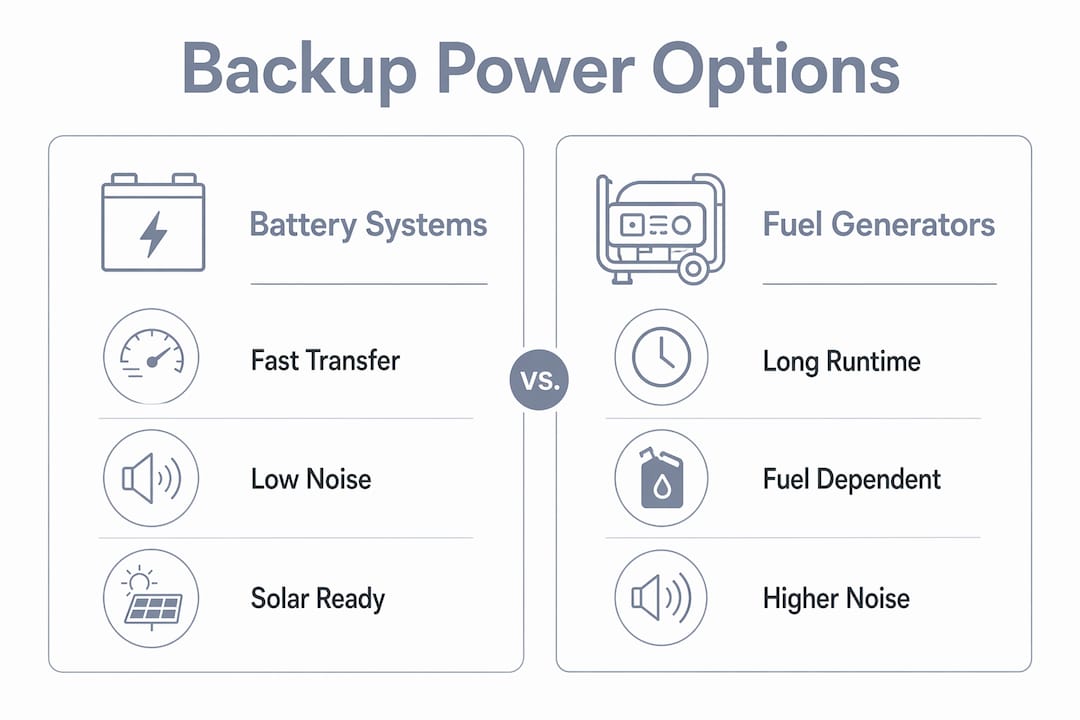
Battery systems can also pair with solar panels. When the grid goes down, solar panels continue charging the battery during daylight hours. Without solar recharge, a battery is a one-time reserve. With solar, it becomes a continuous power source capable of supporting multi-day outages.
Fuel-powered generators
Generac, Kohler, and Briggs and Stratton produce the most widely installed standby generators for residential use. These units run on natural gas, propane, or diesel. They take 10–30 seconds to start after detecting an outage, which causes a brief interruption to connected devices. They are loud, require annual maintenance including oil changes and fuel checks, and produce carbon monoxide, which means they must be installed outdoors.
The cost comparison favors batteries over time. Generators consume fuel continuously during an outage and require professional servicing every year. Batteries have near-zero operating costs once installed.
| Feature | Battery system | Fuel generator |
|---|---|---|
| Transfer time | Milliseconds | 10–30 seconds |
| Noise level | Silent | 65–75 decibels |
| Maintenance | Minimal | Annual servicing |
| Lifespan | 10–15 years | 10–20 years |
| Fuel dependency | None (or solar) | Continuous fuel supply |
| Operating cost | Near zero | Ongoing fuel and service |
Pro Tip: If your property has security cameras or a wired network, a battery system is the better choice. The millisecond transfer time prevents cameras from rebooting and losing footage during the switchover.
What design factors determine if your backup system actually works?
The biggest misconception about home battery systems is that a large battery automatically means whole-home backup. It does not. Whole-home backup depends on inverter capacity, not just total stored energy. The inverter converts stored DC electricity into usable AC power. If your home’s peak demand exceeds the inverter’s output rating, the system shuts down even if the battery still has energy stored.
Here is what that means in practice. A 10 kWh battery with a 5 kW inverter cannot run a central air conditioner, an electric oven, and a pool pump at the same time. The math does not work. Battery systems require tailored design that matches battery size, inverter output, and a clear load strategy.
Key design factors to address before installation:
- Load prioritization: Identify which circuits are critical (security cameras, refrigerator, lighting, medical equipment) and which are not (pool heater, electric dryer, decorative lighting).
- Inverter sizing: The inverter must handle your peak demand, not just your average demand. Air conditioners and motors draw surge current at startup.
- Partial vs. whole-home backup: Partial backup covers essential circuits only. Whole-home backup covers everything. The latter requires a larger inverter and typically a larger battery bank.
- Commissioning: Proper commissioning validates that the system transfers correctly when the grid fails. Many backup failures happen because the system was installed but never tested under real failure conditions.
- Solar pairing: A battery without solar is a finite reserve. Pairing with solar panels extends autonomy from hours to days during extended outages.
Pro Tip: Ask your installer for a written commissioning report. It should confirm that the system was tested by simulating a grid failure. If they cannot provide one, the system has not been properly verified.
For property managers overseeing low voltage security systems, this design discipline is non-negotiable. A security camera that reboots during a power transfer is offline for 60–90 seconds. That gap is enough to miss a critical event.
What financial benefits do battery systems offer beyond outage protection?
The benefits of emergency power go beyond keeping the lights on. Home battery systems reduce electricity bills through a strategy called load shifting. The battery charges during off-peak hours when electricity rates are low, then discharges during peak hours when rates are high. In markets with time-of-use pricing, this can produce meaningful monthly savings.
The financial case for battery backup strengthens further through utility demand response programs. Here is how that works:
- You enroll your battery system in your utility’s demand response program.
- During high-demand periods, the utility draws power from your battery to reduce grid stress.
- You receive bill credits or direct payments in return.
- Your battery recharges afterward, restoring your backup capacity.
This turns your backup system into an income-generating asset, not just a safety net. Generators cannot participate in demand response programs. They only consume fuel.
The long-term cost comparison also favors batteries. A Generac standby generator costs $500–$1,000 per year in fuel and maintenance under normal use. A battery system costs almost nothing to operate after installation. Over a 10-year period, the savings are substantial.
Backup power also reduces exposure to electricity rate volatility. When rates spike during peak demand events, a battery-equipped home draws from storage instead of the grid. That protection compounds over time as utility rates continue to rise.
How to select the right backup system for your home or property
Choosing the right backup system starts with an honest assessment of your power needs. Most homeowners and property managers underestimate their peak demand and overestimate what a single battery can cover.
- List your critical loads first. Security cameras, refrigerators, medical devices, routers, and lighting are the starting point. Add HVAC only if your inverter can handle the startup surge.
- Calculate your daily energy use. Your utility bill shows monthly kilowatt-hour consumption. Divide by 30 to get a daily average, then identify which loads run during an outage.
- Size the inverter for peak demand, not average demand. A 5 kW inverter handles most essential loads. Whole-home backup typically requires 7.6 kW or higher.
- Evaluate solar pairing. If your property is in a high-sun region like South Florida, solar recharge extends your backup from one day to indefinite coverage during daylight hours.
- Hire a licensed installer. Backup systems involve high-voltage DC wiring, transfer switches, and utility interconnection. Improper installation creates fire risk and may void your warranty.
- Schedule annual testing. Simulate a grid failure once a year to confirm the system transfers correctly and the battery holds its rated capacity.
For facility managers overseeing multiple properties, standardizing on one battery platform across properties simplifies maintenance and monitoring. Remote monitoring apps from Tesla, Enphase, and SolarEdge let you check system status from anywhere.
Key takeaways
Backup power is a necessity for any home or property where safety, security, and operational continuity cannot be interrupted by a grid failure.
| Point | Details |
|---|---|
| Outages last longer than expected | The 2024 US average outage was 11 hours, long enough to trigger health and security risks. |
| Battery systems outperform generators for sensitive loads | Millisecond transfer times protect cameras, networks, and electronics that generators cannot. |
| Inverter size determines whole-home capability | Battery storage capacity alone does not guarantee whole-home backup without adequate inverter output. |
| Batteries generate financial returns | Load shifting and demand response programs turn backup systems into bill-reducing assets. |
| Professional commissioning is non-negotiable | Systems must be tested under simulated failure conditions to confirm reliable transfer. |
What I’ve learned after years of installing backup power systems
Most homeowners contact us after an outage, not before. That pattern tells you something important about how people think about grid reliability. They assume the grid is stable until it proves otherwise. The data says otherwise. Outages are getting longer, not shorter, and the gap between “minor inconvenience” and “genuine emergency” closes fast when you have a tenant on oxygen or a property with 12 security cameras that just went dark.
The technology has improved dramatically. Modern battery systems from Tesla, Enphase, and LG are reliable, quiet, and increasingly affordable. But the technology is only as good as the design behind it. I have seen systems with impressive battery capacity that shut down the moment the air conditioner compressor kicked on, because nobody sized the inverter correctly. That is not a product failure. That is a design failure.
The other misconception I encounter regularly is that backup power is a luxury. It is not. For a property manager responsible for motorized gates, security cameras, and tenant safety, backup power is infrastructure. The same way you would not operate a property without a fire alarm, you should not operate one without a plan for grid failure.
The trend toward solar-plus-storage is the right direction. A battery alone buys you hours. A battery paired with solar buys you days. For properties in storm-prone regions, that distinction is the difference between staying operational and shutting down entirely.
Ready to protect your property with reliable backup power?
Lowvoltagecorp designs and installs backup power solutions for homeowners and property managers who cannot afford downtime. From security cameras and motorized gates to wired networks and cell boosters, every system we install is built to stay online when the grid goes down. Our team handles professional installation, commissioning, and ongoing maintenance so your backup system works when you actually need it. Explore our cost-saving security upgrades for South Florida property owners, or review our energy-efficient tips for property managers to see how backup power fits into a broader resilience strategy.
FAQ
What is the average length of a power outage in the US?
The national average power outage duration reached 11 hours in 2024. Outages exceeding 8 hours are linked to increased emergency hospitalizations, particularly for cardiovascular and respiratory conditions.
Why do backup batteries matter more than generators for security systems?
Battery backup systems switch to power within milliseconds, preventing security cameras and network equipment from rebooting. Generators take 10–30 seconds to start, creating a gap where cameras go offline and footage is lost.
Can a home battery system power my entire house during an outage?
Whole-home backup depends on inverter output capacity, not just battery size. If your peak demand exceeds the inverter’s rating, the system will shut down even with stored energy remaining.
How long does a home battery last without solar recharge?
A standalone battery without solar provides a one-time reserve, typically covering 8–24 hours depending on your load. Pairing with solar panels allows continuous recharging during daylight, extending coverage through multi-day outages.
Do I need a professional to install a backup power system?
Yes. Backup systems involve high-voltage DC wiring, transfer switches, and utility interconnection. Professional installation and commissioning are required to verify the system transfers correctly during a real grid failure.