A power supply is defined as the component that converts incoming AC power into regulated DC voltages, delivering stable electrical current to every piece of equipment in your facility. For property and facility managers, understanding the importance of power supplies goes far beyond knowing what a fuse box does. Inadequate or unreliable power delivery causes equipment failure, data loss, and operational shutdowns that cost far more to fix than to prevent. This guide breaks down how power supplies work, where they fail, and what you can do right now to protect your operations.
What is the importance of power supplies in facility operations?
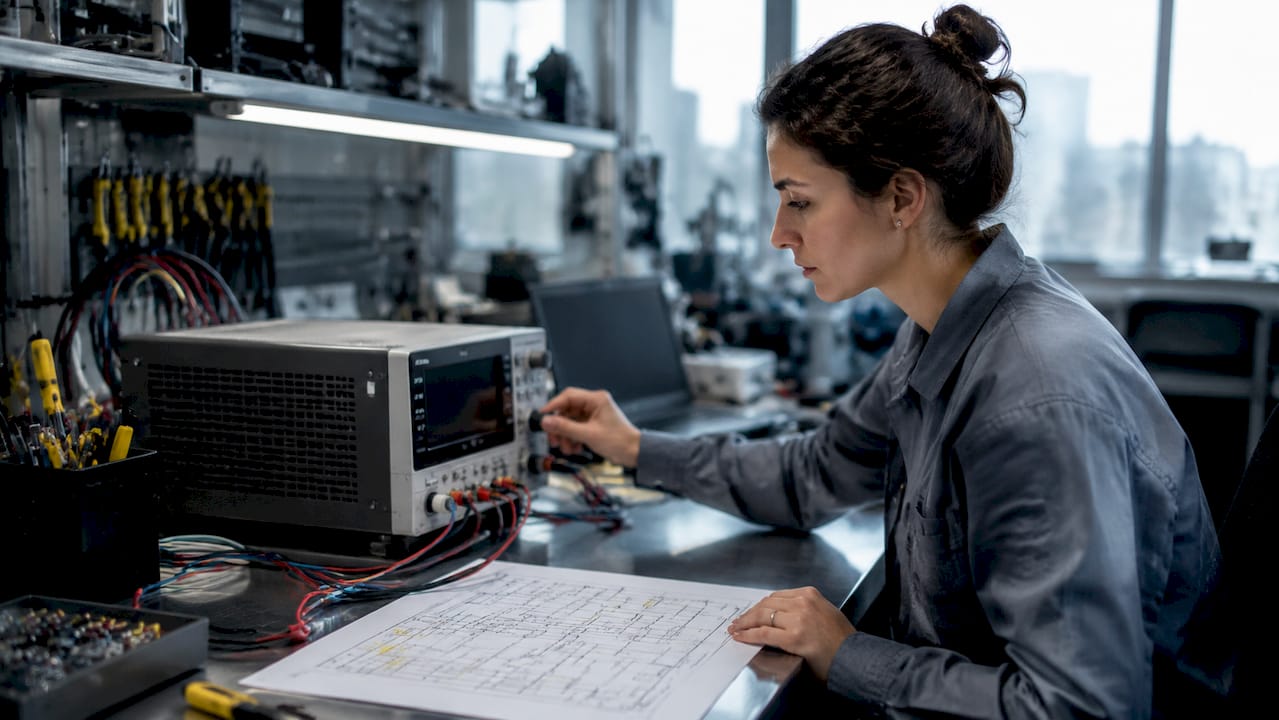
Power supplies perform one job above all others: they take the raw, fluctuating AC power from the utility grid and convert it into the clean, stable DC voltages that your equipment actually needs. PSU capacity and regulation quality directly impact operational stability, preventing shutdowns and instability across connected systems. That means every server, access control panel, security camera, and network switch in your building depends on the quality of its power supply.
The function of power supplies extends well beyond simple conversion. A properly rated unit also handles:
- Voltage regulation: Keeps output voltage steady even when input fluctuates from the grid.
- Overcurrent protection: Shuts down safely before a fault can damage downstream equipment.
- Short-circuit protection: Prevents a single component failure from cascading through the system.
- Load distribution: Splits power across multiple output rails to prevent overloading any single circuit.
Poor capacity matching is one of the most common mistakes in facility power design. Running a power supply at or above its rated capacity causes thermal stress, shortens its lifespan, and increases the risk of sudden failure. A unit rated at 80% load capacity under normal conditions has far more headroom to handle demand spikes without tripping.
Pro Tip: Size your power supplies to operate between 50% and 80% of their rated capacity under normal load. This gives you thermal headroom and extends service life without requiring an oversized unit.
How does power supply reliability affect mission-critical operations?
The biggest design mistake facility managers make is treating emergency power as the primary reliability strategy. Designing normal power for high reliability is the foundation of mission-critical operations, because standby sources typically cover only a portion of total facility loads. If your normal power delivery is fragile, your generator and UPS systems are already fighting an uphill battle.
Consider what happens when power fails even briefly. Milliseconds of power interruption can corrupt data and cause outages costing millions in mission-critical environments. That is not a data center problem exclusive to large enterprises. Any facility running access control systems, networked cameras, or automated gates faces real operational and financial exposure from even a momentary power drop.
The most reliable facilities use multiple independent utility feeds to maintain full site capacity under failures. This approach means that losing one utility service does not bring the whole building down. Combined with UPS-backed power at critical distribution points, this creates a layered defense that keeps operations running through most real-world failure scenarios.
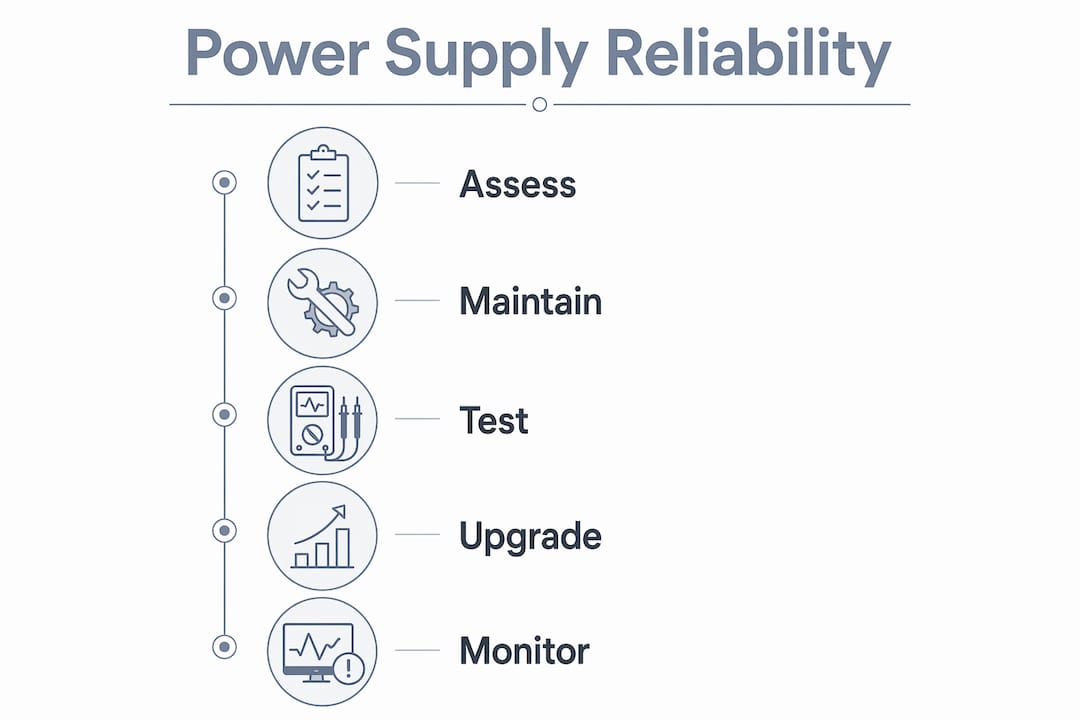
Here is the sequence that defines a reliable power delivery strategy:
- Independent utility feeds: Two separate utility services from different substations where possible.
- Automatic transfer switches (ATS): Detect utility failure and switch to backup within seconds.
- UPS systems: Bridge the gap between utility failure and generator startup, typically 10 to 30 seconds.
- Generator backup: Sustains power for extended outages once the UPS has bridged the transition.
- Selective coordination: Breaker design that limits any fault to the smallest possible section of the facility.
“Focusing on emergency power alone is the biggest design mistake. Normal power must be engineered for high reliability to maximize uptime.” — Consulting-Specifying Engineer, 2026
What are the common challenges in integrating generators with UPS systems?
Generator and UPS compatibility is one of the most underestimated technical challenges in facility power management. UPS systems reject generator power if voltage or frequency fall outside acceptable windows, which forces the UPS to run on battery. If the generator does not stabilize quickly enough, the batteries deplete before the generator is accepted, and the critical load goes dark.
The root cause is often the generator’s governor type and fuel system. Generator fuel types and governor regulation directly affect how quickly and cleanly the unit stabilizes voltage and frequency after startup. Diesel generators are preferred for large-capacity applications, but even diesel units vary significantly in regulation quality depending on the governor specification.
Here is a comparison of the key compatibility factors:
| Factor | Risk if mismatched | Best practice |
|---|---|---|
| Voltage regulation tolerance | UPS rejects generator, drains battery | Verify generator output stays within UPS input window |
| Frequency stability | UPS switches to bypass or battery mode | Specify electronic governors for tighter frequency control |
| Generator sizing | Voltage sag under load causes UPS rejection | Size generator at 125% or more of UPS input rating |
| Fuel type | Slow response time on propane vs. diesel | Prefer diesel for large UPS loads requiring fast stabilization |
Common pitfalls to watch for during commissioning:
- Passing a simple transfer test at no load does not confirm compatibility under real operating conditions.
- Harmonic loads from UPS rectifiers can cause generator voltage instability that only appears at full load.
- Undersized generators sag in voltage when the UPS load transfers, triggering rejection.
Pro Tip: Always test generator and UPS compatibility under full load conditions, not just at idle. A generator that passes a no-load switch test can still fail when the UPS transfers its actual facility load.
How do surge protection and power quality affect equipment longevity?
Surge protection and power supply longevity are directly connected, and most facility managers do not realize how much upstream power quality affects the lifespan of their UPS systems. Switching surges from ATS equipment and harmonic distortion from generators degrade UPS rectifiers over time, reducing mean time between failures well below manufacturer specifications.
The distinction between a surge protector and a UPS matters here. A UPS provides battery backup and some power conditioning, but its internal metal oxide varistors (MOVs) are not a substitute for a dedicated surge protective device (SPD). Placement of surge protectors upstream of the UPS is required under IEC 61643-12 standards, because the UPS itself is a sensitive load that needs protection from transient events on the utility feed.
| Power quality threat | Source | Effect on equipment |
|---|---|---|
| Switching transients | ATS operation, capacitor switching | Degrades MOVs and rectifier components |
| Harmonic distortion | Variable speed drives, UPS rectifiers | Causes transformer heating and neutral overloading |
| Voltage sags | Heavy motor starts, utility faults | Triggers UPS to battery mode unnecessarily |
| Sustained overvoltage | Utility regulation issues | Accelerates insulation breakdown in power supplies |
The practical takeaway is that your SPD belongs between the utility feed and the UPS input, not downstream of it. Installing a surge protector on the output side of a UPS does nothing to protect the UPS itself from incoming transients.
Pro Tip: Treat your UPS as a sensitive load, not just a protective device. Install a certified SPD on the utility feed side of every UPS to protect the rectifier from switching transients and extend its service life.
What practical strategies can managers use to optimize power reliability?
Optimizing power supply reliability in a managed facility requires treating the entire power chain as one integrated system. Upstream design faults cause downstream UPS stress and early failure, which means fixing a failing UPS without addressing the root cause upstream is a recurring expense, not a solution.
Here are the strategies that produce the most measurable improvement:
- Implement N+1 redundancy at every distribution level. N+1 and 2N redundancy configurations prevent any single component failure from affecting mission-critical loads. Tier III and Tier IV data center standards require this, and the same logic applies to any facility running security or life-safety systems.
- Test under real conditions. Thorough real-world testing of generator and UPS compatibility is the only way to find hidden failures before they occur during an actual outage. Schedule full-load transfer tests at least annually.
- Apply selective coordination in your breaker design. Selective coordination and diversified power distribution limit any fault to the smallest possible section of the facility, keeping the rest of the building operational during a localized failure.
- Use remote monitoring for early detection. Remote monitoring gives you real-time alerts on power supply anomalies, UPS battery health, and generator status before a failure becomes an outage.
- Consult specialists before specifying equipment. Power supply compatibility across generators, UPS systems, and SPDs involves technical tolerances that vary by manufacturer. Getting the specification wrong at the design stage costs far more to correct after installation.
Pro Tip: Do not wait for a failure to audit your power chain. Schedule an annual review of UPS battery health, generator load test results, and SPD condition reports. Most failures are predictable with the right data.
Key takeaways
Reliable facility power depends on engineering the entire supply chain, from utility feed to equipment input, as one integrated system rather than a collection of independent components.
| Point | Details |
|---|---|
| Power supply function | Converts AC to regulated DC and protects equipment from overcurrent, shorts, and voltage instability. |
| Normal power reliability | Design utility feeds and distribution for high reliability first; emergency backup covers only partial loads. |
| Generator-UPS compatibility | Test under full load conditions; governor type and generator sizing determine whether UPS accepts the transfer. |
| Surge protection placement | Install SPDs upstream of the UPS on the utility feed side to protect rectifiers from switching transients. |
| Redundancy and monitoring | Apply N+1 redundancy at every level and use remote monitoring to detect failures before they cause outages. |
What I’ve learned from managing power systems in the field
After years of working on low voltage systems across commercial properties and managed facilities, the pattern I see most often is this: managers invest in a quality UPS, install a generator, and assume the power problem is solved. It is not. The UPS and generator are only as good as the system they are connected to.
The facilities that avoid costly outages are the ones where someone thought carefully about the utility feed design, the breaker coordination, and the surge protection before any backup equipment was specified. I have seen brand-new UPS units fail within 18 months because no one installed an SPD upstream of them. The switching transients from the ATS destroyed the rectifier slowly, and the failure looked random until we traced it back to the installation sequence.
The other thing I would push back on is the assumption that a generator transfer test at commissioning is sufficient. Passing a no-load test tells you almost nothing about real-world compatibility. The real test is under full load, with the UPS carrying its actual facility load, and most facilities never run that test until something goes wrong.
If you manage a property with security cameras, access control, or networked systems, your UPS protects low voltage systems that are often more operationally critical than people realize. Treat the power chain that feeds them with the same seriousness you give the equipment itself.
— Aaron
How Lowvoltagecorp can help protect your facility’s power systems
Lowvoltagecorp specializes in the installation, repair, and maintenance of low voltage systems across commercial and managed properties, including security cameras, motorized gates, wired and wireless networks, and cell boosters. Every one of those systems depends on clean, reliable power to function correctly. The team at Lowvoltagecorp understands how power supply quality affects the performance and longevity of the low voltage infrastructure they install and maintain. If you are looking to improve operational reliability, explore energy-efficient security upgrades or review cost-effective power solutions tailored to South Florida property managers. Contact Lowvoltagecorp for a consultation on building a power-reliable facility from the ground up.
FAQ
What does a power supply actually do in a facility?
A power supply converts AC power from the utility grid into regulated DC voltages that equipment requires for stable operation. It also provides overcurrent, short-circuit, and voltage regulation protection to prevent equipment damage.
Why do UPS systems sometimes fail to accept generator power?
A UPS rejects generator power when the generator’s output voltage or frequency falls outside the UPS input tolerance window, forcing the unit to run on battery. Generator sizing, governor type, and load conditions all affect whether the transfer is accepted.
Where should surge protectors be installed relative to a UPS?
Surge protective devices must be installed upstream of the UPS on the utility feed side, not downstream. The UPS itself is a sensitive load, and its internal MOV components do not meet certified SPD protection standards under IEC 61643-12.
What is N+1 redundancy and why does it matter for facility managers?
N+1 redundancy means one additional backup unit exists for every critical component in the power distribution chain, so any single failure does not interrupt the load. This configuration is required for Tier III and Tier IV facility power designs.
How often should generator and UPS systems be tested together?
Full-load transfer testing between generators and UPS systems should be conducted at least annually. No-load switch tests at commissioning are insufficient to confirm real-world compatibility under actual facility operating conditions.