A power surge is a sudden, brief spike in electrical voltage that can instantly destroy sensitive circuitry or degrade your electronics over time. The risk of power surges explained simply: every home and business faces this threat daily, not just during lightning storms. IEEE estimates billions in annual damages from surge events, and most of that destruction happens quietly, one small spike at a time. Understanding what causes surges, what they damage, and how to stop them is the most cost-effective electrical decision you can make.
What causes power surges inside and outside your home or business?
Power surges have two distinct origins, and most people only worry about the wrong one. Lightning represents less than 5% of all surge causes. That means the other 95% is happening inside your walls, every single day, regardless of the weather.
Internal surges: the daily threat you don’t see
Between 60% and 80% of power surges originate from household appliances cycling on and off. That statistic means a typical home experiences more than 20 small surges daily. Every time your HVAC compressor kicks on, your refrigerator restarts, or your well pump activates, it draws a large current that briefly disrupts the voltage in your electrical system. Variable-frequency drives and motor-start equipment in commercial properties can push surges reaching thousands of volts, making businesses even more vulnerable than most owners realize.

External surges: rare but catastrophic
External surges come from lightning strikes near power lines, utility grid switching during outages or load balancing, and downed power lines. These events are infrequent, but a single external surge can carry enough energy to destroy every unprotected device in your building simultaneously. Utility grid switching, which happens whenever your power company reroutes electricity, is actually far more common than lightning and produces surges that travel directly into your home through the service entrance.
Pro Tip: Install a whole-home surge protector at your electrical panel to intercept external surges before they reach any device in your building. This is your first line of defense against grid-related events.
What risks do power surges pose to your electronics and electrical systems?
The damage from power surges falls into two categories: immediate destruction and slow degradation. Both are serious, and the second one is harder to detect.
Immediate damage happens when a large surge overwhelms a device’s internal components. Circuit boards in computers, smart TVs, and HVAC control panels are particularly vulnerable because they operate on low, regulated voltages. A single spike well above their rated tolerance fries transistors and capacitors instantly. Vulnerable electronics replacement costs can exceed $5,000 to $10,000 per household, which puts the cost of protection in sharp perspective.
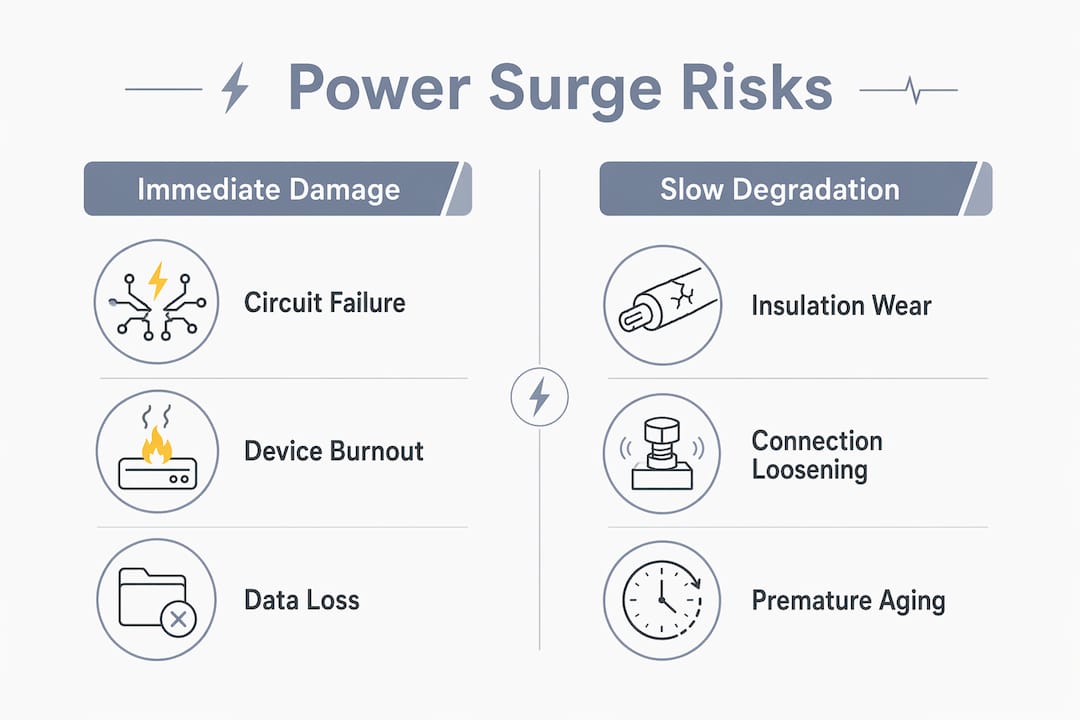
Slow degradation is the more common and more insidious problem. Each small internal surge chips away at the insulation and components inside your devices. A router or smart thermostat that should last seven years might fail in three because of cumulative surge stress. You replace it, assume it was a defective unit, and never connect the failure to your electrical system.
The fire hazard dimension is real and underappreciated. Loose wiring connections and failing neutrals create electrical instability that surges exploit. When excess voltage has nowhere safe to go, it generates heat inside walls and junction boxes. This is why wiring faults paired with surges create fire risks that no surge protector can fix on its own.
The devices at highest risk include:
- Desktop and laptop computers with sensitive motherboards and storage drives
- Smart TVs and streaming devices running on low-voltage processors
- HVAC control boards that regulate your entire heating and cooling system
- Routers, modems, and network switches that run continuously
- Medical devices, home security panels, and smart home hubs
“Surge protectors cannot fix wiring faults. Visible signs of electrical instability indicate a fire risk that requires a licensed electrician, not just a better power strip.”
How do surge protectors and layered protection strategies work?
No single device stops every type of surge. Whole-building surge protection requires multiple coordinated surge protective devices (SPDs) installed at different points in your electrical distribution system. This layered approach is the industry standard for a reason: different surges travel differently, and one device cannot intercept all of them.
| Protection type | Cost range | What it stops | Best for |
|---|---|---|---|
| Whole-home SPD (Type 1) | $200 to $500 installed | Lightning currents at service entrance | All homes and businesses |
| Panel-mounted SPD (Type 2) | $150 to $400 installed | Internal switching surges at sub-panels | Larger homes, commercial properties |
| Point-of-use surge protector | $20 to $300 | Residual surges reaching outlets | Computers, TVs, home offices |
A whole-home protector installed at your main electrical panel handles the large external surges. Point-of-use devices at individual outlets catch the smaller residual voltage that slips past the panel protector. Together, they cover both threat categories.
When buying point-of-use protectors, look for three things: UL 1449 certification, a joule rating above 1,000 (higher is better), and a low clamping voltage, ideally below 400 volts. These specs tell you the device meets safety standards, can absorb significant energy, and activates quickly enough to protect sensitive components.
Surge protectors use metal-oxide varistors (MOVs) to absorb voltage spikes. MOV components degrade after repeated use, which means a protector that survived a major surge event may offer little protection afterward. The indicator light on most devices shows whether protection is still active. When it goes out, replace the unit.
Pro Tip: Never plug high-power appliances like refrigerators, air conditioners, or space heaters into a point-of-use surge protector. These devices draw too much current and accelerate MOV degradation, leaving your other connected devices unprotected.
What are warning signs of electrical issues that need professional attention?
Some electrical problems look like minor annoyances but signal serious hazards. Recognizing them early prevents both equipment loss and fire risk. You should contact a licensed electrician if you notice any of the following:
- Warm or discolored outlets and switch plates. Heat at an outlet means current is arcing or resistance is building inside the connection. This is a fire precursor, not a minor inconvenience.
- Buzzing or sizzling sounds from outlets or your electrical panel. These sounds indicate loose connections or failing components that create dangerous electrical instability.
- Flickering lights throughout the house. Occasional flickers during a storm are normal. Persistent flickering under normal conditions points to a loose neutral connection, which also generates surges internally.
- Frequent breaker trips. A breaker that trips repeatedly on the same circuit is telling you the circuit is overloaded or has a fault. Resetting it without investigation is not a fix.
- Burning smell near outlets or the panel. This requires immediate action. Turn off the circuit and call an electrician the same day.
Warm outlets and buzzing panels indicate wiring failure and fire risk where surge protectors alone are insufficient. An electrical panel inspection by a licensed professional is the only way to diagnose and correct these faults safely.
Practical tips for preventing power surge damage
Prevention is not complicated, but it requires consistency. Follow these steps to reduce your exposure significantly:
- Install a whole-home surge protector at your main panel. This is the single highest-impact step you can take. It costs $200 to $500 installed and protects every circuit in your building.
- Add point-of-use protectors for all sensitive electronics. Computers, routers, smart TVs, and home security panels all deserve dedicated protection at the outlet level.
- Replace surge protectors every 3 to 5 years. Surge protectors degrade over time even without a visible surge event. Treat them as consumables, not permanent fixtures.
- Unplug devices during severe storms. No surge protector stops a direct lightning strike to your service line. Unplugging is the only guaranteed protection during extreme weather.
- Verify your grounding system is intact. An effective grounding system is critical for surge protectors to divert excess voltage safely. A licensed electrician can test and correct grounding issues during a routine inspection.
Pro Tip: Schedule a whole-home electrical inspection every three to five years. Inspections catch wiring degradation, grounding faults, and panel issues before they become surge amplifiers. Review low voltage safety tips for a broader checklist of what to include.
Also consider your HVAC system specifically. HVAC fire hazards often overlap with electrical instability, and HVAC control boards are among the most expensive components to replace after a surge event.
Key takeaways
Effective surge protection requires a layered strategy combining a whole-home panel protector, point-of-use devices, proper grounding, and regular replacement of degraded equipment.
| Point | Details |
|---|---|
| Internal surges dominate | 60% to 80% of surges originate from appliances inside your home, not lightning. |
| Layered protection works | Combine whole-home panel SPDs with point-of-use protectors for full coverage. |
| Protectors wear out | Replace surge protectors every 3 to 5 years or after any major surge event. |
| Warning signs mean wiring faults | Warm outlets, buzzing sounds, and flickering lights require a licensed electrician, not just a better surge strip. |
| Grounding is non-negotiable | Surge protectors cannot divert excess voltage without a properly functioning ground system. |
What I’ve learned after years of protecting electrical systems
Most homeowners I talk to are focused on lightning. They buy a $15 power strip, plug in their TV and laptop, and consider the job done. That mindset leaves them exposed to the threat that actually destroys most electronics: the chronic, low-level surges generated by their own appliances every single day.
I’ve seen HVAC control boards fail prematurely in properties that had no whole-home protection. I’ve seen routers and security cameras die months after installation because the electrical system feeding them was generating constant micro-surges. The owners assumed the equipment was defective. It wasn’t. The building was the problem.
The uncomfortable truth is that a $20 power strip with a surge protector label is not a protection strategy. It’s a starting point. Real protection means a Type 1 or Type 2 SPD at your panel, quality point-of-use devices with verified UL 1449 ratings, and a grounding system that actually works. That combination costs a few hundred dollars installed. Replacing a fried HVAC control board, a dead server, or a destroyed security system costs far more.
Heed the warning signs your electrical system gives you. Buzzing outlets, warm panels, and lights that flicker for no reason are not quirks. They are your building telling you something is wrong. Act on them before a surge does.
— Aaron
Protect your property with Lowvoltagecorp
Lowvoltagecorp specializes in low voltage installation, repair, and maintenance for security cameras, motorized gates, wired and wireless networks, and cell boosters across South Florida. Surge damage to any of these systems means downtime, replacement costs, and security gaps. The team at Lowvoltagecorp can assess your current protection setup, identify vulnerabilities in your electrical and low voltage systems, and recommend the right combination of whole-home and point-of-use solutions. Explore security system installation options or review cost-saving security upgrades to see how protection and efficiency work together for your property.
FAQ
What is a power surge and why is it dangerous?
A power surge is a brief spike in electrical voltage above the standard 120 volts in a home circuit. It is dangerous because it can instantly destroy sensitive electronics or cause cumulative damage that shortens device lifespan significantly.
Are power surges dangerous to my home’s wiring?
Yes. Repeated surges stress insulation and connections inside your walls, and surges combined with loose wiring or failing neutrals create a direct fire hazard that requires professional repair.
How do I know if my surge protector is still working?
Check the indicator light on your surge protector. If it is off or the device has absorbed a major surge event, the MOV components inside are likely depleted and the unit needs replacement. Replace all surge protectors every 3 to 5 years regardless.
Do I need both a whole-home protector and plug-in surge protectors?
Yes. A whole-home protector at your electrical panel stops large external surges, while point-of-use devices catch the residual voltage that passes through. Using only one type leaves gaps in your protection.
Can unplugging devices during a storm actually prevent surge damage?
Unplugging devices is the only method that guarantees zero surge exposure during a severe storm. No surge protector, regardless of joule rating, can fully stop a direct lightning strike to your service entrance.