Modern gate technologies combine UL325-compliant operators, smart sensors, and IoT-connected controllers into a unified access and security system for your property. If you’re evaluating options right now, three things should drive every decision: the motor and drive type, the safety sensor package, and how well the system integrates with your existing security setup. Lowvoltagecorp installs and maintains all of these components, and the guidance below reflects what actually matters in the field.
Before you go further, check these three things on any bid:
- Motor/drive type: Does the operator match your gate style (swing, slide, cantilever) and your daily cycle count?
- Safety sensors: Are photoelectric eyes, edge sensors, and entrapment protection zones included and UL325-compliant?
- Integration capability: Can the controller connect to your mobile app, home platform, or NVR without a proprietary lock-in?
Table of Contents
- What makes up a modern gate system?
- What technologies are you most likely to see today?
- How does smart home and IoT integration actually work?
- What emerging technologies should you plan for?
- Solar, battery backup, and energy-efficient motors
- What safety standards should your gate system meet?
- How do material and design choices affect your gate system?
- What does installation actually cost and how long does it take?
- Routine maintenance and troubleshooting steps you can handle yourself
- Installer best practices: field configuration and commissioning
- How to choose the right system and what to ask your installer
- Zoning laws, accessibility rules, and other compliance requirements
- Key Takeaways
- What installers notice that homeowners usually miss
- Lowvoltagecorp handles the full installation, not just the operator
- Standards and further reading
What makes up a modern gate system?
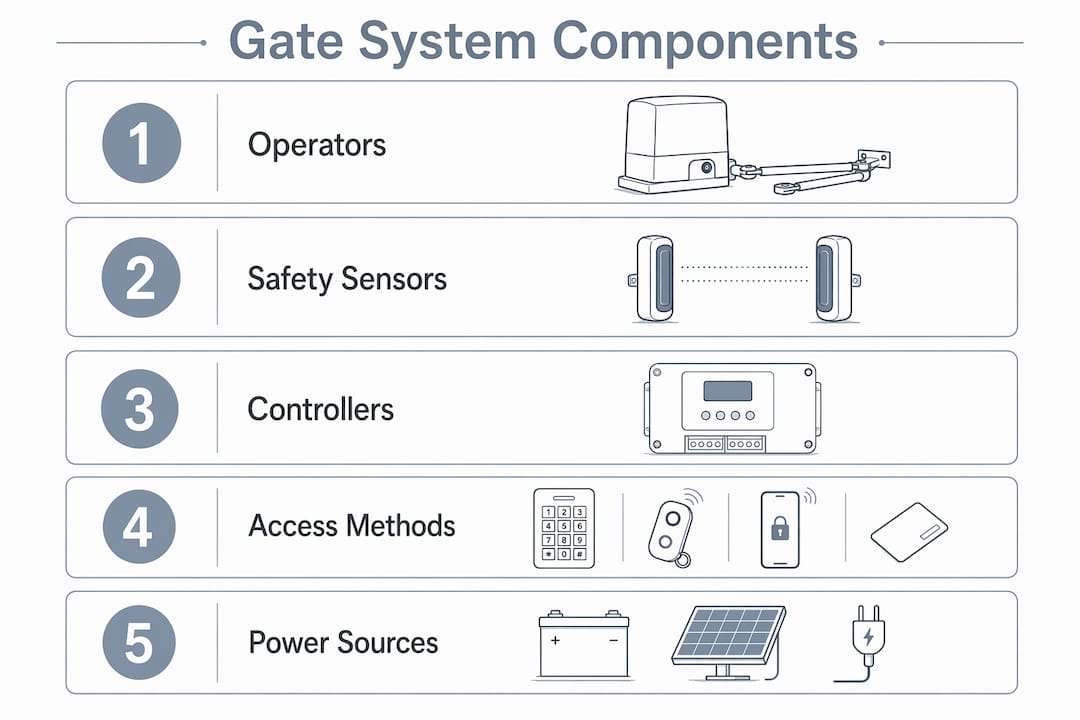
A modern automated gate system is more than a motor bolted to a post. It’s a stack of interdependent components, and understanding each one helps you read a quote without getting lost in jargon.
Operators and drives are the mechanical heart. Swing operators move gates on a pivot; slide operators pull a gate laterally along a track; cantilever operators do the same without a bottom track, which matters on uneven driveways; vertical lift operators are used where horizontal space is truly limited. The drive inside can be electromechanical (a gearbox driven by an AC or DC motor) or hydraulic (fluid-pressure driven, favored for very heavy gates and high-cycle commercial use). Electromechanical units dominate residential installs because they’re lighter, easier to service, and more energy-efficient.
Safety peripherals are what separate a compliant system from a liability. Photoelectric sensors (photo eyes) detect obstructions in the gate’s path. Edge sensors on the gate’s leading edge trigger a reversal on contact. Loop detectors buried in the pavement sense vehicle presence and prevent the gate from closing on a car. Entrapment protection zones are defined areas where the gate cannot trap a person.
Controllers and access methods are where the intelligence lives. A modern controller handles logic, timing, and diagnostics. Access methods layered on top include keypads, RFID card readers, biometric locks, intercoms with video, and mobile app credentials. Terms you’ll see on quotes: duty cycle (how many open/close cycles per hour the operator is rated for), fail-safe (gate opens on power loss, common for fire egress), and fail-secure (gate stays closed on power loss, common for high-security perimeters). Field-configurable means an installer can adjust handing, sensor sensitivity, and timers on-site without swapping hardware.
What technologies are you most likely to see today?
The sensor and operator market has matured considerably. Here’s what’s actually deployed on residential and light-commercial properties right now.
Sensors in common use
Infrared (photoelectric) sensors are the most common residential choice. They’re inexpensive, easy to align, and reliable in most climates. The weakness: direct sunlight and heavy rain can cause false triggers. Microwave sensors emit a radar field and detect motion within a defined zone. They’re less affected by weather and work well for detecting slow-moving vehicles or pedestrians, though they require careful sensitivity tuning to avoid nuisance trips. Loop detectors use an inductive wire loop cut into the pavement. They’re highly reliable for vehicle detection and are standard on commercial and gated-community entries where false triggers are costly.
Operator types and where they fit
- Swing operators: Best for single-family driveways with adequate swing clearance. Lower cost, simpler installation, but require more lateral space.
- Slide operators: Popular in modern residential and commercial settings for their space efficiency and clean aesthetic. They pair naturally with automation and sensors.
- Cantilever operators: The right call when a bottom track would collect debris or ice, or when the driveway surface is uneven.
- High-cycle commercial operators: Designed for gated communities and multi-unit properties where the gate opens dozens of times per day. Hydraulic drives often make sense here.
Pro Tip: For a single-family driveway with fewer than 25 cycles per day, a mid-range electromechanical swing or slide operator is almost always the right call. Hydraulic systems add cost and complexity that residential use rarely justifies.
How does smart home and IoT integration actually work?
Smart integration is where modern gate systems earn their keep — or create headaches if done carelessly; learn practical home security door installation guidance to connect your gates effectively with wider security strategies.

Local vs. cloud control is the first fork in the road. A locally controlled system (LAN-based) keeps all commands and access logs on your network. It works during an internet outage and doesn’t expose your gate credentials to a third-party server. Cloud-based systems offer easier remote access and mobile notifications from anywhere, but they depend on the vendor’s uptime and introduce a larger attack surface. The best setups use local control as the primary path with cloud as a fallback.
Ecosystem integration is now practical for most homeowners. Devices like the Aqara Smart Gate Lock U500 support Matter over Thread, store access data locally, and work across Apple Home, Google Home, and Amazon Alexa without forcing you into a single ecosystem. Controllers like the ismartgate connect directly to existing operators via two wires and add HomeKit, Google Assistant, and SmartThings compatibility without replacing the operator itself.
CCTV and NVR integration is where the real security value comes from. Gates linked to cameras and lighting function as active nodes in a security perimeter rather than isolated entry points. When the gate opens, the NVR can trigger a camera preset, log a timestamp, and push a notification simultaneously.
Security best practices for smart gate setups:
- Place gate controllers on a dedicated IoT VLAN, separate from your main home network. See why network segmentation matters for property managers.
- Use encrypted protocols (Z-Wave S2, Zigbee 3.0, or TLS for cloud APIs) wherever possible.
- Enable two-factor authentication on any admin account that can unlock the gate remotely.
- Audit access credentials quarterly and revoke any that are no longer needed.
Pro Tip: Field-configurability matters here too. Operators like the HySecurity SwingSmart 535 let installers configure every function wirelessly from a smartphone, including entrapment sensor settings. That means your installer spends less time on-site and future adjustments don’t require a truck roll.
What emerging technologies should you plan for?
The next wave of gate automation is already in early commercial deployment. Knowing what’s coming helps you buy hardware that won’t be obsolete in three years.
AI and machine learning are moving from enterprise to residential. Predictive maintenance is the most practical near-term application: controllers with diagnostic logging can detect patterns that precede failures, such as rising motor current draw that signals a worn bearing, before the gate stops working. Remote diagnostics and status reporting are already built into newer controllers and feed directly into these predictive workflows.
License-plate recognition (LPR) is crossing into high-end residential. An LPR camera at the gate reads a plate, checks it against an approved list, and triggers the operator automatically. Paired with CCTV event correlation, it creates an audit trail that’s genuinely useful after an incident.
Pros and cons of AI-enhanced gate systems:
- Upside: Reduced downtime through early failure detection, automated access for approved vehicles, richer security logs.
- Upside: Anomaly detection can flag unusual access patterns (repeated failed attempts, off-hours entries) and alert the property manager.
- Downside: Higher upfront cost and more complex configuration.
- Downside: LPR raises privacy questions in shared-driveway or HOA settings where residents may object to plate logging.
- Downside: AI features tied to a vendor’s cloud service create dependency risk.
Future-proofing your purchase: Choose controllers with open APIs or published integration hooks. Confirm the manufacturer has a firmware update track record. Modular controller designs let you add an LPR module or AI analytics board later without replacing the operator.
Solar, battery backup, and energy-efficient motors
Power planning is one of the most under-specified items on residential gate quotes.
Grid-tied systems are the default and the simplest. The operator runs on AC power, and a small battery inside handles brief outages. The limitation: if the outage lasts more than a few hours, the gate may stop operating.
Battery-backed systems extend that window significantly. Some modern operators provide backup for multiple cycles after AC power loss, with larger lithium battery upgrades available for solar applications. For a residential gate with typical daily use, these backups provide coverage for an extended period of normal operation without grid power.
Solar-powered setups work well in high-sun climates (the Southwest, Florida, Southern California) where the gate sees consistent daily charging. A solar-only system is realistic for low-to-moderate cycle counts on a well-sited panel. Hybrid setups, where solar charges a battery bank that also connects to grid power, are the more reliable choice for properties in variable-sun regions or with high daily cycle counts.
Motor efficiency is worth specifying. Brushless DC (BLDC) motors run cooler, draw less current, and last longer than brushed alternatives. For a gate that opens 30+ times per day, the lifecycle cost difference adds up.
- Grid-tied: lowest upfront cost, least resilience.
- Battery backup only: moderate cost, good for short outages.
- Solar + battery hybrid: higher upfront, best long-term resilience and sustainability.
- BLDC motors: specify these explicitly on any quote for high-cycle applications.
What safety standards should your gate system meet?
UL325 is the core U.S. safety standard for automated gate operators. Any operator you buy or have installed should carry a UL325 listing. It specifies required entrapment protection, safe installation practices, and documented testing. ASTM F2200 covers the construction of the gate itself, setting requirements for the physical structure that the operator moves.
Required protections under a compliant installation:
- Entrapment protection zones on both sides of the gate’s travel path.
- Reversing sensors that stop and reverse the gate on contact or obstruction detection.
- Photoelectric eyes (photo eyes) across the gate opening.
- Force-limiting edge devices on the gate’s leading edge.
Compliance checklist for homeowners:
- Ask for the operator’s UL325 listing number before signing a contract.
- Confirm ASTM F2200 compliance for the gate structure itself.
- Request the wiring diagram and sensor placement documentation at project closeout.
- Walk the site with the installer and physically test each safety device before final payment.
Pro Tip: Request the compliance test reports and operator wiring diagrams as a condition of final payment. A legitimate installer will have them. If they hesitate, that’s a red flag worth taking seriously.
How do material and design choices affect your gate system?
The gate’s physical design isn’t just aesthetic. It directly affects where sensors go, how cameras see, and how much maintenance you’ll do in five years.
Aluminum and powder-coated steel are the dominant choices for modern residential gates. Aluminum is lightweight (easier on operators and hinges), corrosion-resistant, and holds paint well. Powder-coated steel is heavier and stronger but requires attention to coating integrity in coastal environments where salt air accelerates rust at any chip or scratch. Stainless steel is the premium coastal option. Composite wood panels offer a warm aesthetic but add weight and require more maintenance than metal.
Design choices that affect function:
- Slatted panels look clean but create gaps that affect sensor placement. A photoelectric beam aimed through a slatted gate may need repositioning as the gate moves. Camera sightlines through slats can also create blind spots.
- Solid panels simplify sensor placement but block natural light and can act as a wind sail, adding stress to hinges and operators.
- Laser-cut steel panels offer design flexibility but are typically heavier than aluminum alternatives.
For coastal installations, specify marine-grade hardware on every hinge, roller, and fastener. Inland properties have more material latitude, but annual inspection of coating integrity still pays off. LED lighting integrated into gate posts or the gate frame itself is a practical addition: it improves camera performance at night and deters casual intrusion without adding a separate lighting circuit.
What does installation actually cost and how long does it take?
| Scope | Typical Cost Range | Typical Timeline |
|---|---|---|
| Basic retrofit (operator + sensors on existing gate) | — | 1–2 days |
| Full automation (new gate + operator + intercom + cameras) | — | 3–7 days |
| Premium package (LPR, AI analytics, NVR integration) | — | 1–3 weeks |
These ranges reflect U.S. residential and light-commercial installs. Costs vary by region, gate size, and site conditions.
Installation milestones:
- Site survey and permit check (1–5 business days, depending on jurisdiction).
- Foundation work: concrete footings for posts and operator pad (1–2 days, cure time adds 3–7 days).
- Gate fabrication or delivery lead time (2–6 weeks for custom gates).
- Operator and wiring installation (1–2 days).
- Sensor placement, network configuration, and commissioning (half day to 1 day).
- Acceptance testing: cycle tests, obstruction simulation, documentation handoff.
Common change-order drivers that inflate the final bill: unexpected soil conditions requiring deeper footings, underground utilities that force conduit rerouting, additional sensors discovered during commissioning, and permit revisions. Budget a 15% contingency on any full-automation project.
For a detailed walkthrough of each stage, the motorized gate installation guide at Lowvoltagecorp covers site prep through commissioning.
Routine maintenance and troubleshooting steps you can handle yourself
Most gate failures aren’t motor failures. Technicians consistently find that environmental wear on mechanical parts and sensor misalignment cause the majority of problems long before the motor reaches end-of-life. That means most preventive maintenance is physical, not electronic.
Monthly checks:
- Inspect rollers and hinges for wear, rust, or binding.
- Clean photoelectric sensor lenses with a dry cloth.
- Test the obstruction reversal: place a 2×4 flat on the ground in the gate’s path and cycle the gate.
- Check battery voltage on the backup battery (most controllers display this).
- Listen for unusual sounds during the full open and close cycle.
Annual checks:
- Lubricate all rollers, hinges, and the drive chain or screw with manufacturer-specified lubricant.
- Inspect loop detector wire at the pavement cut for cracking or lifting.
- Verify sensor alignment with a helper: one person watches the sensor LED, the other walks the beam path.
- Test fail-safe or fail-secure behavior by simulating a power interruption.
- Review access credential lists and remove any that are no longer active.
Before you call a technician, check these first:
- Sensor LED status: a blinking or off LED usually means misalignment, not a failed sensor.
- Loop detector sensitivity: a setting that’s too high will false-trigger on passing traffic; too low and it won’t detect a stopped vehicle.
- Loose wiring at the controller terminal block: vibration loosens connections over time.
When you do call, have the controller’s diagnostic log ready. Most modern controllers store the last 50–100 events. That log cuts diagnostic time significantly. The motorized gate troubleshooting guide at Lowvoltagecorp walks through the most common failure sequences in detail.
Installer best practices: field configuration and commissioning
Field-configurability is one of the most undervalued features on a gate operator spec sheet. An operator that requires a laptop and a proprietary cable to adjust sensor sensitivity is a maintenance liability. One that lets an installer configure handing, timers, and entrapment zones from a smartphone reduces setup time and makes future adjustments faster and cheaper.
Installation checklist for integrators:
- Segment the gate controller onto a dedicated IoT VLAN before commissioning. See wireless network setup basics for practical guidance.
- Link the NVR before the final cycle test so camera triggers are verified during acceptance.
- Apply firmware updates before handing off to the owner, not after.
- Document every sensor sensitivity setting and timer value in the handoff package.
Acceptance test procedures:
- Run multiple full open/close cycles and log any anomalies.
- Simulate an obstruction in each entrapment zone and confirm reversal.
- Test the fail-safe or fail-secure behavior with a simulated power cut.
- Confirm mobile app access and push notifications from outside the property’s Wi-Fi network.
Pro Tip: One configuration detail that prevents repeated callbacks: set the photoelectric sensor sensitivity one step below maximum. At maximum, ambient IR from sunlight or vehicle headlights can cause false trips. One step down eliminates most nuisance reversals without compromising obstruction detection.
A real-world example: a property with a slide gate that was reversing randomly during afternoon hours. The sensor was aligned correctly, but sensitivity was at maximum. Reducing it one step eliminated the false trips entirely. No hardware replacement, no return visit.
How to choose the right system and what to ask your installer
The right gate system depends on three variables: property type, daily cycle count, and security requirements. A single-family home with two cars and a low-traffic street has very different needs than a 40-unit apartment complex.
Buyer checklist by property type:
- Single-family residential: Swing or slide operator, electromechanical drive, photoelectric sensors, keypad or mobile app access, battery backup.
- Multi-unit property: High-duty-cycle operator, loop detectors, intercom with video, RFID or mobile credentials for residents, NVR integration.
- Gated community amenity access: Commercial-grade operator, LPR or RFID, centralized access management, redundant power.
Questions to ask every installer:
- What is the operator’s UL325 listing number, and can you provide the compliance documentation?
- What is the duty cycle rating, and does it match our expected daily cycle count?
- How is the battery backup sized, and what is the cycle count at full charge?
- How is remote access secured — local LAN, cloud, or both? What encryption is used?
- What is the warranty on parts and labor, and who performs warranty service?
- What does the commissioning package include, and will you provide wiring diagrams?
Red flags in bids:
- No UL325 compliance documentation offered.
- Warranty language that excludes sensors or “peripheral devices.”
- No mention of entrapment protection zones in the scope of work.
- A quote that doesn’t specify the operator model by name.
- No commissioning or acceptance testing line item.
For a full apples-to-apples bid comparison, the gate automation owner’s guide at Lowvoltagecorp includes a checklist you can hand to every bidder.
Zoning laws, accessibility rules, and other compliance requirements
UL325 and ASTM F2200 cover safety. They don’t cover everything a local jurisdiction may require.
Zoning and permitting vary significantly by municipality. Many cities require a building permit for any new gate installation, and some HOAs have design-review requirements that govern gate height, material, and color. In historic districts, design approval may be required before a permit is issued. Check with your local building department before signing a contract.
Accessibility regulations apply when a gate serves a public accommodation or a multi-unit residential property covered by the Americans with Disabilities Act (ADA) or the Fair Housing Act. ADA-compliant gate access typically requires that controls be reachable from a wheelchair (no higher than 48 inches above the ground), that the gate provide adequate passage width (at least 32 inches clear), and that the activation method be operable without tight grasping or twisting. For multi-unit properties, consult a qualified accessibility consultant before specifying the access control method.
Fire and emergency access is another layer. Many jurisdictions require a Knox Box or a fire department override on automated gates serving residential communities. Confirm this with your local fire marshal before installation.
This article is general information, not legal or regulatory advice. Confirm current requirements with your local building department, fire marshal, and, where applicable, an accessibility consultant for your specific property.
Key Takeaways
Modern gate systems deliver the most value when safety compliance, smart integration, and routine maintenance are treated as equally important from day one.
| Point | Details |
|---|---|
| Verify UL325 compliance | Request the listing number and compliance documentation before signing any installation contract. |
| Specify field-configurable operators | Mobile app setup for sensors and timers reduces installer time and lowers long-term maintenance costs. |
| Plan power backup from the start | Size battery backup for your daily cycle count; solar hybrid setups suit high-sun climates and high-cycle properties. |
| Secure the network | Place gate controllers on a dedicated IoT VLAN and use encrypted protocols for all remote access. |
| Lowvoltagecorp for installation and support | Lowvoltagecorp installs, repairs, and maintains motorized gates, security cameras, and networks across properties in the U.S. |
What installers notice that homeowners usually miss
The gap between a well-specified gate system and a problem-prone one almost never comes down to the operator brand. It comes down to the details nobody puts on the quote.
Foundation work is the most common surprise. A soft or sloped driveway apron can require significantly more concrete than a standard bid assumes, and that cost lands as a change order after the project starts. Ask every bidder to walk the foundation location with you and put their soil assessment in writing.
Water intrusion is the second one. Controllers and wiring junction boxes installed without proper conduit sealing or drainage slopes fail faster in wet climates. Specify IP65-rated enclosures for any outdoor electronics, and confirm that conduit entry points are sealed.
Sensor sightlines are the third. An installer who places a camera or photoelectric sensor without accounting for the gate’s full travel arc will create a blind spot or a false-trigger zone. Walk the full open and close cycle during the site survey and mark where each sensor needs to land.
My consistent advice to every property owner: keep your gate controller on a network segment that doesn’t touch your personal devices, budget a 15% contingency on any full-automation project, and schedule a physical inspection every spring. The gate that gets checked twice a year rarely fails at 11 PM on a Friday.
Lowvoltagecorp handles the full installation, not just the operator
If you’ve read this far, you know that a gate system is only as good as its installation, its network setup, and its maintenance schedule. Lowvoltagecorp covers all three. The team installs and commissions motorized gates, handles wiring and network segmentation for smart integrations, and provides ongoing maintenance and troubleshooting for residential and commercial properties.

For properties that also need camera coverage tied to gate events, Lowvoltagecorp’s security camera wiring guide covers the integration from conduit to NVR. If you’re ready to move forward on a gate installation or need a second opinion on an existing system, contact Lowvoltagecorp directly for a site assessment.
Standards and further reading
- UL325 (Gate Operator Safety Standard): The primary U.S. standard for automated gate operators. Compliance documentation should be available from any legitimate operator manufacturer. Verify listings at UL’s product certification database.
- ASTM F2200 (Automated Vehicular Gate Construction Standard): Governs the physical gate structure. Request ASTM F2200 compliance confirmation for any new gate fabrication.
- HySecurity SwingSmart 535: Manufacturer spec sheet covers field-configurability, battery backup cycle counts, and UL325 compliance details.
- Lowvoltagecorp reference guides:
- Gate sensor terminology for reviewing quotes and spec sheets.
- Motorized gate installation steps for site prep through commissioning.
- Motorized gate troubleshooting guide for property managers.
Always check the operator’s spec sheet for duty cycle rating, safety certifications, and battery backup specifications before committing to a purchase. Those three numbers tell you more about long-term reliability than any marketing description.