For home runs, Cable Matters and Monoprice cover most buyers well. For prosumer and SME builds, Belden and Leviton hit the right balance of verified specs and reasonable cost. Enterprise and mission-critical installs belong to CommScope and Siemon, both of which carry independent certifications and long manufacturer warranties. For outdoor and industrial runs, Belden again leads, with jacket options rated for UV exposure and direct burial. On a tight budget for patch cords, Amazon Basics and Monoprice are the two names IT pros reach for without hesitation.
The organizing principle is straightforward: the right brand depends on the project, not a single universal ranking. Mission-critical work demands long warranties and independent verification. Budget and patch-cord work demands confirmed solid copper and a transparent spec sheet.
- Home / streaming backhaul: Cable Matters Cat6 solid copper UTP, Monoprice Cat6 bulk
- Prosumer / SME: Belden Cat6A, Leviton BERK-TEK Cat6A
- Enterprise / mission-critical: CommScope, Siemon (both carry TIA/EIA and ISO certifications)
- Value / patch cords: Monoprice (lifetime warranty on many SKUs), Amazon Basics Cat6
- Industrial / outdoor: Belden (UV-rated, direct-burial jackets available)
Table of Contents
- How do the top network cable brands compare on what actually matters?
- What should you check before buying network cable?
- Which brand fits your project? Profiles of the top manufacturers
- What do Cat5e, Cat6, Cat6A, Cat7, and Cat8 actually mean for your install?
- Why installation quality usually matters more than the brand you choose
- Concrete picks by use case: what to search for and buy
- What does network cable actually cost, and where do you buy it in the US?
- How do top brands handle customer support and service?
- Are these brands compatible with Cisco, Netgear, and other networking equipment?
- How do these cables hold up outdoors and in harsh environments?
- What proprietary technologies do the leading brands offer?
- What are buyers and installers actually saying about these brands?
- Key Takeaways
- The brand debate misses the real question
- When it makes sense to hire a professional for your network cabling
- Useful sources and further reading
How do the top network cable brands compare on what actually matters?
| Brand | Best for | Max supported spec | Conductor material | Shielding options | Typical price range | Warranty & certifications | US availability |
|---|---|---|---|---|---|---|---|
| CommScope | Enterprise, data center | Cat8 | Solid bare copper | UTP, F/UTP, S/FTP | Premium | Long manufacturer warranty, TIA/EIA, ISO | Pro distributors, Anixter, Graybar |
| Siemon | Enterprise, mission-critical | Cat8 | Solid bare copper | UTP, F/UTP, S/FTP | Premium | Long warranty, TIA/EIA, ISO, UL | Pro distributors, direct |
| Belden | Enterprise, industrial, outdoor | Cat6A | Solid bare copper | UTP, F/UTP, STP | Mid to premium | Long warranty, UL listed | Pro distributors, Graybar, direct |
| Leviton | Enterprise, high-density PoE | Cat6A | Solid bare copper | UTP (BERK-TEK SST line) | Mid to premium | Manufacturer warranty, TIA/EIA | Pro distributors, direct |
| Monoprice | Home, SME, patch cords | Cat8 | Solid bare copper (verify per SKU) | UTP, STP | Value to mid | Lifetime warranty on many SKUs | Amazon, Monoprice.com, direct |
| Cable Matters | Home, prosumer, patch cords | Cat8 | Solid bare copper | UTP, STP | Value to mid | Manufacturer warranty | Amazon, direct |
| Amazon Basics | Home, casual patch cords | Cat7 | Solid / stranded (verify per SKU) | UTP, STP | Value | Standard return policy | Amazon |
| trueCABLE | Prosumer, DIY, direct-to-consumer | Cat6A | Solid bare copper (ETL verified) | UTP, F/UTP | Value to mid | Forever Warranty | Direct (truecable.com) |
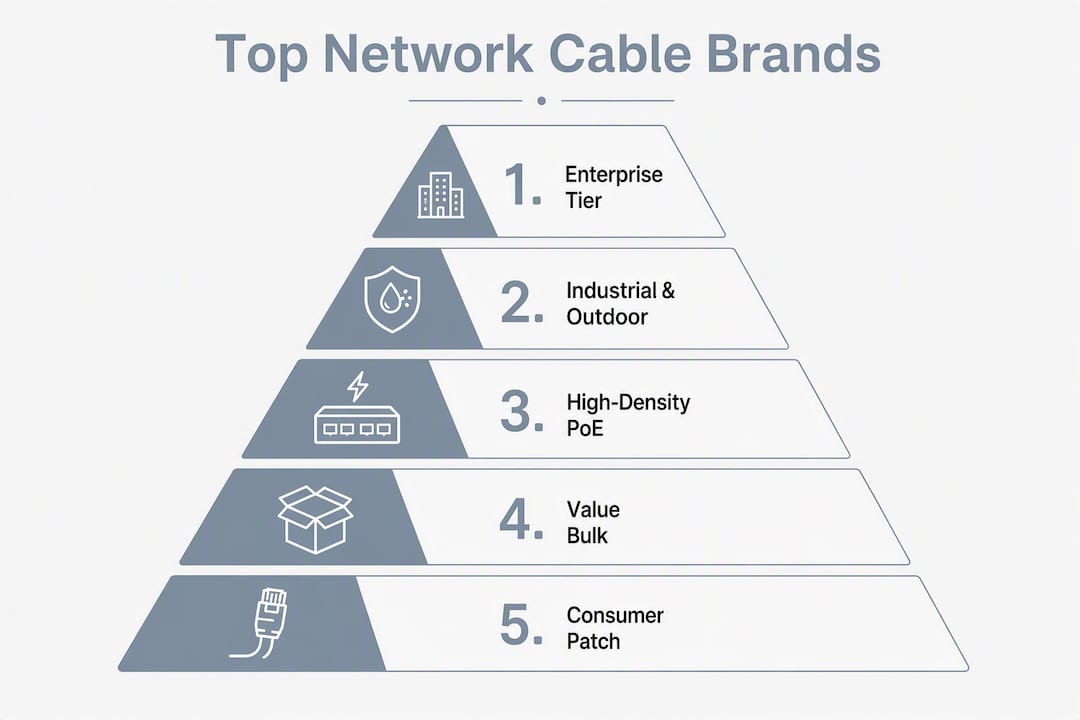
Price context: Value bulk cable Cat6 UTP is generally affordable from direct-to-consumer brands. Mid-range Cat6A cables from brands like Belden or Leviton cost more, with premium enterprise-grade Cat6A or Cat8 cables from CommScope or Siemon costing the most through professional distribution. Premade patch cords span a range of prices depending on shielding and brand.
Availability by channel: CommScope and Siemon are almost exclusively through pro distributors like Graybar, Anixter, or Wesco. Belden and Leviton are available through both pro distribution and some direct channels. Monoprice, Cable Matters, trueCABLE, and Amazon Basics are direct-to-consumer, available on Amazon or their own sites.
Pro Tip: When reading this table, let your use case drive the column you weight most. Home buyers should prioritize conductor material and price. Enterprise buyers should weight certifications and warranty first, then shielding options for their environment.
What should you check before buying network cable?
Follow this checklist in order. Skipping steps two or three is where most buyers regret their purchase six months later.
-
Match the Cat rating to your actual need. Cat6 handles 10 Gbps up to 55 meters. Cat6A handles 10 Gbps to 100 meters. Cat8 is for short data-center runs (30 meters max at 40 Gbps). Buying Cat8 for a home run is money wasted; buying Cat5e for a new PoE camera install is a problem waiting to happen.
-
Confirm solid bare copper conductors. The spec sheet should say “solid bare copper” or “solid BC.” If it says CCA (copper-clad aluminum) or omits the conductor material entirely, walk away. CCA can fail TIA/EIA standards and creates real heat and resistance problems in PoE applications. This is the single most important check on any marketplace listing.
-
Check shielding for your environment. UTP works fine in most residential and light commercial settings. If you are running cable near fluorescent lighting, motors, or medical imaging equipment, you need F/UTP or S/FTP. Shielded cable also requires shielded jacks and a proper ground path, or the shielding makes things worse.
-
Verify the jacket rating. CM is for general indoor use. CMR (riser-rated) is required in vertical runs between floors. CMP (plenum-rated) is required in air-handling spaces. Outdoor runs need a UV-stabilized PE jacket or a direct-burial rating. Using the wrong jacket in a plenum space is a fire code violation.
-
Look for independent test marks. ETL listed, UL listed, or a TIA/ISO reference on the packaging means a third party verified the cable meets the spec it claims. A brand printing “Cat6” on a box without an independent mark is not the same thing.
-
Check the warranty length and terms. Lifetime warranties (Monoprice, trueCABLE) signal confidence in the product. Enterprise brands like CommScope and Siemon offer system warranties when their cable is used with their connectors and tested by a certified installer.
-
Confirm distributor transparency. Can you download a spec sheet? Does the listing show the conductor material, jacket rating, and AWG? If a seller cannot answer those questions, find one who can.
Red flags to avoid:
- “CCA” or “copper-clad” anywhere in the product description
- Missing conductor material in the spec sheet
- No independent test mark (ETL, UL, or equivalent)
- Suspiciously low price for bulk cable (under $60 for 1,000 ft Cat6 from an unknown brand)
- Vague warranty language (“limited warranty” with no defined term)
Pro Tip: To validate “solid copper” from a product listing, look for the AWG spec alongside the conductor description. Solid Cat6 is typically 23 AWG. If the listing says 24 AWG or omits AWG entirely, that is a signal to dig deeper before buying. Legitimate brands publish full spec sheets.
For backbone runs and any install where a building permit or insurance compliance is involved, insist on a channel certification test using a Fluke DSX-series tester or equivalent. The certification report is the only document that proves the installed link performs to the rated spec, regardless of what the box says.
Which brand fits your project? Profiles of the top manufacturers
CommScope
CommScope is the name enterprise network designers reach for when the install cannot fail. Their cable lines cover Cat6A through Cat8, all solid bare copper, with UTP, F/UTP, and S/FTP shielding variants. The real differentiator is the system warranty: when CommScope cable is installed with CommScope connectivity and tested by a certified installer, the warranty covers the channel, not just the cable. Available almost exclusively through pro distributors like Graybar and Anixter. The caveat is cost and access: you will not find CommScope on Amazon, and the price premium is real.
Choose CommScope when: You are building a data center, a healthcare facility, or any environment where downtime has a dollar figure attached to it.
Siemon
Siemon competes directly with CommScope at the enterprise tier and has a strong reputation among structured cabling designers for tight manufacturing tolerances and consistent performance margins. Their Cat6A and Cat8 lines carry TIA/EIA and ISO certifications, and their system warranty program mirrors CommScope’s approach. Siemon also publishes detailed application notes for high-density PoE environments, which is useful for anyone designing a camera or wireless AP deployment.
Choose Siemon when: Your project requires documented compliance with TIA-568 or ISO/IEC 11801 and you need a system warranty that covers the full channel.
Belden
Belden sits at the intersection of enterprise and industrial. Their cable portfolio covers standard structured cabling through harsh-environment industrial Ethernet, and their outdoor-rated jackets are among the most specified in the US market. Belden is UL listed across most of their product lines and available through both pro distribution and some direct channels. The price is mid-to-premium, but the manufacturing consistency is well regarded among installers.
Choose Belden when: You need outdoor runs, industrial environments, or a brand with a long track record in both IT and OT (operational technology) networks.
Leviton
Leviton’s BERK-TEK SST Cat6A U/UTP cable is worth calling out specifically. It is designed for high-density PoE environments with an isolation wrap that manages heat dissipation and reduces alien crosstalk in bundled runs. That is not a marketing claim: bundled PoE cables generate measurable heat, and most Cat6A cables are not designed with that in mind. Leviton’s structured cabling system also carries TIA/EIA compliance and a manufacturer warranty. Available through pro distributors and direct.
Choose Leviton when: You are running high-density PoE (wireless APs, IP cameras, VoIP phones) and need a cable designed for that thermal load.
Monoprice
Monoprice is the go-to for IT pros who need solid copper bulk cable or patch cords without paying enterprise prices. Their Cat6 and Cat6A bulk cable is solid bare copper, and many of their networking products carry a lifetime warranty. IT community forums consistently recommend Monoprice for home and SME builds. One thing to watch: Monoprice sells a wide product mix, so verify the conductor material on each specific SKU rather than assuming all their cable is solid copper.
Choose Monoprice when: You are wiring a home, a small office, or need a large quantity of patch cords with a solid warranty at a fair price.
Cable Matters
Cable Matters is a direct-to-consumer brand with strong ratings on Amazon for premade patch cords and short bulk runs. Their Cat6 patch cords are among the most consistently reviewed for build quality in the prosumer space, and IT pros cite them alongside Monoprice in community discussions. Less commonly used for large bulk runs, but a reliable choice for patch panels and equipment connections.
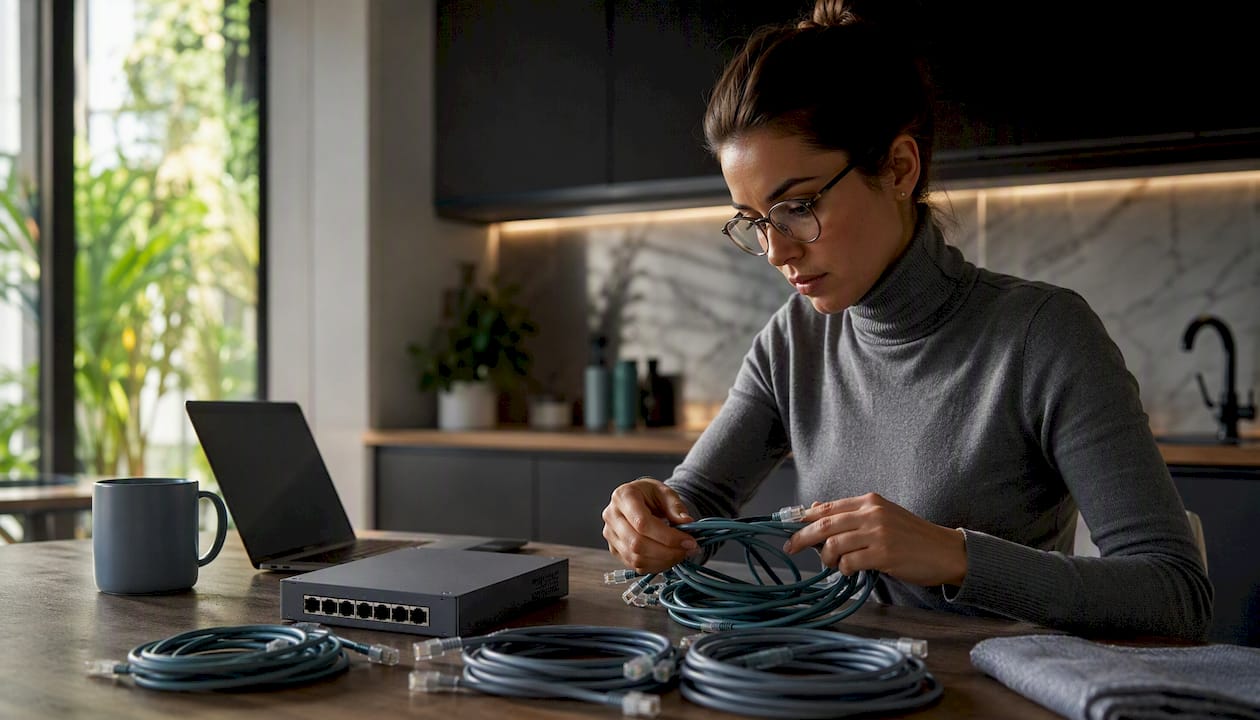
Choose Cable Matters when: You need reliable premade patch cords for a rack or a home network and want something a step above generic.
Amazon Basics
Amazon Basics Cat6 and Cat7 cables are fine for home use and casual patch connections. The price is hard to beat, and for a home user connecting a router to a switch, they work. The issue is transparency: Amazon Basics does not always publish detailed spec sheets, and conductor material is not always clearly stated. For anything beyond home use, the lack of independent test marks and limited warranty terms make them a poor choice.
Choose Amazon Basics when: You need a short patch cord for a home setup and price is the primary concern.
trueCABLE
trueCABLE is a direct-to-consumer brand that punches above its price point. Their Cat5e, Cat6, and Cat6A bulk cables are solid bare copper, ETL verified, and backed by a Forever Warranty. They publish full spec sheets and are transparent about conductor material. For DIY installers and prosumer buyers who want professional-grade cable without going through a distributor, trueCABLE is one of the strongest options available.
Choose trueCABLE when: You are a DIY installer or prosumer buyer who wants ETL-verified solid copper cable shipped direct, with a warranty that actually means something.
Pro Tip: Datwyler, Panduit, and Superior Essex are also well-regarded in the US pro distribution channel. If your electrical wholesaler stocks them, they are worth comparing for large commercial projects.
What do Cat5e, Cat6, Cat6A, Cat7, and Cat8 actually mean for your install?
Understanding cable categories is the foundation of any good purchasing decision. Here is what each rating means in practice.
| Category | Max bandwidth | Max speed (copper) | Practical distance | Typical use case |
|---|---|---|---|---|
| Cat5e | 100 MHz | 1 Gbps | 100 m | Legacy office, home basic |
| Cat6 | — | 10 Gbps (to 55 m) | 100 m (1 Gbps) | Home, SME, general office |
| Cat6A | 500 MHz | 10 Gbps | 100 m | Enterprise, PoE, IP cameras |
| Cat7 | — | 10 Gbps | 100 m | Niche; non-standard connectors |
| Cat8 | — | 25–40 Gbps | 30 m | Data center, server-to-switch |
Cat7 is worth a note: it uses GG45 or TERA connectors rather than standard RJ45, which creates compatibility problems with most networking equipment. Most installers skip Cat7 entirely and go straight to Cat6A for 10 Gbps runs.
Solid vs. stranded conductors is not a preference, it is a function. Solid copper is for permanent horizontal runs pulled through walls and ceilings. Stranded copper is for patch cords that flex repeatedly. Using stranded cable for a long horizontal run causes measurable signal loss. Using solid cable as a patch cord causes the conductors to fatigue and break at the connector over time.
Shielding options:
- UTP (unshielded twisted pair): Standard for most commercial and residential installs. Works well where EMI is not a concern.
- F/UTP (foil-shielded UTP): A foil wrap around all pairs. Good for moderate EMI environments.
- S/FTP (individually shielded pairs plus overall braid): Maximum protection. Used in high-EMI environments like hospitals, industrial floors, or near MRI equipment.
Jacket ratings determine where the cable can legally and safely be installed:
- CM: General indoor use, horizontal runs in conduit or open spaces
- CMR (riser): Vertical runs between floors
- CMP (plenum): Air-handling spaces; low-smoke, low-flame jacket required by code
- LSZH: Low-smoke zero-halogen; common in European specs and some US healthcare installs
- PE / direct-burial: Outdoor and underground runs
One safety note on PoE: when bundling PoE cables in a conduit or cable tray, heat builds up across the bundle. The TIA-568 standard addresses this, and Leviton’s BERK-TEK SST line is specifically engineered to manage that thermal load. Do not exceed the bundle size recommendations in the TIA standard for your cable type.
Why installation quality usually matters more than the brand you choose
The cable brand is not the most common reason a network run fails. Poor terminations, crushed jackets, and excessive bend radius account for the majority of field failures installers see. A $400-per-box CommScope cable terminated sloppily into a cheap keystone jack will underperform a properly installed Monoprice run every time.
The most common field failures, in rough order of frequency:
- Bad terminations: Untwisting pairs too far before punching down or crimping. TIA-568B requires keeping the untwisted portion under half an inch.
- Crushed cables: Cable stapled too tightly, pinched in a door frame, or kinked at a sharp corner. A crushed Cat6A cable is a Cat5e cable at best.
- Excessive bend radius: Cat6A has a minimum bend radius of four times the cable diameter. Violating it permanently deforms the pairs.
- Stranded cable used for horizontal runs: Covered above, but worth repeating because it shows up constantly in field troubleshooting.
After installation, these are the checks worth running:
- Visual inspection of every termination point for proper seating and jacket integrity
- Continuity test with a basic cable tester to catch wiring errors before patching in
- Full channel certification test with a Fluke DSX or equivalent for any run that will carry PoE, 10 Gbps, or mission-critical traffic
For network infrastructure maintenance and long-term reliability, a certification report at installation creates a baseline. If a link degrades later, you have something to compare against.
When to hire a pro instead of DIY:
- Backbone runs between floors or buildings
- Any plenum or riser work (code compliance, fire rating)
- High-density PoE installations (cameras, APs, VoIP)
- Installs that require a system warranty from the cable manufacturer
- Any job where a building permit or insurance compliance is involved
Pro Tip: When reviewing ETL or UL marks on cable packaging, look for the specific standard referenced (e.g., “ETL verified to ANSI/TIA-568-C.2”). A generic “UL listed” without a standard reference tells you the jacket passed a flame test, not that the cable meets the Cat6 electrical spec. Both marks matter, but they test different things.
Concrete picks by use case: what to search for and buy
These are the minimum specs worth buying for each scenario, along with search terms you can hand to a purchaser or type directly into Amazon or a distributor’s site.
-
Home streaming and Wi-Fi backhaul: — Cat6 solid bare copper UTP bulk 1,000 ft. Search: “Cat6 solid copper UTP bulk 1000ft ETL”. Monoprice or trueCABLE are the two names to start with. Patch cords: Cable Matters or Monoprice Cat6 snagless.
-
Patch cords (any environment): — Monoprice or Cable Matters for value. Belden or Leviton for enterprise rack patching. Always stranded copper for patch cords.
Where to buy:
Pro Tip: For smart home and structured wiring projects, running Cat6A during construction or renovation costs almost nothing extra in labor compared to Cat5e, and it future-proofs the install for 10 Gbps and high-density PoE for the next 20 years.
What does network cable actually cost, and where do you buy it in the US?
Price expectations vary more than most buyers realize, and the gap between value and premium is not always about performance. Sometimes it is about the warranty program, the distribution channel, and whether a certified installer is required.
For bulk cable, the value tier (Monoprice, trueCABLE, Cable Matters) delivers solid bare copper Cat6 for roughly $80–$150 per 1,000 ft. Cat6A in the same tier runs $150–$220. These are direct-to-consumer prices with no distributor markup. Mid-range brands like Belden and Leviton add $50–$100 per 1,000 ft for better manufacturing tolerances, UL listings, and broader shielding options. Enterprise brands (CommScope, Siemon) are priced through distribution and vary by project volume, but expect to pay a meaningful premium over mid-range.
Patch cords are a different story. A 3-foot Cat6 patch cord from Monoprice or Amazon Basics costs under $3. A shielded Cat6A patch cord from Belden or Leviton for a data center rack can run $15–$25 each. For a 48-port patch panel, that difference adds up fast, which is why most enterprise installs use brand-matched patch cords to maintain the system warranty.
The US distribution landscape breaks into three tiers. Pro distributors (Graybar, Anixter, Wesco) carry CommScope, Siemon, Belden, Leviton, Panduit, and Superior Essex. They require an account and usually a minimum order, but they provide spec sheets, project pricing, and technical support. Direct-to-consumer brands (Monoprice, trueCABLE, Cable Matters) ship from their own sites or Amazon with no account required. Big-box stores (Home Depot, Lowe’s) carry a limited selection of Cat6 and Cat5e, mostly from brands like Southwire; always verify conductor material before buying from a big-box shelf.
How do top brands handle customer support and service?
Support quality varies significantly by brand tier, and it matters most when something goes wrong mid-project.
CommScope and Siemon both offer dedicated technical support lines and certified installer programs. If you are a contractor working with either brand through a pro distributor, you have access to application engineers who can review your design and help troubleshoot a failing channel test. That level of support is not available from a direct-to-consumer brand.
Belden and Leviton sit in a similar position: technical support through distribution, with application notes and design guides published on their websites. Leviton’s BERK-TEK team is particularly responsive for PoE design questions.
Monoprice and trueCABLE handle support through online channels, and both have reputations for responsive customer service on warranty claims. Monoprice’s lifetime warranty on many networking products is straightforward to invoke. trueCABLE’s Forever Warranty is similarly clean in practice.
Amazon Basics support runs through Amazon’s standard return and replacement process. For a $5 patch cord, that is fine. For a bulk cable order where you discover a conductor issue after pulling 500 feet through a wall, it is not a support structure you want to rely on.
Are these brands compatible with Cisco, Netgear, and other networking equipment?
Any cable that meets the TIA-568 standard for its rated category is compatible with any networking equipment that uses standard RJ45 connectors, including Cisco, Netgear, Ubiquiti, Aruba, and every other major vendor. The cable does not care what switch it is plugged into.
The compatibility question that actually matters is at the connector level, not the cable level. Cat7 cable uses non-standard GG45 or TERA connectors that are not compatible with standard RJ45 ports. That is one of the main reasons most installers skip Cat7 entirely. Cat6A, Cat8, and everything below uses standard RJ45 and is universally compatible.
For PoE compatibility, the relevant standard is IEEE 802.3bt (PoE++), which defines power delivery up to 90W per port. Any cable rated Cat6A or above with solid bare copper conductors handles 802.3bt without issue. CCA cable is a problem here: the higher resistance of aluminum means more heat and voltage drop under PoE load, which can cause equipment to behave erratically or fail to power up.
Cisco’s structured cabling guidelines recommend Cat6A minimum for new installations, which aligns with what most enterprise cable brands (CommScope, Siemon, Belden) push as their standard recommendation. Netgear and Ubiquiti do not publish specific cable brand requirements, but their PoE switches are tested to IEEE 802.3bt, so the cable spec is what matters.
How do these cables hold up outdoors and in harsh environments?
Outdoor and harsh-environment performance is where brand selection genuinely separates the field. Not every brand offers outdoor-rated products, and the ones that do vary in how well they specify the ratings.
Belden is the most consistently specified brand for outdoor and industrial Ethernet in the US market. Their outdoor Cat6A cables use UV-stabilized polyethylene (PE) jackets rated for direct exposure to sunlight and temperature swings. Direct-burial variants add a gel-filled or armored construction for underground runs. Belden publishes operating temperature ranges and UV exposure ratings in their spec sheets, which is what you want to see before specifying a cable for a rooftop camera run or a parking lot access point.
CommScope and Siemon also offer outdoor-rated products, primarily for enterprise campus and building-to-building runs. Their outdoor cables are available through pro distribution and are typically specified as part of a larger structured cabling system.
For UV resistance, look for a PE (polyethylene) outer jacket rather than PVC. PVC degrades under UV exposure over time, becoming brittle and cracking. PE holds up significantly longer in direct sunlight. For temperature ratings, outdoor Ethernet cable should be rated for at least 40°F below zero to 167°F (20°C to 75°C) to handle the range of conditions in most US climates.
Direct-burial cable adds a moisture barrier and sometimes a flooding compound to prevent water ingress. If the run goes underground without conduit, direct-burial rating is not optional. Running a standard indoor cable underground, even in conduit, without a proper moisture-rated jacket is a failure waiting to happen within a few years.
What proprietary technologies do the leading brands offer?
Most cable is cable. The physics of twisted-pair copper do not change much between manufacturers. But a few brands have developed construction details worth knowing about.
Leviton’s BERK-TEK SST (Small Diameter Technology) Cat6A line uses an isolation wrap around each pair to reduce alien crosstalk and manage heat in bundled PoE runs. The smaller diameter also means more cables fit in a conduit, which matters in retrofit projects where conduit fill is a constraint.
Belden’s DataTwist line uses a proprietary pair geometry designed to maximize performance margins above the TIA-568 minimums. The result is a cable that tests well above the Cat6A floor, which gives installers more headroom when a run is close to the 100-meter limit or when the termination is not perfect.
CommScope’s SYSTIMAX brand includes cables with enhanced alien crosstalk performance for high-density 10 Gbps environments, and their GigaSPEED line has been a reference product for enterprise Cat6A for years.
trueCABLE’s approach is less about proprietary geometry and more about transparency: they publish full third-party ETL test reports for their cable lines, which is unusual for a direct-to-consumer brand and gives buyers something concrete to verify.
What are buyers and installers actually saying about these brands?
Community feedback from IT pro forums like Spiceworks and Reddit’s r/homelab and r/networking paints a consistent picture. Monoprice and Belden are the two most frequently recommended brands for bulk cable in IT community discussions, with Monoprice winning on price and Belden winning on consistency for larger commercial projects.
Cable Matters and Monoprice dominate the patch cord recommendations. The consistent praise is for build quality at the price point: snagless boots that actually hold, consistent color coding, and no dead-on-arrival cables in bulk orders.
Amazon Basics gets mixed reviews. Home users are generally satisfied. IT pros who have tried to use Amazon Basics for commercial installs report inconsistency in conductor material labeling and occasional quality control issues. The consensus is that Amazon Basics is fine for a home office patch cord and not appropriate for anything that needs to last.
trueCABLE has built a loyal following among DIY installers and prosumer buyers. The ETL verification and Forever Warranty are the two features most commonly cited in positive reviews. The direct-to-consumer model also means buyers can reach a human for technical questions, which matters when you are pulling cable for the first time.
CommScope and Siemon reviews come almost entirely from enterprise installers and network designers. The feedback is consistently positive on performance and system warranty support, with the main complaint being price and the requirement to work through distribution.
Key Takeaways
The best network cable brands in 2026 are use-case specific: CommScope and Siemon for enterprise, Belden and Leviton for commercial and industrial, and Monoprice or trueCABLE for value-conscious prosumer and home builds.
| Point | Details |
|---|---|
| Pick by use case, not brand prestige | Enterprise needs CommScope or Siemon; home and SME builds work well with Monoprice or trueCABLE. |
| Solid copper is non-negotiable for PoE | CCA cable fails TIA/EIA standards and creates heat and resistance problems under PoE load. |
| Installation quality often decides reliability | Poor terminations and crushed cables cause more failures than cable brand; a Fluke DSX certification report is the proof of a good install. |
| Independent test marks matter | ETL or UL listed to a named TIA/ISO standard means a third party verified the spec, not just the manufacturer. |
| Lowvoltagecorp handles the installs that matter most | For PoE-heavy, plenum, or mission-critical runs in South Florida, Lowvoltagecorp provides professional installation with the handling and testing practices that protect your investment. |
The brand debate misses the real question
The conversation about which cable brand is best tends to focus on the box. The more useful question is whether the cable was installed correctly and whether anyone tested the channel after the fact.
Plenty of enterprise projects have been wired with premium CommScope or Siemon cable and still failed their certification tests because of a bad punch-down or a cable stapled too tight around a corner. Plenty of prosumer installs with Monoprice or trueCABLE have tested clean and run without issue for a decade. The cable is a starting point, not a guarantee.
What the brand choice actually controls is the risk floor. A verified solid-copper cable from a brand that publishes ETL test reports gives you a better starting point than an unverified marketplace listing. A system warranty from CommScope or Siemon gives you recourse if something fails. But neither of those things replaces a proper installation and a certification test.
For property managers and facility managers in South Florida, the practical advice is this: specify the right cable for the environment, insist on solid copper and an independent test mark, and have the install done by someone who will hand you a certification report when the job is done. That report is worth more than the brand name on the cable.
When it makes sense to hire a professional for your network cabling
Pulling cable through a finished building, managing plenum compliance, or designing a high-density PoE system for IP cameras and wireless APs is not the same as running a patch cord across a desk. The situations where professional installation pays for itself are specific: backbone runs between floors, any work in plenum or riser spaces, bundled PoE installations where thermal management matters, and any project where a system warranty or building permit is involved.
Lowvoltagecorp specializes in wired and wireless network installation, repair, and maintenance for commercial and residential properties across South Florida. For property managers and facility managers who need a network install done right the first time, with proper cable handling, certified terminations, and a channel test report to back it up, Lowvoltagecorp is the contractor to call. The team also handles PoE camera systems, where security camera wiring and network cabling intersect directly. Contact Lowvoltagecorp to get a quote for your next installation or maintenance project.
Useful sources and further reading
Use the spec pages below to verify conductor material and jacket ratings before purchasing. Use the Fluke and TIA references to understand what a certification test actually measures.
- Monoprice Cat6 product listing — verify conductor material and warranty terms per SKU
- Spiceworks community: Cat6 brand preferences — IT pro field recommendations and buying patterns
- Types of network cables: IT pro guide — Lowvoltagecorp’s detailed guide to Cat categories, solid vs. stranded, and jacket ratings
- Network installation tips for IT pros — field-tested handling and termination best practices
- Network infrastructure maintenance for facility reliability — verification and maintenance practices for long-term performance
- Aluminum vs. copper conductor comparison — technical breakdown of why conductor material matters for resistance and heat