A wired security system is a physical cable-based setup where sensors, cameras, and control panels all communicate through dedicated low-voltage copper conductors. Unlike wireless setups, every component connects directly to a central control panel via hard-wired runs, which means zero signal latency and continuous circuit supervision. Physical cabling falls under NEC Article 725 and Article 760, the governing codes for low-voltage and fire alarm circuits. That compliance requirement matters whether you are protecting a single-family home or a commercial property. The result is a system built for stability, not convenience.
What is a wired security system and how does it work?
A wired security system transmits signals over low-voltage copper conductors, delivering effectively zero latency and continuous fault detection. Every sensor, camera, and detector connects back to a central control panel through its own dedicated cable run. The panel monitors each circuit in real time. If a wire is cut or a sensor fails, the panel detects the fault immediately and triggers an alert.
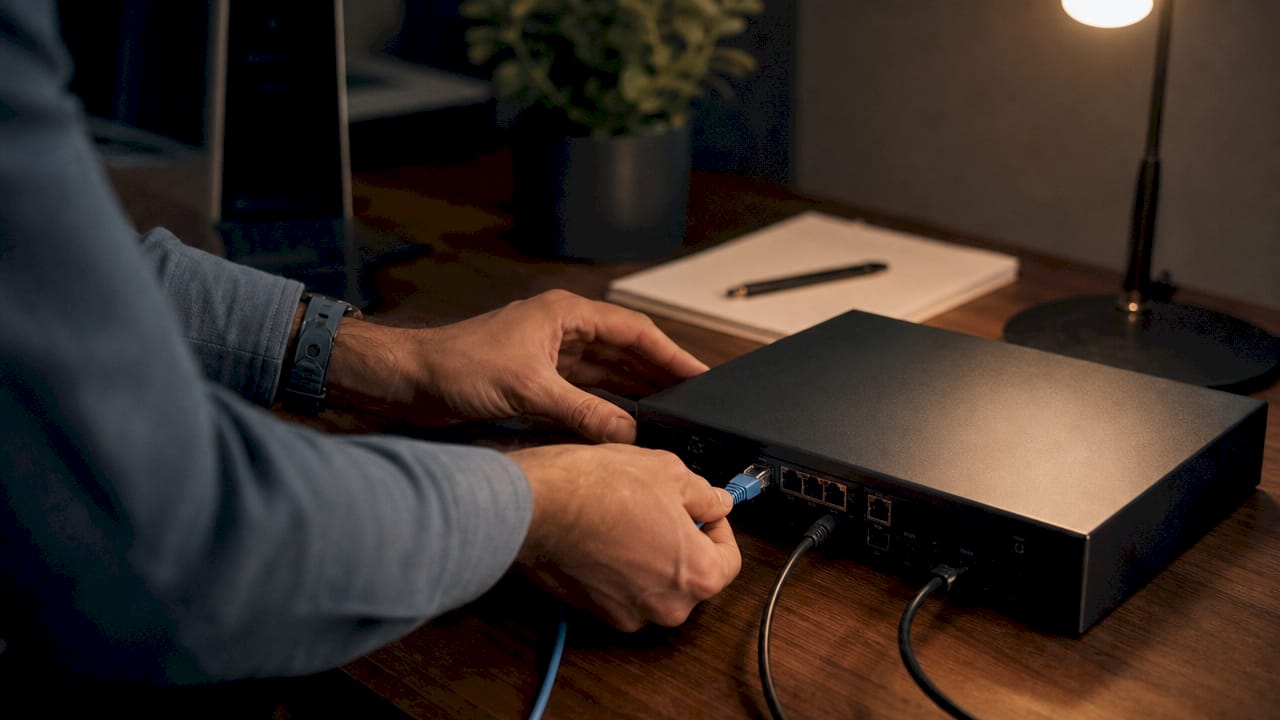
The physical cabling itself varies by component type. Door and window sensors typically use 22-gauge two-conductor wire. IP security cameras use Cat6 Ethernet cable, which carries both data and power when paired with Power over Ethernet (PoE) technology. The control panel sits at the center of the entire system, receiving signals from every connected device and managing alarm activation, zone control, and communication to a monitoring station.
Here is what a standard wired system includes:
- Control panel: The brain of the system. It processes all sensor inputs and triggers alarms or alerts.
- Door and window sensors: Magnetic contacts wired directly to the panel, detecting open or closed states.
- Motion detectors: Passive infrared (PIR) sensors wired to dedicated panel zones.
- IP cameras: Connected via Cat6 cable, often powered by PoE switches rather than separate power supplies.
- Keypads: Hard-wired user interfaces for arming, disarming, and system status.
- Siren or strobe: Wired output devices activated by the panel during an alarm event.
Pro Tip: Label every cable at both ends during installation. A labeled cable run saves hours of troubleshooting when you need to trace a fault years later.
What are the benefits of wired security systems?
Wired systems deliver reliability that wireless setups cannot match in demanding environments. Physical cabling eliminates interference from Wi-Fi congestion, neighboring wireless devices, and radio frequency noise. In a busy commercial building with dozens of wireless networks competing for bandwidth, a wired system keeps performing without degradation.
Cybersecurity is a second major advantage. Wired systems operate on closed networks, physically separated from Wi-Fi infrastructure. CISA cybersecurity experts identify this separation as the core reason wired systems carry a smaller attack surface than wireless alternatives. There is no RF signal to intercept, no wireless protocol to exploit, and no cloud account to compromise.
Long-term cost is where wired systems often surprise property owners. A 10-year lifecycle cost analysis favors wired systems in stable environments because there are no recurring cloud subscription fees and no individual sensor batteries to replace. Wireless systems require ongoing battery maintenance across every sensor. That cost adds up quickly on a large property with 30 or 40 sensors.
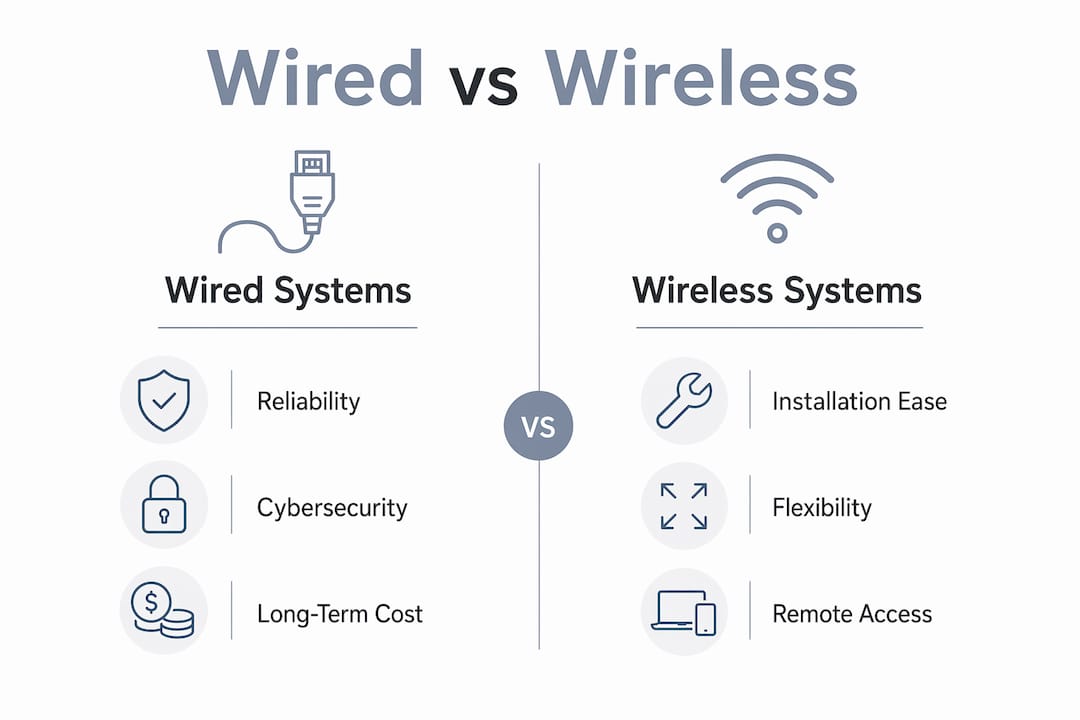
Power reliability is another area where wired systems lead. Centralized power backup via a single UPS at the control panel keeps the entire system running during an outage. Wireless systems require each sensor to carry its own battery, which creates multiple failure points. A single UPS is far easier to test, maintain, and replace than managing batteries across an entire property.
| Feature | Wired systems | Wireless systems |
|---|---|---|
| Signal reliability | No interference from RF or Wi-Fi | Susceptible to congestion and jamming |
| Cybersecurity | Closed network, no RF attack surface | Exposed to wireless protocol vulnerabilities |
| Power backup | Single centralized UPS covers all devices | Individual batteries per sensor |
| Long-term cost | Lower over 10 years, no subscriptions | Recurring subscription and battery costs |
| Best use case | Large properties, commercial buildings | Rentals, retrofits, temporary setups |
Wired home security is the right choice for new construction, large commercial properties, warehouses, and any environment where signal consistency is non-negotiable. Wireless setups work well for renters or small spaces where running cable is not practical.
What are the installation requirements for wired systems?
Wired security system installation is more labor-intensive than wireless, and that is the honest trade-off. Running cables through walls, ceilings, and conduits increases upfront costs but delivers long-term reliability that justifies the investment. Planning the cable routes before any work begins is the single most important step in the entire process.
New construction is the ideal time to install a wired system. Walls are open, conduit can be placed before drywall goes up, and cable runs are clean. Retrofitting an existing building is possible but requires more planning. You will need to fish cables through finished walls, which adds labor time and may require patching work after installation.
Follow these steps for a well-planned wired installation:
- Map all device locations first. Mark every camera, sensor, keypad, and siren position on a floor plan before purchasing cable.
- Calculate cable lengths with a 20% buffer. Always buy more cable than your measurements suggest. Routing around obstacles always adds length.
- Choose the right cable type per device. Use 22-gauge wire for sensors and Cat6 for IP cameras. Do not substitute lower-grade cable to save money.
- Plan conduit runs in exposed areas. Any cable running through a garage, utility room, or exterior wall needs conduit protection per NEC Article 725.
- Install the control panel in a secure, central location. A locked utility closet or server room keeps the panel protected from tampering.
- Test every circuit before closing walls. Use a cable tester to verify continuity on every run before finishing the installation.
PoE technology simplifies camera installation significantly by delivering both power and data through a single Cat6 cable. That eliminates the need to run a separate power line to each camera location. For retrofits, PoE reduces the number of cable runs required, which directly lowers labor costs. A PoE switch or PoE-capable NVR handles power distribution centrally, making the system easier to manage.
Pro Tip: For retrofit installations, use a borescope camera to inspect wall cavities before fishing cable. It saves time and prevents damage to insulation or existing wiring.
You can find a detailed walkthrough of the full process in this security system installation guide from Lowvoltagecorp.
How do wired systems integrate with modern smart home and hybrid setups?
Wired systems and modern smart home technology are not mutually exclusive. The industry has moved toward hybrid security setups that combine wired connections for critical points with wireless sensors for flexibility. Industry experts describe hybrid systems as the current best practice for balancing stability and convenience. That means you get the reliability of physical cable where it matters most and the easy placement of wireless sensors where running cable is impractical.
Wired control panels now include built-in cellular chips and battery backups that maintain communication even during internet and power outages. That capability closes the gap between wired and wireless monitoring continuity. Your panel stays connected to a monitoring station regardless of whether your internet service is down.
A practical hybrid setup for a commercial property looks like this:
- Wired IP cameras cover all exterior entry points, parking areas, and loading docks where consistent video quality is critical.
- Wired door contacts protect main entry doors, server rooms, and cash handling areas.
- Wireless motion sensors cover interior spaces like open office floors where running cable would require significant disruption.
- Wired control panel with cellular backup maintains monitoring continuity during outages.
- Smart home integration connects the panel to lighting automation, access control, and mobile alerts via a dedicated app.
This approach gives property owners the best of both technologies. Wired connections handle the high-stakes zones. Wireless handles the flexible, lower-risk areas. The result is a system that is both reliable and practical to install. For property managers looking at wired network benefits beyond security, the same physical infrastructure often supports network connectivity and access control on the same cable plant.
Key Takeaways
A wired security system delivers superior reliability, cybersecurity, and long-term cost efficiency compared to wireless alternatives, making it the best choice for large properties and commercial environments.
| Point | Details |
|---|---|
| Physical cable reliability | Wired systems transmit with zero latency and continuous circuit supervision, eliminating interference. |
| Cybersecurity advantage | Closed networks with no RF exposure reduce attack surface compared to wireless systems. |
| Long-term cost efficiency | No subscription fees or individual sensor batteries lower the 10-year total cost of ownership. |
| PoE simplifies installation | A single Cat6 cable delivers both power and data to IP cameras, reducing labor and material costs. |
| Hybrid systems are best practice | Combining wired critical points with wireless flexible sensors balances reliability and convenience. |
Why wired still wins where it counts
I have been in this industry long enough to watch the wireless security market go through several cycles of hype. Every few years, a new wireless protocol arrives with promises of reliability that match wired performance. And every time, the fundamental physics of radio frequency communication creates the same problems: interference, range limitations, and attack surfaces that do not exist in a physical cable.
The properties where I see the most security failures are the ones that went fully wireless to save on installation costs. A warehouse with 40 wireless sensors and a spotty Wi-Fi environment is not a secure facility. It is a liability. The upfront savings on installation disappear quickly when you factor in battery replacements, signal troubleshooting, and the occasional sensor that drops off the network without anyone noticing.
What I tell every property owner is this: use wired connections for the points that matter most. Front doors, server rooms, camera feeds, cash drawers. These are not the places to cut corners on signal reliability. Use wireless where it genuinely makes sense, like interior motion sensors in a large open space where running cable would require tearing up a finished ceiling.
The hybrid approach is not a compromise. It is the right engineering decision. Wired where reliability is non-negotiable. Wireless where flexibility is the priority. That combination, paired with a panel that has cellular backup, gives you a system that performs under real-world conditions rather than ideal lab conditions.
— Aaron
Lowvoltagecorp’s wired security installation services
Lowvoltagecorp specializes in the installation, repair, and maintenance of wired security camera systems, and the team has handled everything from single-family homes to large commercial properties across South Florida.

Whether you are planning a new installation or upgrading an existing setup, Lowvoltagecorp provides hands-on expertise for every stage of the project. The team handles cable routing, PoE camera setup, control panel configuration, and system testing. Property owners looking to reduce long-term costs can also review cost-saving security upgrades tailored to South Florida properties. For a consultation on your specific property and security needs, contact Lowvoltagecorp directly through the website.
FAQ
What is a wired security system in simple terms?
A wired security system connects all sensors, cameras, and control panels through physical cables rather than radio signals. This delivers consistent, interference-free communication between every component.
Are wired security systems better than wireless?
Wired systems outperform wireless in reliability, cybersecurity, and long-term cost in stable environments. Wireless systems offer easier installation and flexibility for rentals or spaces where running cable is not practical.
How hard is wired security system installation?
Installation requires running cables through walls, ceilings, and conduits, which increases upfront labor costs. New construction is the easiest scenario; retrofitting an existing building requires more planning and skilled labor.
What cable does a wired security system use?
Door and window sensors use 22-gauge two-conductor wire. IP cameras use Cat6 Ethernet cable, especially when PoE technology delivers both power and data through a single cable run.
Can a wired security system work during a power outage?
Yes. Wired control panels with centralized UPS backup and built-in cellular chips maintain full system operation and monitoring communication even when power and internet service are interrupted.