Smart building technology is defined as a network of integrated, automated systems that unify HVAC, lighting, security, and sensors under centralized control to reduce energy use and operating costs. Buildings globally account for approximately 40% of total energy consumption, which makes intelligent building systems one of the most direct levers property managers can pull to hit sustainability targets. The industry term for this category is Building Automation and Control Systems, or BACS. The examples of smart building tech covered here are drawn from real commercial deployments, with quantified results you can use to evaluate what fits your property.
1. What are the best examples of smart building tech?
Unified Building Automation and Control Systems are the foundation every other smart technology depends on. Without a central platform connecting HVAC, lighting, and occupancy sensors, each system operates in isolation and delivers a fraction of its potential value.
The Wings commercial development in Belgium demonstrates this clearly. The project deployed an integrated BACS platform to manage HVAC, lighting, and indoor environmental quality across the entire building. The result was up to 30% energy savings compared to conventional operation. That figure is not a projection. It reflects measured consumption data from a live building.
The single most important feature of a unified BACS is the management interface. Facility teams get one digital dashboard that shows HVAC status, lighting zones, and security feeds simultaneously. Cross-system automation becomes possible: a motion sensor in a conference room can simultaneously adjust lighting, temperature, and access control without any manual input.
- Centralized control: One platform manages HVAC, lighting, and security data together.
- Real-time monitoring: Sensor data feeds continuously into the dashboard for instant response.
- Cross-system automation: Occupancy triggers adjust multiple systems at once.
- Energy reporting: Continuous data logging supports compliance and audit requirements.
Pro Tip: Before selecting a BACS platform, confirm it supports open protocols like BACnet or Modbus. Proprietary systems lock you into one vendor and make future upgrades expensive.
The most common failure point in smart building retrofits is the lack of integration between independent systems. A unified middleware layer that aggregates data from all building systems is what separates a true intelligent building from a collection of disconnected gadgets.
2. AI-driven HVAC optimization
AI software platforms sit on top of existing HVAC equipment and make decisions that human operators cannot make fast enough. They pull in weather forecasts, occupancy schedules, and real-time grid pricing to adjust cooling and heating before demand spikes occur.
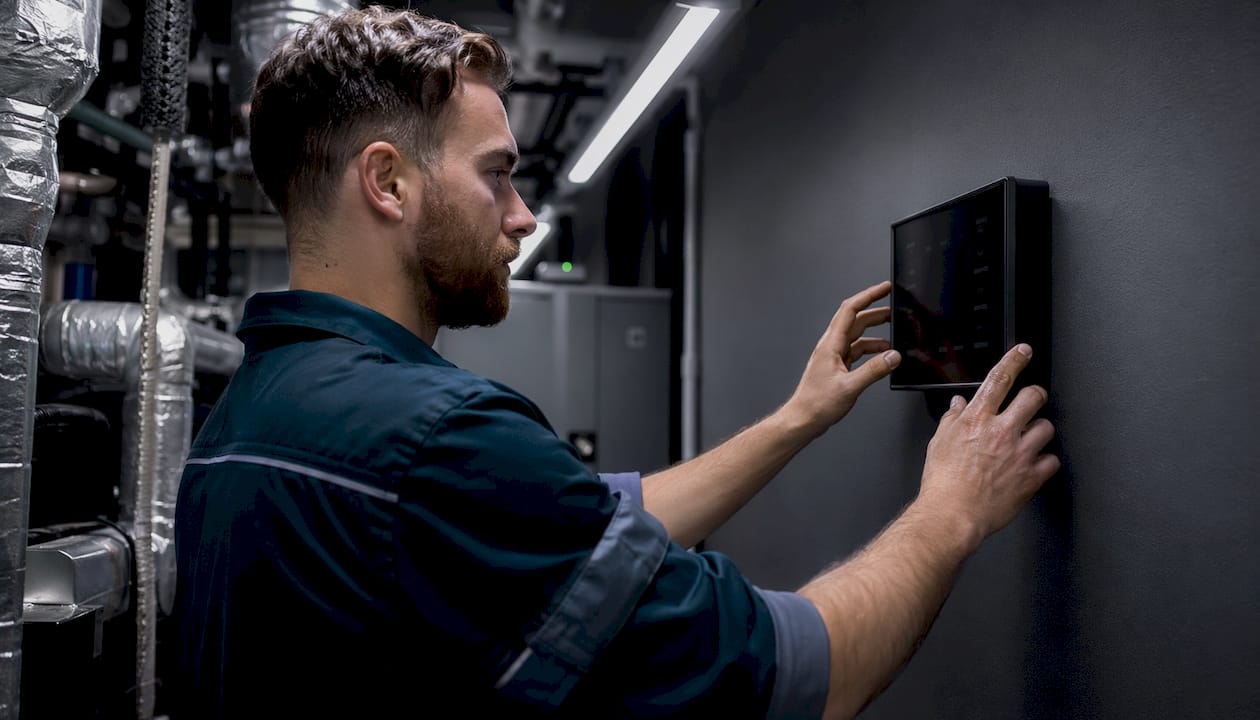
AvalonBay, a large residential real estate company, deployed AI-driven HVAC software across its portfolio. During peak heat waves in 2025, the software curtailed air conditioning use at the right moments and earned approximately $30,000 in utility demand-response payments. That is revenue generated directly from a software decision.
The financial case goes further. New York City’s Local Law 97 sets carbon emission limits on large buildings, with significant penalties for violations. AvalonBay’s software avoided an estimated $200,000 in potential penalties by keeping emissions within compliance thresholds. Software-driven controls are shifting compliance from a cost center into a financial opportunity.
Here is how the process works in practice:
- The software ingests weather data and forecasts cooling demand for the next 24 hours.
- It checks utility pricing signals and identifies peak-rate windows.
- It pre-cools the building before peak periods to reduce load during expensive hours.
- It logs all adjustments for carbon compliance reporting automatically.
Pro Tip: Ask your utility provider whether they offer demand-response programs before purchasing HVAC optimization software. The incentive payments can offset a significant portion of the software cost within the first year.
3. Wireless, battery-free sensor technology
Wireless sensors solve the biggest obstacle in retrofit projects: cabling. Running new wiring through occupied commercial buildings is expensive, disruptive, and slow. Battery-free sensors eliminate both problems.
EnOcean technology uses energy harvesting to power sensors from ambient light, motion, or temperature differentials. No batteries means no replacement cycles and no maintenance labor tied to sensor upkeep. Henkel’s China headquarters used EnOcean wireless sensors to control lighting and HVAC dynamically across the facility, without adding extra wiring to an existing structure.
The practical benefits for property managers are direct:
- No cabling disruption: Sensors install in hours, not days, with no structural work required.
- Zero battery maintenance: Self-powered sensors remove a recurring operational cost entirely.
- Flexible placement: Sensors can be repositioned as floor plans change without rewiring.
- Compatibility: EnOcean-based devices integrate with most major BACS platforms through standard gateways.
- Occupant comfort: Dynamic lighting and temperature adjustments respond to actual room conditions rather than fixed schedules.
Wireless sensor networks also support energy-efficient security integration, where motion detection feeds both security cameras and HVAC zone control simultaneously. That kind of dual-purpose data use is where wireless networks pay for themselves quickly.
4. Predictive maintenance and digital twin technology
Predictive maintenance replaces the reactive model of fixing equipment after it breaks. Instead, sensors monitor mechanical systems continuously and flag anomalies before they become failures. The result is longer equipment life and fewer emergency repair costs.
Thamrin Nine in Jakarta uses an AI-powered building management system that proactively controls cooling loads to reduce mechanical stress on chillers and air handlers. Predictive control frameworks extend equipment lifespan by minimizing the wear that comes from constant cycling between high and low loads.
Digital twin technology takes this further. A synchronized, bi-directional digital twin architecture creates a live virtual model of the physical building. Facility managers can run what-if simulations, testing how a change to HVAC scheduling will affect energy use and comfort before applying it to the real system. That eliminates guesswork and reduces the risk of costly configuration errors.
| Technology | Primary Benefit | Best Application |
|---|---|---|
| Predictive maintenance sensors | Reduces unplanned equipment failures | HVAC, elevators, pumps |
| Digital twin simulation | Tests changes before live deployment | Complex multi-system buildings |
| Edge AI anomaly detection | Filters false alarms from sensor noise | High-sensor-density facilities |
| AI copilot interface | Supports human operator decisions | Buildings with lean facility teams |
Facility teams often suffer alert fatigue when raw sensor data floods their dashboards without filtering. Implementing “guarded” AI copilots allows human operators to review and confirm critical system changes rather than having automation override them without context. That balance between automation and human oversight is what makes predictive systems operationally safe.
Pro Tip: When evaluating digital twin platforms, ask vendors whether the twin updates in real time from live sensor data or only syncs on a scheduled basis. Real-time synchronization is the feature that makes what-if simulations actually useful.
5. Physical infrastructure design as a smart building factor
Physical design decisions affect smart building performance as much as software does. This is the factor most property managers overlook when planning intelligent building upgrades.
Thamrin Nine’s engineering team located chillers on upper floors rather than in the basement. That placement reduces static pressure losses by up to 15% compared to conventional basement chiller placement. In a high-rise building, that pressure difference translates directly into pump energy savings that run continuously, every day, for the life of the equipment.
Software cannot compensate for poor physical infrastructure design. A building with undersized ductwork or poorly located mechanical equipment will always underperform, regardless of how sophisticated the control system is. Physical and digital design must be planned together from the start.
6. Integrated security and access control systems
Security systems are a core component of intelligent building systems, not a separate category. When cameras, access control, and motion sensors share data with the BACS, the building responds to security events automatically.
A motion sensor detecting activity in a restricted area after hours can simultaneously lock access doors, increase camera recording resolution, and alert facility staff through the central dashboard. That level of coordination requires a wired or wireless network that connects all systems reliably. Network infrastructure is the physical backbone that makes integrated security possible.
Motorized gates with sensor integration add another layer. Gate sensors can verify vehicle credentials, log entry and exit times, and feed that data into occupancy models that the HVAC system uses to adjust conditioning in parking structures. The gate becomes part of the building’s intelligence rather than a standalone access point.
7. Choosing the right smart building technologies for your property
The right technology mix depends on three factors: building age, operational budget, and regulatory environment. New construction allows full BACS integration from the ground up. Existing buildings require a retrofit strategy that minimizes disruption.
For retrofits, wireless sensor technology is the lowest-friction starting point. It delivers measurable results without structural work and integrates with most existing control systems. For new builds or major renovations, specifying open-protocol BACS platforms from the design phase gives you the flexibility to add AI optimization software and digital twin capabilities later without replacing core infrastructure.
Regulatory pressure is accelerating the business case. Laws like NYC Local Law 97 are spreading to other jurisdictions. Property managers who build compliance capability into their systems now avoid the scramble and penalty exposure that comes with reactive upgrades. You can find a detailed breakdown of technology categories and their applicability in this building automation guide from Lowvoltagecorp.
Key takeaways
Integrated Building Automation and Control Systems, combined with AI-driven software and wireless sensors, deliver the most measurable energy and cost reductions available to property managers today.
| Point | Details |
|---|---|
| Unified BACS delivers real savings | Integrated systems like The Wings achieved up to 30% energy reduction through centralized control. |
| AI software turns compliance into revenue | AvalonBay earned $30,000 in demand-response payments and avoided $200,000 in potential penalties. |
| Wireless sensors simplify retrofits | Battery-free EnOcean sensors install without cabling and require no ongoing maintenance labor. |
| Digital twins reduce operational risk | Real-time simulation lets facility teams test changes before applying them to live systems. |
| Physical design matters as much as software | Chiller placement alone can cut static pressure losses by up to 15% in high-rise buildings. |
What I’ve learned about smart building tech after years in the field
Most property managers I talk to focus almost entirely on the technology itself. They want to know which sensors to buy or which software platform to choose. That is the wrong starting point.
The integration layer is what determines whether a smart building actually performs. I have seen properties with expensive HVAC optimization software that delivered almost nothing because the sensors feeding it were on a separate, incompatible network. The software was fine. The integration was broken. The result was a system that looked smart on paper and performed like a conventional building in practice.
My honest recommendation: start with your network infrastructure. A reliable wired or wireless network that connects all your building systems is the prerequisite for everything else. Without it, sensors cannot communicate, software cannot act, and digital twins cannot update. Get the foundation right before adding layers on top.
The second thing I would tell any property manager is to take regulatory timelines seriously. Carbon compliance laws are not going away. They are expanding. The property managers who build compliance capability now, through AI-driven HVAC controls and continuous energy monitoring, will have a significant financial advantage over those who wait for a penalty notice to motivate action.
Start with one system, prove the value, then scale. Wireless sensor technology is the right first step for most existing buildings. It is low risk, low disruption, and produces results you can measure within the first billing cycle.
— Aaron
How Lowvoltagecorp supports your smart building upgrade
Smart building technology depends on reliable low-voltage infrastructure. Cameras, sensors, access control panels, and network switches all require professional installation to perform as designed.

Lowvoltagecorp specializes in the installation, repair, and maintenance of security cameras, motorized gates, wired and wireless networks, and cell boosters for property managers across South Florida. Whether you are integrating a new sensor network or upgrading your security camera wiring, the team at Lowvoltagecorp brings the technical depth to do it right the first time. Start with the lighting and surveillance guide to understand how lighting design affects camera performance in integrated security systems. For camera infrastructure specifically, the security camera wiring guide covers everything from cable selection to termination standards.
FAQ
What is a Building Automation and Control System?
A Building Automation and Control System, or BACS, is an integrated platform that manages HVAC, lighting, security, and sensors from a single interface. It automates cross-system responses and provides continuous energy monitoring for facility teams.
How much energy can smart building tech actually save?
Real-world deployments like The Wings in Belgium achieved up to 30% total energy savings through integrated HVAC, lighting, and sensor management. Results vary by building type, climate, and the level of system integration.
Are wireless sensors reliable enough for commercial buildings?
Battery-free wireless sensors using EnOcean technology are deployed in commercial headquarters worldwide, including Henkel’s China facility. They eliminate battery maintenance and integrate with standard BACS platforms through open-protocol gateways.
What is a digital twin in a building context?
A digital twin is a real-time virtual model of a physical building that updates continuously from live sensor data. Facility managers use it to simulate system changes and verify outcomes before applying them to the actual building.
How do smart building systems help with carbon compliance?
AI-driven HVAC software tracks energy consumption and carbon output in real time, enabling buildings to stay within regulatory limits like NYC Local Law 97. AvalonBay used this approach to avoid an estimated $200,000 in potential penalties while earning demand-response revenue.