A security camera maintenance contract is a signed service agreement that schedules preventive maintenance, guarantees response times through a service level agreement, and documents system health so you have usable evidence when footage actually matters. Any facility manager overseeing more than a handful of cameras needs one since unmaintained systems fail quietly. They fail during outages, insurance claims, or the week a break-in finally happens. A real contract cuts downtime, keeps recordings admissible, and satisfies insurers and procurement officers who now ask for maintenance records before honoring a claim.
TL;DR:
- Proper vendor selection and a pre-contract site health check are essential to avoid inheriting pre-existing faults and vague SLA commitments.
- Contracts should include clear response times, uptime guarantees, and written service reports after each maintenance visit to ensure accountability.
- Preventive maintenance performed at recommended intervals costs less and provides documented evidence, which is critical for insurance claims and compliance.
- Costs vary widely based on camera count, site risk level, and included parts or services, with typical annual fees ranging from $500 to over $8,000.
- Exclusions often cover damage from external factors, legacy equipment, and software/license fees, so review contracts thoroughly to avoid unexpected expenses.
Table of Contents
- What Should a Security Camera Maintenance Contract Include?
- What Response Times Should a Service Level Agreement Guarantee?
- Preventive Maintenance vs. Reactive Repairs: Which Actually Saves Money?
- What Does a CCTV Maintenance Contract Cost?
- How Do You Choose and Negotiate a Maintenance Provider?
- What Contract Clauses and Language Should You Insist On?
- Why Maintenance Records Matter for Insurance and Compliance
- How Do Maintenance Contracts Interact With Manufacturer Warranties?
- How Should Footage Be Handled During Maintenance Visits?
- What Do Maintenance Contracts Typically Exclude?
- Common Contract Mistakes and How to Avoid Them
- Get a Site Health Check Before You Sign Anything
- Sources
What Should a Security Camera Maintenance Contract Include?
Most CCTV service agreements bundle the same core tasks, though the depth and frequency vary by tier. Vendor guides consistently point to a similar baseline of scheduled preventive maintenance, firmware updates, and recording verification as the floor for any serious contract, not the ceiling.
At the equipment level, a technician visit should cover:
- Lens cleaning, alignment, and housing checks — dust, salt air, and spiderwebs degrade image quality faster than most managers realize, especially outdoors in humid climates.
- NVR/DVR health checks and storage verification — confirming the recorder is actually capturing and retaining footage at the retention period your policy requires, not just powered on.
- Firmware updates and credential audits — outdated firmware is one of the most common entry points for camera hijacking, and default or shared passwords are a close second.
- Power, PoE, and cabling inspections — checking junction boxes, PoE injector loads, and connector corrosion before a cable fault takes down a whole run.
- Remote monitoring and reporting — confirming the system flags outages proactively rather than waiting for someone to notice a blank feed.
Beyond that baseline, contracts typically spell out parts and labor terms: whether consumables (mounts, housings, small connectors) are included, whether labor is capped per visit, and how emergency callouts outside scheduled visits get billed. Cabling and junction issues often trace back to installation quality, which is why a complete cabling reference is worth keeping on hand when a vendor flags a wiring problem during a visit.
Optional add-ons are where contracts start to differentiate. Managed monitoring (a live or virtual guard watching feeds), cloud storage as a backup to on-site NVR storage, and access control integration (tying camera events to door logs) are common upsells. None of these are required for a functional maintenance contract, but each solves a specific gap. If your insurer requires off-site backup of footage, cloud storage stops being optional and becomes a contract requirement. Read the base scope carefully before assuming an add-on is bundled in. Vendors count on managers not noticing that “system health checks” and “firmware management” sometimes get sold separately.
What Response Times Should a Service Level Agreement Guarantee?
The service level agreement is the part of the contract that actually protects you when something breaks, and it’s also the part most managers skim past. An SLA should define three things clearly: initial response time, on-site response time, and an uptime guarantee, along with what happens if the vendor misses any of them.
Initial response is how fast someone acknowledges your ticket, ideally within 4 hours during business hours. On-site response is when a technician physically shows up, and this is where tiers diverge sharply: some contracts promise next-business-day service, others guarantee same-day for critical failures. Uptime guarantees are usually expressed as a percentage, and the difference between tiers is bigger than it looks on paper.
The math that matters: A 99.5% uptime guarantee allows roughly 3.6 hours of downtime per month. A 99.9% guarantee cuts that to about 44 minutes. For a parking structure or loading dock camera, that difference might not matter. For a cash-handling area or a controlled-access gate, it usually does.
Ask specifically about after-hours and weekend handling. A contract that reads great during a Tuesday-morning sales call can fall apart when a camera goes dark at 11 p.m. on a Saturday, if the SLA quietly excludes weekends from the response clock.
Remediation matters as much as the promise itself. Look for:
- Service credits when the vendor misses a response window, applied automatically rather than requiring you to file a dispute.
- Escalation paths naming who gets contacted after the first missed deadline.
- Termination triggers if a vendor repeatedly misses SLA targets across a defined period.
Tighter SLAs cost more, and pursuing 99.9% uptime everywhere is usually overkill unless the site’s risk profile justifies it. A retail stockroom camera and a bank vault camera should not carry the same SLA, and a vendor who quotes identical terms for both probably hasn’t looked closely at either.
Preventive Maintenance vs. Reactive Repairs: Which Actually Saves Money?
Preventive maintenance (PM) means scheduled visits that catch problems before they cause an outage. Reactive repair, often called break-fix, means you call someone after a camera has already failed. The financial logic favors PM almost every time: a scheduled lens cleaning costs a fraction of an emergency callout after a break-in went unrecorded because a fogged housing made footage useless.
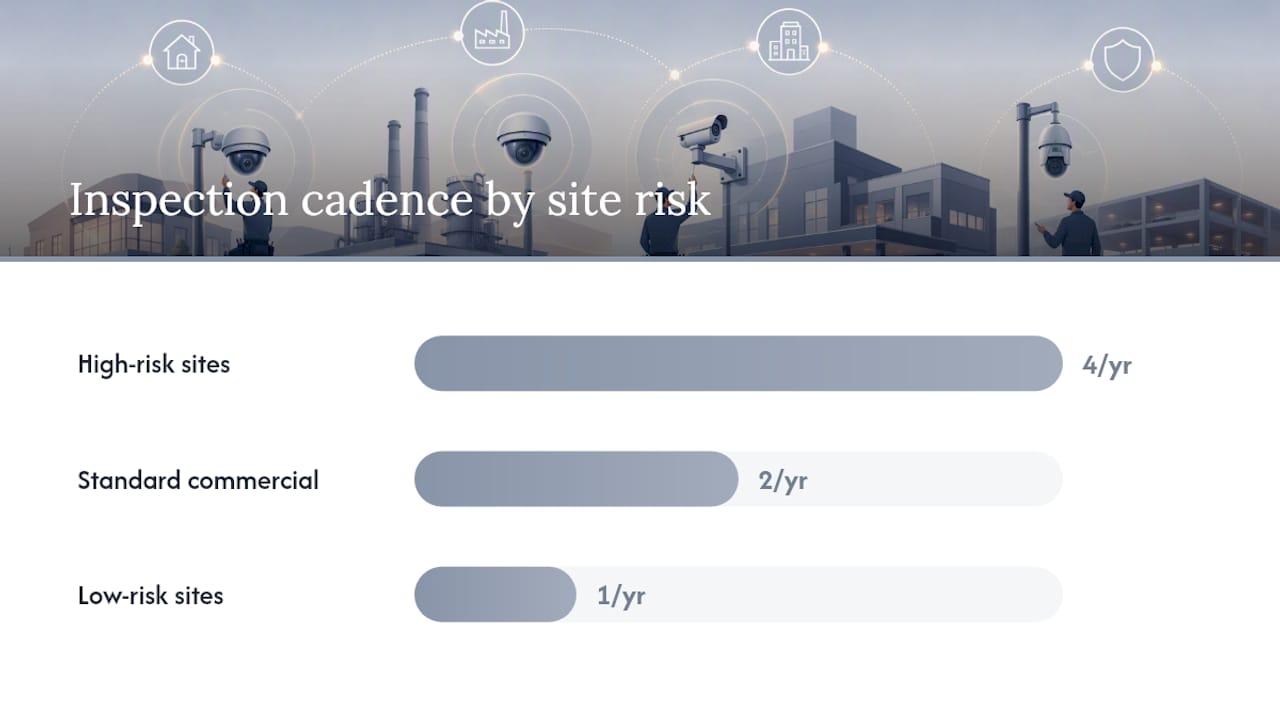
Recommended inspection cadence depends on site risk:
- High-risk sites (cash handling, controlled access, critical infrastructure): quarterly visits.
- Standard commercial sites (offices, retail, multifamily common areas): biannual visits.
- Low-risk or low-traffic sites (storage facilities, low-occupancy buildings): annual visits, at minimum.
PM visits reliably catch a short list of recurring failures: lens fouling from dust or condensation, recording failures from full or failing drives, and firmware exposure from missed security patches. Each of those is cheap to fix during a scheduled visit and expensive to discover during an incident review, when you need footage that turns out not to exist.
There’s a documentation angle here that gets underweighted. Every PM visit that generates a written, dated service report becomes evidence, not just of system health, but of due diligence. Insurers increasingly expect documented maintenance before honoring claims tied to a surveillance failure, and a stack of service reports is exactly what demonstrates you weren’t negligent. A facility manager who can produce eighteen months of dated PM records after an incident is in a very different position than one who can’t.
What Does a CCTV Maintenance Contract Cost?
Pricing structures vary more than most first-time buyers expect, and the structure itself often matters more than the headline number. The four common models are annual flat fee (one price covers a set number of visits), per-visit billing (pay each time a technician comes out), per-camera pricing (a rate multiplied by camera count), and tiered managed services (a package that bundles monitoring, cloud storage, and PM into one subscription).
Several variables move the price up or down:
- Camera count and mix — PTZ (pan-tilt-zoom) cameras cost more to service than fixed cameras because they have moving parts that need mechanical inspection.
- Cloud storage inclusion — off-site backup adds a recurring cost that scales with retention period and camera count.
- Parts coverage — contracts that include replacement housings, mounts, and cabling cost more upfront but reduce billing surprises later.
- Multi-site enrollment — portfolios with several properties can often negotiate a blended rate across locations.
Typical ranges: Small commercial systems generally run $500 to $2,000 per year, while larger systems with more cameras, tighter SLAs, and parts coverage can run $3,000 to $8,000 or more annually. Treat these as planning ranges, not quotes. Actual pricing depends heavily on your camera count, site count, and SLA tier.
Multi-year agreements often come with a discount, sometimes 5% to 15% off the annual rate, in exchange for locking in a term. If you sign multi-year, insist on a capped escalator (a defined maximum annual price increase, often 3% to 5%) rather than leaving renewal pricing open-ended. An uncapped escalator clause is one of the quieter ways a good first-year price turns into a bad third-year price.
How Do You Choose and Negotiate a Maintenance Provider?
Vendor selection is where most of the long-term risk in a maintenance contract actually lives, because a bad contract signed on good terms is still a bad contract. Start with pre-qualification: current insurance, technician certifications, verifiable references from similar properties, and, for public-sector or larger commercial portfolios, GSA/MAS experience if that’s relevant to your procurement rules.
Before signing anything, walk through this checklist:
- Ask exactly how SLA response times are measured and enforced — get the escalation contact in writing, not just a promise.
- Ask about parts lead time and OEM parts policy — some vendors substitute generic parts without disclosing it, which can void a camera’s manufacturer warranty.
- Ask for a sample service report from an existing client before signing, so you know what documentation actually looks like.
- Require a pre-contract site health check with a written remediation list, so you aren’t billed later for faults that existed before the contract started.
- Negotiate a trial period (60 to 90 days is common) with an exit clause if the vendor underperforms.
Red flags worth walking away from: vague SLA language (“prompt response” instead of a defined hour window), no written reports after visits, and auto-renewal clauses with no price review window. A site health check before enrollment protects both sides, and any vendor who resists doing one is telling you something.
Pro Tip: Ask for capped callout fees in writing before you sign, not after the first emergency invoice arrives. A vendor who won’t cap after-hours rates upfront usually won’t negotiate them later either.
For a broader read on vetting any trade contractor before signing a long-term agreement, Trade Intel’s guidance on contractor selection covers due diligence steps that apply just as well to security vendors as to general contractors.
What Contract Clauses and Language Should You Insist On?
The checklist above only works if it survives translation into contract language. A few clauses are worth insisting on by name:
- Scope of work with an equipment list — a table of every camera, NVR, and access point covered, plus an explicit exclusions list, prevents “that camera wasn’t in scope” disputes later.
- Parts and labor terms naming the OEM parts policy specifically, not just “quality parts will be used.”
- SLA metrics with a service-credit formula — for example, a stated percentage credit for each hour past the response window, not a vague “adjustments may apply.”
- Reporting obligations naming a delivery window, such as a written report within five business days of each visit.
- Termination and renewal language with a defined notice period and a capped price escalator for multi-year terms.
None of this is exotic legal drafting. It’s the difference between a contract you can enforce and one you can only hope gets honored.
Why Maintenance Records Matter for Insurance and Compliance
Insurers don’t just want a working camera system; they want proof it was maintained. A claim tied to missing or corrupted footage gets scrutinized hard, and documented maintenance history is increasingly what determines whether that claim gets paid.
- Maintenance records double as compliance evidence for insurers who ask, after an incident, whether the system was serviced on schedule.
- Chain-of-custody matters for footage pulled as evidence — know who has export access and how footage is time-stamped before you need it.
- Data retention periods should match your policy and any applicable regulation, not just the NVR’s default storage window.
- Public-sector procurement often runs through vehicles like GSA/MAS contracts, which specify PM frequency and emergency response windows directly in the solicitation.
How Do Maintenance Contracts Interact With Manufacturer Warranties?
A manufacturer warranty covers defects in a specific camera or recorder, usually for one to three years, and it typically requires the unit to be installed and serviced correctly to stay valid. A maintenance contract doesn’t replace that warranty; it protects it. Improper cleaning, unauthorized part swaps, or skipped firmware updates can void warranty coverage on individual units, and a maintenance vendor who follows OEM procedures is exactly what keeps that from happening.
Where the two genuinely complement each other is in what they each don’t cover. A warranty pays for a defective camera; it does nothing for a fouled lens, a full hard drive, or a loose PoE connector, none of which are manufacturing defects. A maintenance contract handles exactly those gaps. When a warranty claim is needed, a vendor with documented service history can often expedite it, since manufacturers are more responsive when they can see a unit was properly maintained. Ask any prospective vendor how they handle warranty claims on your existing equipment, and specifically whether their parts and labor policy could put current warranty coverage at risk. A vendor who can’t answer that clearly is a vendor who hasn’t thought about it.
How Should Footage Be Handled During Maintenance Visits?
Maintenance visits mean a technician has physical or network access to devices that store sensitive footage, and that access needs boundaries. Before any vendor touches your system, confirm how they handle login credentials during a visit, whether they use their own temporary access or shared admin credentials that should be rotated afterward.
Ask specifically whether footage is ever copied off-site for diagnostic purposes, and if so, under what retention and deletion policy. A reputable vendor should be able to state plainly that diagnostic work happens on-site or through secure remote access, not by exporting clips to a personal device. Credential audits, mentioned earlier as a standard PM task, exist partly for this reason: technician access should be logged, time-limited, and revoked when the contract ends. If your property handles any regulated footage (healthcare common areas, financial transaction points), ask your vendor directly how their maintenance access policy aligns with your compliance obligations, since a generic answer here is a warning sign rather than a technicality.
What Do Maintenance Contracts Typically Exclude?
Every contract has edges, and knowing them before an incident is far better than discovering them during one. Common exclusions include:
- Damage from vandalism, weather events, or vehicle impact — usually billed separately as an insurance matter, not covered under routine maintenance.
- Legacy or third-party equipment the vendor didn’t install and can’t verify compatibility for, sometimes serviced at a higher rate or excluded outright.
- Cabling infrastructure predating the current system, especially in older buildings where original runs weren’t documented.
- Software licensing fees for VMS (video management system) platforms, which often renew separately from the maintenance contract itself.
- Network equipment outside the camera system, such as switches or routers shared with other building systems.
Read the exclusions section as carefully as the inclusions. A contract that looks comprehensive on price can turn expensive fast if half your system’s actual failure points sit outside its stated scope.
Common Contract Mistakes and How to Avoid Them
Three mistakes show up again and again in the contracts facility managers bring me for review. First, signing without a pre-contract health check, which means you inherit whoever’s problems existed before you signed. Second, accepting vague SLA language that sounds reassuring but specifies nothing measurable. Third, letting auto-renewal pass without a price review, which quietly inflates costs over a multi-year term.
The fix is simple: require the health check, put every SLA number in writing, and calendar the renewal date yourself. A documented technician workflow at the start of a contract removes most of the guesswork that leads to disputes later.
— Aaron
Get a Site Health Check Before You Sign Anything
Lowvoltagecorp is the practical alternative to signing a maintenance contract sight unseen. Rather than accepting a vendor’s boilerplate SLA, you get a technician-led site health check first, so any pre-existing faults are documented and remediated before your contract clock starts, exactly the standard the checklist above describes.

Our service covers the full maintenance scope facility managers actually need: scheduled preventive visits, NVR health and storage verification, firmware and credential audits, and cabling inspections across South Florida commercial and residential properties. Contract tiers map directly to the response benchmarks discussed earlier, with written service reports after every visit so you have documentation ready if an insurer or auditor ever asks for it. If your current setup has gaps in cabling or camera coverage, our repair workflow guide walks through exactly what a proper inspection covers. Request a site survey and maintenance proposal today, and get a written scope before you commit to anything.
Sources
For readers who want to dig into the standards and market data behind this guide, a few sources are worth bookmarking:
- CCTV Maintenance Contract: 5 Proven Tips to Save (2026) | Guardian Integrated Security
- CCTV service contracts and service level agreements | CCTV Authority