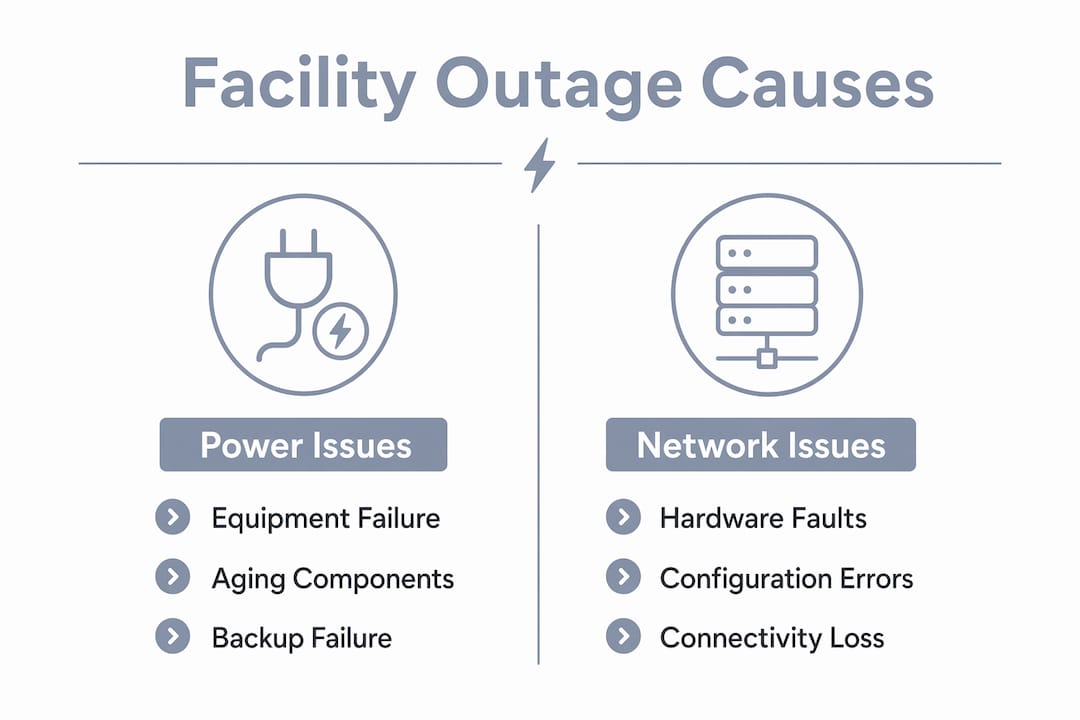
Facility outages are defined as unplanned interruptions to building systems, power, or network services that halt normal operations. Power failures, network connectivity faults, equipment malfunctions, and environmental events are the four primary reasons for facility outages. Power failures alone account for 45% of impactful outages reported in the past year. That single statistic tells you where to focus your maintenance budget first. This guide breaks down each cause category with the specificity you need to reduce downtime and protect your property.
Facility outage causes explained: why power failures lead the list
Power failures are the single largest driver of facility downtime, and the reasons go well beyond a tripped breaker. External grid failures, transformer breakdowns, and switchgear faults all cut power before your internal systems even respond. Internal causes are just as damaging: uninterruptible power supply (UPS) failures, transfer switch malfunctions, and generator faults can all leave a facility dark even when the utility grid is running fine.
Power supply reliability is a layered problem. Aging electrical equipment raises fault risk significantly, especially in buildings where switchgear or distribution panels have not been replaced in over 20 years. Corrosion, vibration, and heat cycling weaken connections over time. Those weakened connections become hidden failure points that escalate to full outages if no one catches them during routine inspections.
Backup power systems are a common false comfort. 87% of operators who experienced impactful outages agreed those outages were preventable with better configuration or maintenance. The core problem is that most facilities test generators on a light load or no load at all. A generator that runs fine at 20% capacity may fail completely when the full building load transfers to it during a real event.
Key power failure causes to monitor:
- Utility grid interruptions from transformer or substation faults
- UPS transfer switch failures during switchover
- Generator fuel supply problems or cooling failures under full load
- Aging distribution panels with corroded or loose terminations
- Overloaded circuits from added equipment without electrical review
Pro Tip: Schedule a full-load generator test at least twice per year. Calendar-based maintenance checks alone do not reveal capacity degradation. Only a real-load test shows whether your backup power will actually hold.
How do network and connectivity failures cause facility downtime?
Network and connectivity issues cause 23% of IT service disruptions, making them the most frequent single category ahead of power failures in that context. That number reflects a shift in how facilities operate. Security cameras, access control systems, motorized gates, and building management platforms all depend on live network connections. When the network goes down, those systems go with it.
The causes split into two groups: internal and external. Internal causes include configuration errors, hardware failures in switches or routers, and firmware mismatches after updates. Configuration and change management failures alongside third-party provider issues are the leading drivers of network-related outages. A single misconfigured VLAN or a botched firmware push can take down every connected system in a building.
External causes are harder to control. Fiber cuts from excavation work, third-party internet service provider outages, and physical damage to outside plant infrastructure can all interrupt connectivity with no warning. Facilities that rely entirely on a single internet provider have no fallback when that provider fails. End-to-end network monitoring that covers both internal infrastructure and third-party connections is now a baseline requirement, not an optional upgrade.
Common network failure triggers:
- Configuration errors after software or firmware updates
- Physical hardware failures in switches, routers, or patch panels
- Third-party ISP or fiber infrastructure outages
- Cascading failures when one system’s failure overloads another
- Lack of redundant internet paths or failover routing
Pro Tip: Use a network maintenance checklist reviewed quarterly. Document every configuration change with a rollback plan. Most network outages caused by human error are traceable to undocumented changes made under time pressure.
What equipment malfunctions cause facility outages most often?
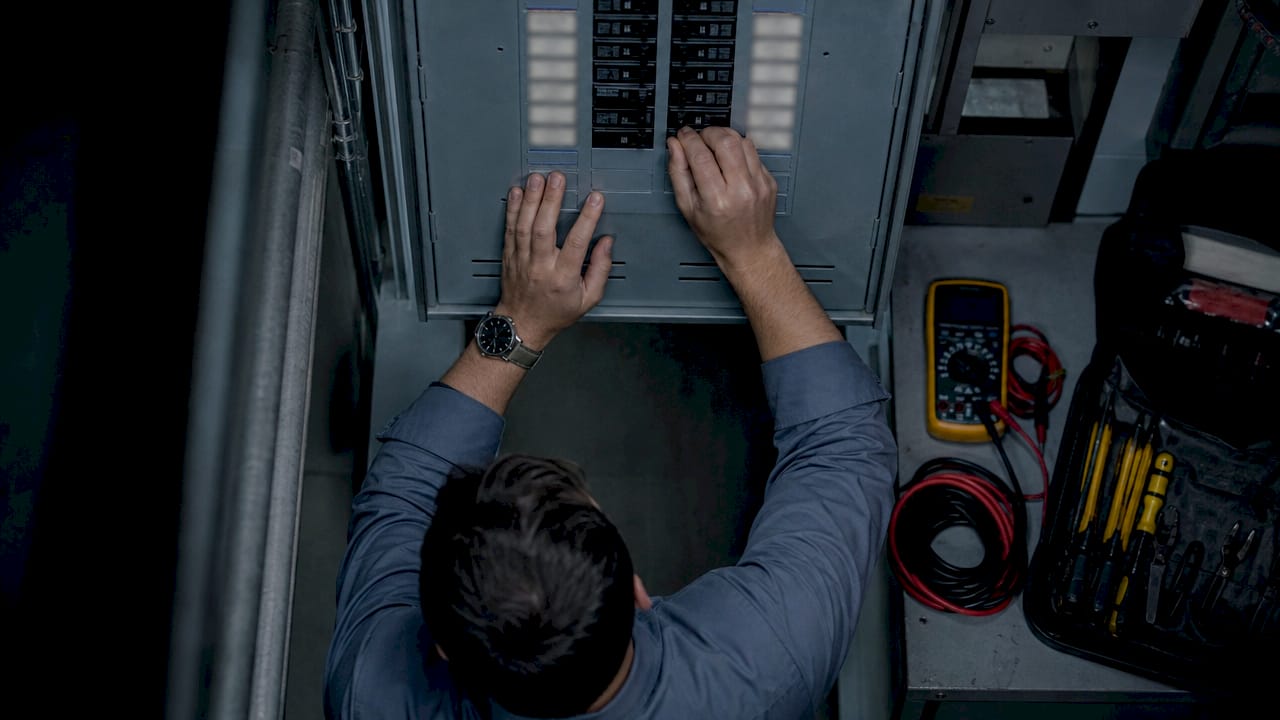
Equipment degradation is a slow, predictable process that most facilities ignore until it causes an outage. Nearly 50% of preventable electrical faults stem from poor maintenance or errors during system switching. That means half of all avoidable outages come down to maintenance decisions you control directly.
Battery failures in UPS systems
VRLA batteries in UPS systems are a specific and well-documented weak point. VRLA batteries often fail within 3–5 years despite a nominal design life of 5–7 years. Heat, improper maintenance, and absent temperature control all accelerate degradation. A battery that tests fine on a voltage check may still fail under load because internal resistance has risen beyond acceptable limits.
Human error and rushed maintenance
Human factors cause a significant share of equipment-related outages. Rushed maintenance, skipped steps, and failure to follow lockout/tagout procedures all introduce faults that would not otherwise exist. Loose terminations from improperly torqued connections, overheating splices from poor installation, and mislabeled circuits that confuse the next technician are all real-world examples.
Substitute and secondhand components
Substitute or secondhand electrical components increase outage risk because their compatibility and history are unknown. During supply shortages, facilities sometimes install non-OEM parts to keep systems running. Those parts may work initially but fail under stress conditions that a properly rated component would survive.
The table below compares maintenance approaches and their effect on outage risk:
| Maintenance approach | Outage risk level | Key weakness |
|---|---|---|
| Calendar-based only | High | Misses capacity and load degradation |
| Visual inspection only | High | Misses internal faults and loose connections |
| Condition-based monitoring | Low | Requires initial investment in monitoring tools |
| Full-load testing plus thermal imaging | Lowest | Most accurate picture of real system health |
Pro Tip: Use infrared thermal imaging during annual electrical inspections. Overheating connections show up clearly on a thermal camera before they cause a fault. This single practice catches more hidden problems than any visual inspection.
Maintenance best practices for reducing equipment-related outages:
- Replace VRLA batteries proactively at the 3-year mark in warm climates rather than waiting for the 5-year nominal life.
- Torque all electrical connections to manufacturer specifications and document the values.
- Use only OEM or fully rated replacement components, especially for UPS and transfer switch parts.
- Conduct thermal imaging scans on all electrical panels and connections annually.
- Follow a written change management process for every configuration or hardware change.
How do environmental and external factors trigger facility outages?
External factors cause fewer total outages than equipment failures, but their impact is often more visible. Severe weather, lightning strikes, flooding, vehicle collisions with utility poles, and excavation damage to underground cables all interrupt power or connectivity with no warning. Wildlife and vegetation are also consistent contributors: squirrels, birds, and overgrown tree branches contacting power lines cause a measurable share of utility outages every year.
The data on restoration time is telling. Equipment failure averages 9.1 hours to restore, while weather-related outages average 5.7 hours. Equipment failures take longer to fix because diagnosing the root cause requires investigation, not just repair. Weather damage is usually visible and localized, which speeds up the response.
| External cause | Typical impact | Average restoration time |
|---|---|---|
| Severe weather or lightning | Power interruption, equipment damage | 5.7 hours |
| Equipment failure (transformer, switchgear) | Extended power loss | 9.1 hours |
| Excavation or vehicle damage | Fiber or cable cut, power loss | Varies by scope |
| Wildlife or vegetation contact | Momentary or sustained outage | 1–4 hours |
Preventive measures for external risks include surge protection on all incoming power and data lines, physical barriers around ground-level equipment, and vegetation management agreements with your utility provider. Facilities in flood-prone areas should elevate critical electrical equipment above the base flood elevation defined by FEMA standards. Backup power systems become especially critical when external events are the trigger, because you cannot control when the utility restores service.
External risk reduction steps:
- Install whole-facility surge protection at the main electrical panel
- Maintain a 10-foot clearance between vegetation and overhead utility lines
- Use conduit burial depth that meets or exceeds NEC Article 300 requirements
- Place physical bollards around exterior electrical equipment in vehicle traffic areas
- Establish a mutual aid agreement with your utility provider for priority restoration
Key Takeaways
Facility outages follow predictable patterns, and power failures, network faults, equipment degradation, and external events each require a specific maintenance response to prevent them.
| Point | Details |
|---|---|
| Power failures lead all causes | Power events account for 45% of impactful outages; backup power testing is the highest-leverage fix. |
| Network faults are rising | Configuration errors and third-party provider failures drive most network-related downtime. |
| Equipment degradation is preventable | Nearly 50% of electrical faults trace to poor maintenance; thermal imaging and load testing catch them early. |
| Backup power needs real-load testing | Calendar-based checks miss capacity degradation; only full-load tests confirm readiness. |
| External events are faster to restore | Weather outages average 5.7 hours vs. 9.1 hours for equipment failures, but surge protection limits their damage. |
What I’ve learned from watching facilities fail the same way twice
After years of working on low voltage systems across South Florida properties, the pattern I see most often is not ignorance. It’s overconfidence. A facility manager runs a generator test, it starts up fine, and they check the box. Six months later, during an actual outage, the generator trips on overload because nobody tested it at full building load.
The same dynamic plays out with network infrastructure. A switch gets replaced, the technician makes a configuration change without documenting it, and three months later nobody can explain why a camera system or access control panel keeps dropping offline. The low voltage safety practices that prevent these situations are not complicated. They require discipline, not expertise.
What concerns me more now is the compounding effect of adding systems without reassessing the electrical and network infrastructure underneath them. A property adds a new camera system, a cell booster, and a motorized gate in the same year. Each device draws power and network bandwidth. Nobody audits whether the existing UPS, panels, or switches can handle the added load. That’s how a facility that ran fine for a decade suddenly starts having outages.
The facilities that avoid repeat outages share one habit: they treat maintenance as a diagnostic process, not a checklist. They ask why a system is showing early wear, not just whether it passed the test. That shift in thinking is worth more than any single piece of equipment.
— Aaron
Lowvoltagecorp services that reduce your outage exposure
Property managers dealing with recurring outages often find the root cause sits in the low voltage layer: a camera system drawing power from an overloaded circuit, a network switch with no redundancy, or a motorized gate that loses connectivity during every power event.
Lowvoltagecorp specializes in the installation, repair, and maintenance of security cameras, motorized gates, wired and wireless networks, and cell boosters across South Florida properties. If your facility has experienced unexplained downtime, the fix for low voltage issues often starts with a system audit that maps every device back to its power and network source. Lowvoltagecorp also offers energy-efficient security upgrades that reduce the load on aging infrastructure while improving overall facility resilience. Contact Lowvoltagecorp to schedule a site assessment.
FAQ
What is the leading cause of facility outages?
Power failures are the leading cause, accounting for 45% of impactful outages according to Uptime Institute 2026 analysis. Internal electrical faults and backup power failures contribute alongside external utility grid events.
How do network failures cause facility downtime?
Network and connectivity issues cause 23% of IT service disruptions, driven by configuration errors, hardware failures, and third-party provider outages. When network connectivity drops, security cameras, access control, and building management systems all go offline.
Why do backup power systems fail during outages?
Backup power systems fail most often because generators and transfer switches are not tested under real load conditions. VRLA batteries in UPS systems also degrade faster than their rated life when exposed to heat or improper maintenance.
How long does it take to restore power after an outage?
Equipment failures average 9.1 hours to restore, while weather-related outages average 5.7 hours. Equipment failures take longer because diagnosing the root cause requires investigation before repairs can begin.
What is the most effective way to prevent facility outages?
Condition-based maintenance combined with full-load backup power testing and end-to-end network monitoring reduces outage risk more than any single measure. Addressing equipment degradation before failure is the highest-return prevention strategy available to property managers.