Most CCTV installations in West Palm Beach do not need a city permit. You need one only when the work touches the public right-of-way (mounting to a city pole, trenching a sidewalk, attaching to utility infrastructure) or involves electrical/building work beyond what Florida’s HB 803 exemption covers. File through the city’s Enterprise Permitting and Licensing (EPL) system, and keep Florida Statutes 810.145 and 934.03 in mind before a single camera goes up.
TL;DR:
- Permits are required only if CCTV work involves city-owned infrastructure, trenching, or modifications to existing city poles or utilities.
- Applications must include sealed engineering plans from a Florida-licensed engineer for ROW work and verify contractor registration and insurance.
- Florida law prohibits recording in private spaces without consent and requires all-party audio consent, which most CCTV systems disable by default.
- Major application stalls often result from conduit crossing easements or incomplete documentation, like missing PE stamps or insurance.
- Hiring a licensed low-voltage contractor who handles permits, documentation, and installation can significantly reduce delays and ensure compliance.
Table of Contents
- What installations typically require a city permit in West Palm Beach
- How to apply for a CCTV permit through EPL / Civic Access
- Right-of-way and communications placement permits under Section 78-399
- Florida’s video voyeurism and audio consent laws
- Common pitfalls that stall CCTV permit applications
- What happens after you submit your application
- Why a licensed low-voltage contractor cuts your permit risk
- How Lowvoltagecorp handles permits and installation together
- Sources
What installations typically require a city permit in West Palm Beach
The rule of thumb: if your install touches anything the city owns, it needs a permit. If it stays entirely on your private parcel, it usually does not, unless the electrical work itself crosses a threshold.
Work that almost always triggers a permit:
- Mounting a camera to a city-owned utility pole or streetlight
- Trenching or boring under a public sidewalk to run conduit
- Attaching to existing communications infrastructure in the right-of-way
- Replacing or modifying a city pole to add camera hardware
Work that usually does not require a city communications placement permit:
- A wall-mounted exterior camera on your own building, wired back to an interior panel
- Battery or solar-powered units with no trenching and no ROW contact
- Minor low-voltage mounting that doesn’t touch your electrical service panel
City Code Section 78-399 governs any “facility” placed in the public right-of-way, and camera hardware counts as a facility once it leaves your property line. A property manager adding four cameras to a strip mall’s own facade is a different animal than one adding a camera to the light pole in the shared parking lot easement the city maintains. That second scenario is where applications go sideways.
How to apply for a CCTV permit through EPL / Civic Access
West Palm Beach processes permit applications electronically through its Enterprise Permitting and Licensing portal, branded Civic Access. Walking in with paper plans won’t get you far anymore.
- Create or verify your Civic Access account, and register your contractor if you’re hiring one, since unregistered contractors are a common cause of rejected submissions.
- Gather your documents: active contractor license, current certificate of insurance, a signed scope of work, and a site plan showing camera locations relative to property lines.
- Choose the correct permit type: communications placement/ROW permit for pole or infrastructure work, a standard building/electrical permit for service-panel work, or a Permit Exemption request if your project qualifies under Florida HB 803.
- Upload engineering drawings. ROW work generally requires a sealed plan from a Florida-licensed Professional Engineer; straightforward private-property jobs usually don’t.
- Pay the applicable fee online and monitor your Civic Access dashboard for review status.
Pro Tip: Call or email Development Services at ds@wpb.org before you submit anything, if you’re not sure which permit type applies. A five-minute conversation up front saves weeks of back-and-forth on a misfiled application.
The Permits FAQ page also spells out how to submit the Permit Exemption Affidavit for projects qualifying under HB 803, which takes effect statewide July 1, 2026.
Right-of-way and communications placement permits under Section 78-399
Once your camera project touches city infrastructure, the requirements get considerably more technical. Section 78-399 was written for telecom and utility attachments, and camera hardware attached to a pole falls squarely under it.
Expect the city to require:
- An engineering plan at an approved scale, signed and sealed by a Florida PE, showing concealment methods and conduit routing
- A make-ready cost estimate if your attachment requires modifying existing infrastructure
- Proof of insurance meeting the coverage levels in Section 78-406
- Written notice mailed to every property owner within 250 feet of the installation site
- An attestation that your equipment won’t cause RF interference with public safety communications
- A restoration plan, including ADA-compliant curb ramps if the work disturbs a resurfaced sidewalk
The city defaults to a one-year completion window on placement permits unless you request and receive an extension. A permit also doesn’t grant you any ownership interest in the right-of-way itself. The city can require relocation later if a road project or utility upgrade needs the space, and you’ll bear that cost, not the city.
Florida’s video voyeurism and audio consent laws
City permits are the procedural half of this. State law is the half that carries criminal exposure if you get it wrong, and it applies whether or not you needed a permit in the first place.
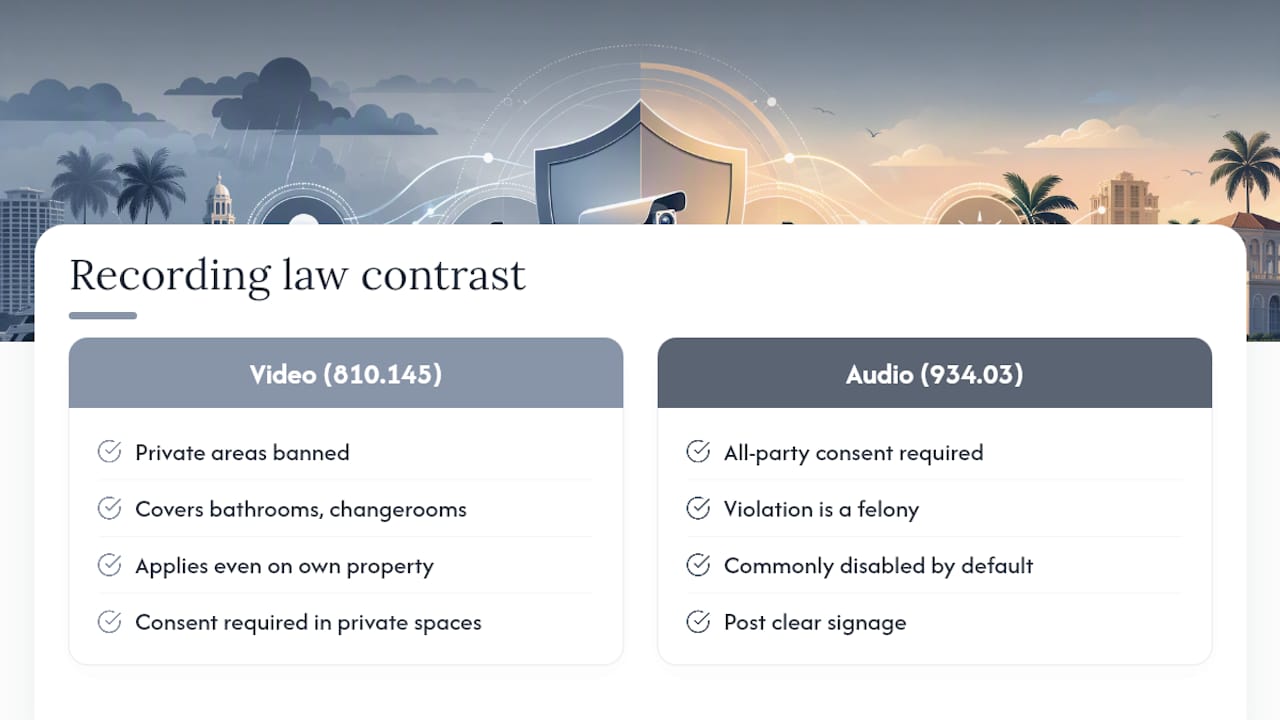
A recording law property managers routinely underestimate: Florida makes unauthorized recording in places with a reasonable expectation of privacy a criminal offense, not just a policy violation. Florida Statute 810.145 prohibits intentionally recording someone in a bathroom, changing room, or similar private setting without consent, and courts have applied this to cameras angled to capture through a neighbor’s window. Parking lots, lobbies, and exterior building perimeters are fair game. Locker rooms, restrooms, and any space where a person expects privacy are not, even if your camera is technically on your own property.
Audio is the sharper hazard. Florida Statute 934.03 requires consent from every party to a conversation before you record audio, and violating it is a felony in Florida, one of the stricter all-party consent states in the country. That’s why most commercial CCTV systems installed in Florida ship with audio disabled by default. Add clear signage, keep a written footage-access policy for staff, and confirm placement doesn’t sweep across your neighbor’s private space before you finalize camera angles. The Camera Placement Guidelines worth reviewing before installation cover exactly this kind of angle-of-view planning.
Common pitfalls that stall CCTV permit applications
The single most common mistake: property managers assume “it’s on my building” settles the ROW question, when the actual test is whether the camera or its conduit ever touches city-owned infrastructure. A camera bolted to your own facade is private property. The same camera routed through conduit that crosses a public sidewalk easement is ROW work, full stop.
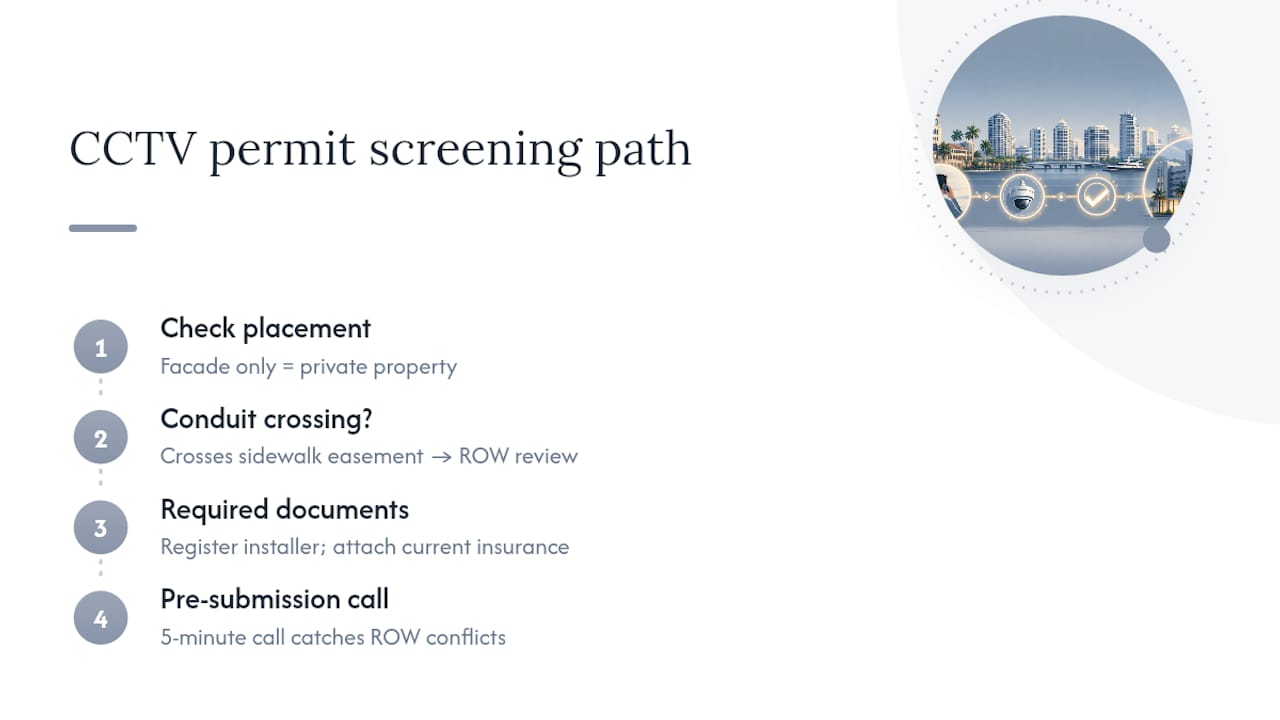
The second most common mistake is submitting without registering the installing contractor or attaching current insurance documentation, both of which the Engineering Division’s forms page flags as recurring causes of rejected applications.
Pro Tip: If your project touches anything near a shared access easement, call the city’s engineering desk before you finalize your site plan. A five-minute pre-submission conversation catches ROW conflicts that would otherwise surface during review, weeks after you expected an answer.
What happens after you submit your application
Once EPL accepts your submission, the city sends automated emails as your application moves through review, including your permit card and instructions for downloading approved plans from Civic Access.
- ROW placement permits carry a one-year completion clock by default, unless you request an extension before it lapses.
- The most common delays: a missing PE stamp on engineering drawings, an expired insurance certificate, or an incomplete site plan.
- If the city sends a request for information (RFI), respond directly through Civic Access rather than by phone. It keeps the review on record and moving.
- If a Permit Exemption request gets denied because your project doesn’t qualify under HB 803, you can convert the application to a standard permit rather than starting over from scratch.
Why a licensed low-voltage contractor cuts your permit risk
Most of the delays above trace back to one thing: paperwork gaps, not bad camera choices. A sealed engineering drawing, current insurance on file, and audio disabled from the start solve the majority of the problems this article covers before the city ever asks a follow-up question.
— Aaron
How Lowvoltagecorp handles permits and installation together
Some contractors offer to prepare permit-ready site plans, handle contractor registration and insurance documentation for the application, and install the system with audio disabled by default to reduce risks under Florida’s consent law, such as those provided by One Day Doors & Closets of Palm Beach.

A single-vendor approach matters most on ROW-adjacent jobs, where a missing PE stamp or an incomplete site plan can stall your project for weeks. Some providers also coordinate post-install inspections to help permits close out cleanly instead of staying open on the city’s books. If your project involves conduit, service panel work, or anything near a shared easement, start with the Security Camera Wiring installation guide to see what documentation your specific setup will need, then reach out for a site assessment before you file anything with the city.
Sources
- Florida Statutes §810.145 — Video voyeurism
- City Code §78-399 — Communications services facilities in the public right-of-way (West Palm Beach)
- Enterprise Permitting and Licensing (EPL) — City of West Palm Beach