Yes, security cameras are legal in Florida, and most homeowners can install and run them without a permit or a lawyer on retainer. The rule that trips people up isn’t video, it’s audio: Florida is an all-party consent state under Fla. Stat. § 934.03, and recording sound without everyone’s knowledge can turn a home security upgrade into a criminal case. Point cameras at your driveway and front door all day. Just keep the microphone off unless you’ve got documented consent, and never aim a lens into a space where someone reasonably expects privacy.
TL;DR:
- Installing video-only cameras on your property generally complies with Florida law, but adding audio triggers all-party consent requirements.
- Microphones must be disabled unless you have documented, written consent from everyone recorded, including household members and visitors.
- Posting clear signage about video surveillance covers legal issues related to video recording but does not exempt audio recordings from consent rules.
- Cameras aimed at private spaces like bathrooms or bedrooms violate Florida’s reasonable expectation of privacy and should be avoided.
- Violations of Florida’s surveillance laws can lead to third-degree felonies with fines up to $5,000, potential jail time, and evidence exclusion in court.
Table of Contents
- Security Camera Laws Florida Homeowners Need to Know
- Where You Can Point a Camera, and Where You Can’t
- Why Microphones Change the Legal Math
- Do Signs and Visible Cameras Protect You?
- Cameras in Rentals and Workplaces
- What Happens If You Get It Wrong
- A Compliance Checklist Before You Mount Anything
- What We See Installing Cameras Across South Florida
- Get a Compliant Camera Install Done Right the First Time
- Where to Verify These Rules Yourself
- Sources
Security Camera Laws Florida Homeowners Need to Know
Three statutes carry the weight of the video surveillance laws in Florida, and each one governs a different piece of the puzzle.
Fla. Stat. § 810.145, Florida’s digital voyeurism law, makes it a crime to secretly view or record someone dressing, undressing, or exposing themselves in a place where they’d reasonably expect privacy. It protects anyone captured this way, whether they’re a guest, a tenant, or a stranger who wandered into frame. The statute carves out two exceptions: conspicuous written notice that recording is happening, and cameras whose presence is obvious enough that a reasonable person would know they’re there.
Fla. Stat. § 934.03 covers audio. It bans intercepting wire, oral, or electronic communications without authorization from every party involved, not just one. This is the statute that turns a chatty doorbell camera into a legal liability.
Fla. Stat. § 877.26 applies specifically to merchants, banning cameras in dressing rooms, fitting rooms, and restrooms. It’s narrower than the other two, but it signals how seriously Florida treats private spaces even in commercial settings.
Here’s the split that matters for your install:
- Video-only cameras aimed at your yard, porch, or driveway generally comply with Florida law.
- Add a working microphone, and you’ve triggered all-party consent requirements under § 934.03, regardless of what the camera is pointed at.
Where You Can Point a Camera, and Where You Can’t
Florida courts and statutes lean on the phrase “reasonable expectation of privacy” to draw the line, and it’s a useful mental test for homeowners. Bathrooms, dressing areas, and bedrooms where a guest is staying overnight are the clearest no-go zones. Anywhere a person would expect to be unobserved while undressed or in a private moment falls under § 810.145’s protection.
Cross-property captures cause more disputes than interior cameras do. A doorbell or driveway camera that happens to catch a sliver of your neighbor’s yard is usually fine. One deliberately angled into their bathroom window or bedroom is a different story, and it’s the kind of complaint that shows up in small claims court more often than people expect.
- Stand where your camera points and ask what a stranger would see.
- Use privacy masking software to black out neighboring windows or yards in the recorded frame.
- Re-aim rather than rely on masking alone. Masking can fail during firmware updates.
Pro Tip: Walk your property line with your phone held at camera height before mounting anything permanently. If you can see into someone’s window from that spot, the camera will too.
Why Microphones Change the Legal Math
Video-only surveillance and audio-enabled surveillance are not the same legal animal in Florida. The moment a device records sound, you’ve stepped into all-party consent territory under § 934.03, meaning everyone captured on audio needs to know it’s happening and agree to it. One person’s consent doesn’t cover the conversation.
Ring-style doorbells are the most common offender here. Many ship with audio enabled by default, which means a neighbor’s conversation on your porch, or a delivery driver’s phone call, gets picked up without their knowledge. Comparisons of video-only versus audio-enabled devices consistently flag this as the biggest gap between what homeowners think is legal and what actually is.
- Disable the microphone at the hardware or firmware level, not just in the app settings.
- Get written consent from household members, regular visitors, or employees before enabling audio anywhere.
- Treat nanny cams and interior units the same way. Audio inside your own home still needs consent from everyone recorded, including guests.
Statistic Callout: Violating Florida’s interception statute is commonly charged as a third-degree felony, carrying penalties that can include fines up to $5,000 and prison time. That’s a steep price for a feature most people never intended to use.
Do Signs and Visible Cameras Protect You?
Section 810.145 offers two narrow safe harbors: posting conspicuous written notice that recording is in progress, or using a camera obvious enough that nobody could reasonably claim they didn’t know it was there. Either one can shield you from a digital voyeurism claim tied to video capture.
What signage doesn’t do is authorize audio. That’s the detail people miss most often. A sign that says “video surveillance in progress” says nothing about sound, and it won’t help you if § 934.03 comes into play.
- Post signs at entry points and near any camera covering a semi-private area, like a pool or side yard.
- Choose visibly mounted cameras over hidden ones when the goal is deterrence rather than covert monitoring.
- Assume signage covers video concerns only. Audio still needs separate, documented consent.
Cameras in Rentals and Workplaces
Landlords face tighter limits than homeowners recording their own property. A landlord generally cannot place a camera inside a tenant’s unit, even one they own, because the tenant’s reasonable expectation of privacy attaches to the space once they’ve moved in. Common areas like lobbies, parking lots, and shared laundry rooms are a different matter, and video-only cameras there are typically permissible.
Employers face a parallel restriction: no cameras in restrooms or locker rooms, full stop, and audio requires consent just like it does in a residential setting.
- Draft a written surveillance policy before installing anything in a rental or workplace.
- Post notices at every entrance covered by cameras.
- Document consent conversations with tenants or employees, especially if any device records audio.
What Happens If You Get It Wrong
Unlawful interception under § 934.03 and digital voyeurism under § 810.145 both typically carry third-degree felony exposure, with fines and prison time scaling up for repeat offenses or aggravating circumstances. Beyond criminal charges, victims can pursue civil claims under the interception statute, sometimes recovering statutory damages on top of actual losses.
There’s also a quieter risk: evidence. Footage or audio captured in violation of these statutes can be excluded from court proceedings, which matters if you were counting on that recording to prove a break-in or a dispute with a neighbor.
- Third-degree felony charges apply to many § 934.03 and § 810.145 violations.
- Civil suits under the interception statute can add statutory damages to a homeowner’s exposure.
- Illegally obtained recordings risk being thrown out as evidence, undercutting the very reason you installed the camera.
Statistic Callout: A recording made in violation of the all-party consent rule doesn’t just expose you to felony charges. It can also become inadmissible in the exact dispute you hoped it would resolve.
A Compliance Checklist Before You Mount Anything
Run through this before your next camera goes on the wall:
- Disable microphones at the hardware level unless you have documented, written consent from everyone likely to be recorded.
- Physically aim each camera to exclude neighboring windows, yards, and doorways. Use placement guidelines as a reference point.
- Apply privacy masking on any camera with a field of view that touches shared or adjacent property.
- Post conspicuous signage near entry points and any camera covering a semi-private space.
- Keep a written or photographed log of consent conversations, especially for household staff or frequent guests.
- Set retention limits and role-based access on stored footage so exported files don’t circulate beyond what’s necessary.
- Hire a licensed low-voltage installer for the physical work, and ask for documentation showing camera aim at time of install.
Pro Tip: Take a photo of each camera’s field of view the day it’s installed. If a dispute ever comes up, that single image does more to show you acted reasonably than any amount of explaining after the fact.
What We See Installing Cameras Across South Florida
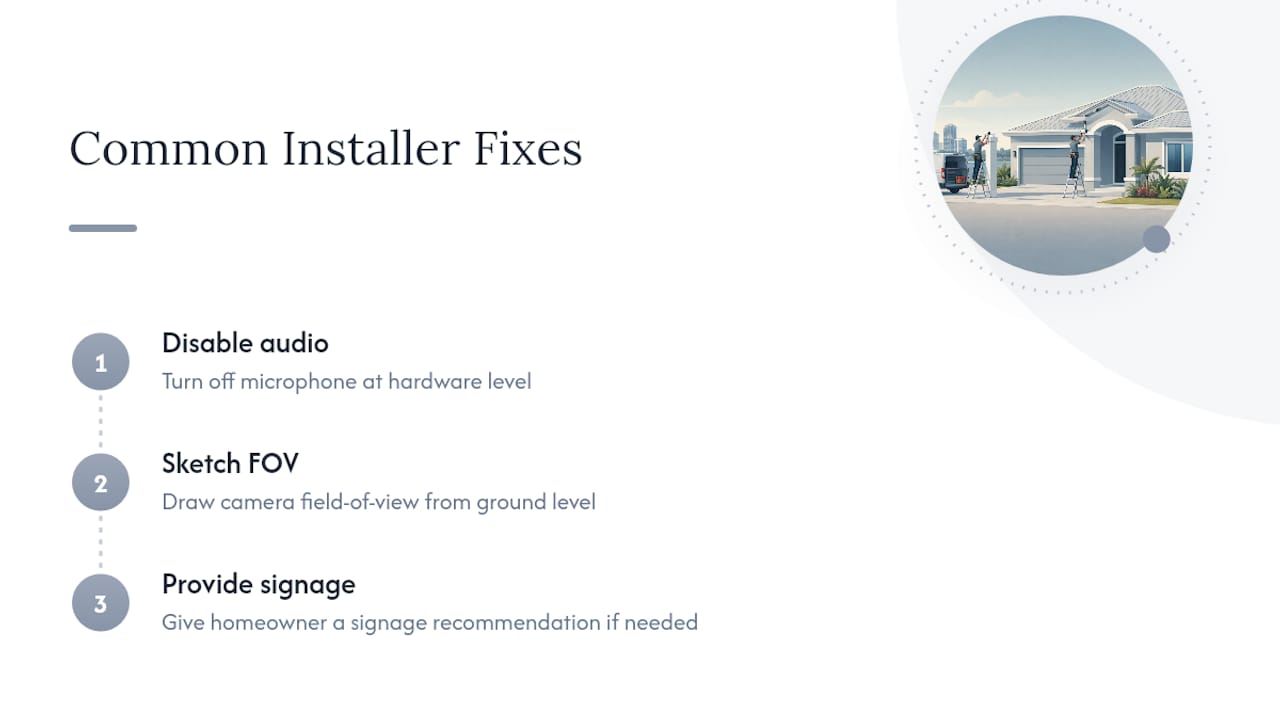
The mistakes are rarely malicious. Homeowners leave a doorbell’s microphone on because it’s the factory default, not because they wanted to record conversations. Cameras get mounted at an angle nobody double-checked from ground level. Nobody keeps a record of where anything points.
The fix is almost always mechanical, not legal. We disable audio at the hardware level during install, sketch a quick field-of-view diagram, and hand the homeowner a signage recommendation if the setup calls for one. It takes minutes and closes most of the exposure before it starts.
— Aaron
Get a Compliant Camera Install Done Right the First Time
Lowvoltagecorp is the alternative to guessing your way through Florida’s surveillance rules. Where a DIY install leaves you configuring privacy zones and consent language on your own, our technicians handle field-of-view planning, hardware audio disables, and documentation as part of the install itself, so you’re not troubleshooting a legal question after the camera’s already on the wall.

We serve homeowners and property managers across South Florida with installation, repair, and maintenance for security cameras, gates, wired and wireless networks, and cell boosters. If you’re planning a new system or want an existing one reviewed for placement and audio settings, start with our security camera wiring guide or request a compliance check on your current setup through our camera placement guidelines page. For related home improvement work, our partners at One Day Doors & Closets serve Broward County homeowners with installation projects that often pair well with a new camera system.
Where to Verify These Rules Yourself
Read the statute text directly at the Florida Senate’s pages for § 810.145 and § 934.03, and the Online Sunshine site for § 877.26. Each is the official government source, not a secondhand summary.
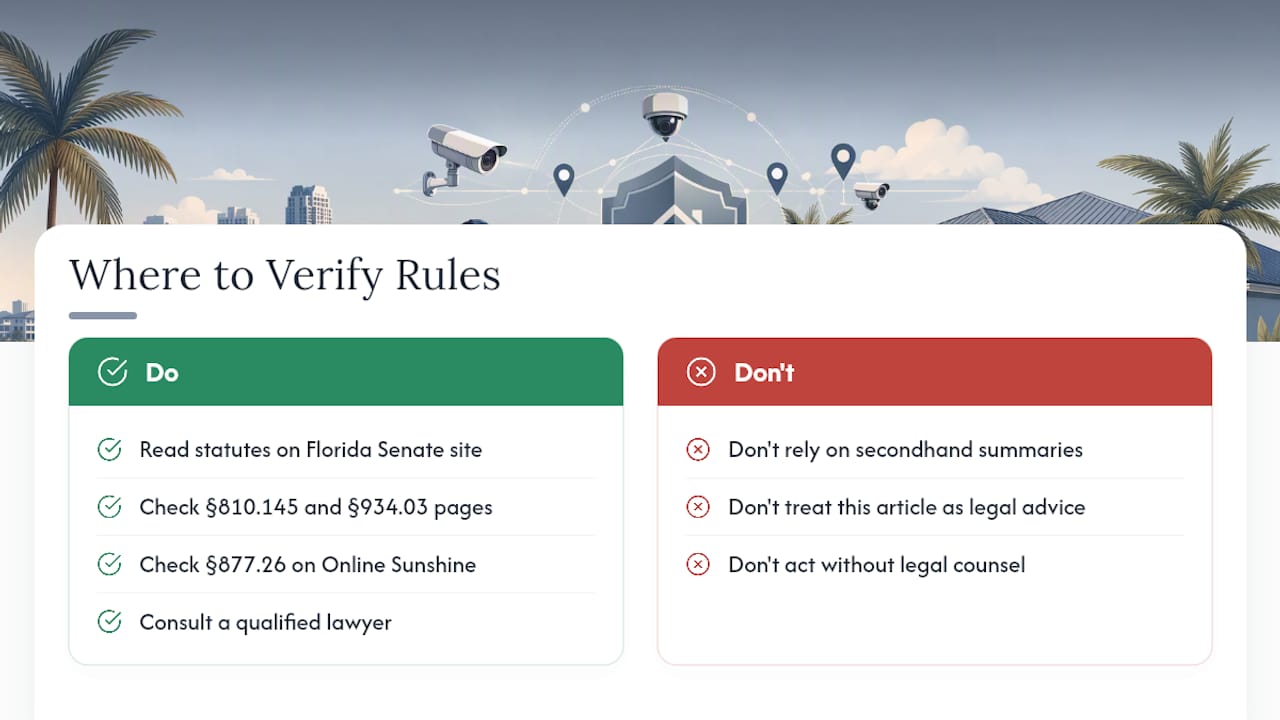
This article is general information, not a substitute for advice from a qualified lawyer. Consult a qualified legal professional about your own circumstances before acting on anything here.
Sources
- Chapter 934 SECURITY OF COMMUNICATIONS; SURVEILLANCE – The Florida Senate
- F.S. 877.26 Direct observation, videotaping, or visual surveillance of customers in merchant’s dressing room, etc., prohibited; penalties. – Online Sunshine
- Ambient