Managing a portfolio of properties with limited staff and zero margin for missed incidents is one of the most persistent challenges in facility management. The advantages of remote monitoring cut directly through that problem. Instead of relying on manual site checks and reactive maintenance calls, you get continuous visibility across every asset, every location, and every potential threat. This article breaks down exactly what those advantages look like in practice, how to evaluate them for your specific portfolio, and what separates a well-implemented system from one that creates more noise than clarity.
Table of Contents
- Key takeaways
- 1. How to evaluate the advantages of remote monitoring for your portfolio
- 2. Real-time centralized visibility across distributed facilities
- 3. Enhanced security and smarter alarm management
- 4. Predictive maintenance and reduced emergency repair costs
- 5. Operational efficiency through better resource allocation
- 6. Scalability and data reliability as portfolios grow
- My honest take on what makes remote monitoring actually work
- How Lowvoltagecorp helps facility managers get this right
- FAQ
Key takeaways
| Point | Details |
|---|---|
| Centralized visibility | Remote monitoring replaces reactive site checks with real-time, portfolio-wide operational awareness. |
| Smarter alarm management | Intelligent filtering reduces false alerts and prevents staff from missing critical events. |
| Predictive maintenance | Early equipment anomaly detection lets you schedule repairs before costly failures occur. |
| Scalable data reliability | Consistent telemetry is non-negotiable. Gaps in data directly reduce your ability to act. |
| Operational cost reduction | Fewer emergency repairs, faster technician dispatch, and optimized work orders lower total facility costs. |
1. How to evaluate the advantages of remote monitoring for your portfolio
Before selecting a system, you need a clear framework for what “better monitoring” actually means in your context. Not every benefit applies equally to every portfolio. A 10-property residential manager has different priorities than a facility director overseeing a mixed-use commercial campus.
Here are the core criteria worth evaluating:
- Operational visibility: Can the system surface anomalies across all sites from a single dashboard, without requiring manual log-ins to individual locations?
- Security enhancement: Does it reduce unauthorized access risks and generate alerts tied to verified events rather than noise?
- Maintenance efficiency: Will it detect equipment degradation early enough to schedule preventive action rather than emergency repair?
- Alarm management: How does the system differentiate between critical alerts and low-priority notifications? Does it protect your team from decision fatigue?
- Scalability: Can the platform grow with your portfolio without degrading data reliability or response times?
- Integration capability: Does it connect with your existing work order systems, access control platforms, or building management software?
Pro Tip: Before committing to any monitoring platform, map out your three most common operational failures from the past 12 months. The right system should address at least two of them directly. If it does not, it is not the right fit.
2. Real-time centralized visibility across distributed facilities
The single most transformative benefit of remote monitoring is the shift from reactive to proactive operations. Instead of dispatching staff to physically check each site, you receive continuous data streams from sensors and connected assets across your entire portfolio.
Continuous sensor data enables early anomaly detection and portfolio-level alert response that manual inspection schedules simply cannot match. A technician visiting a building once per week will never catch an HVAC system trending toward failure mid-cycle. A sensor broadcasting real-time temperature and pressure data will.
This centralized awareness creates several tangible operational advantages:
- Multi-site dashboards aggregate data from all locations into a single interface
- Anomalies trigger alerts the moment thresholds are crossed, not the next time someone walks through the door
- Response teams receive prioritized notifications so critical issues get attention first
- Facility managers can identify patterns across locations, not just individual incidents
The operational model shift is significant. Centralized remote monitoring replaces periodic site checks with a closed-loop system that routes alerts directly to work orders. Your team spends less time on routine checks and more time resolving actual problems.
3. Enhanced security and smarter alarm management
Alarm fatigue is a real operational risk in facility management. When every sensor triggers the same generic notification with the same urgency level, staff begin ignoring alerts. That is when critical events get missed.
“The challenge is not just generating alerts. It is generating the right alerts at the right priority level so your team actually acts on them.”
Research analyzing millions of facility alarms found that alarm burden remains persistently high even when best practices are in place, making intelligent filtering a necessity rather than a luxury.
Here is how smarter alarm management changes security outcomes:
| Without intelligent filtering | With intelligent filtering |
|---|---|
| All alerts treated as equal urgency | Alerts tiered by severity and operational impact |
| High false-alert volume | False alerts filtered before reaching staff |
| Staff desensitized to notifications | Staff respond to verified, meaningful alerts |
| Critical events buried in noise | Critical events surface immediately |
| Slower response times | Faster, more targeted responses |
Technology-based alert routing reduces cognitive burden on your team while actually strengthening your security posture. When your staff trust that an alert means something real, response rates and response quality both improve. Paired with quality security camera installation, intelligent alarm filtering turns your monitoring system into a genuine security asset rather than a source of constant background noise.
4. Predictive maintenance and reduced emergency repair costs
Unplanned equipment failures are expensive. Not just in repair costs, but in the lost productivity, tenant complaints, and emergency contractor rates that come with them. Remote monitoring addresses this directly through early detection of equipment degradation before failures occur.
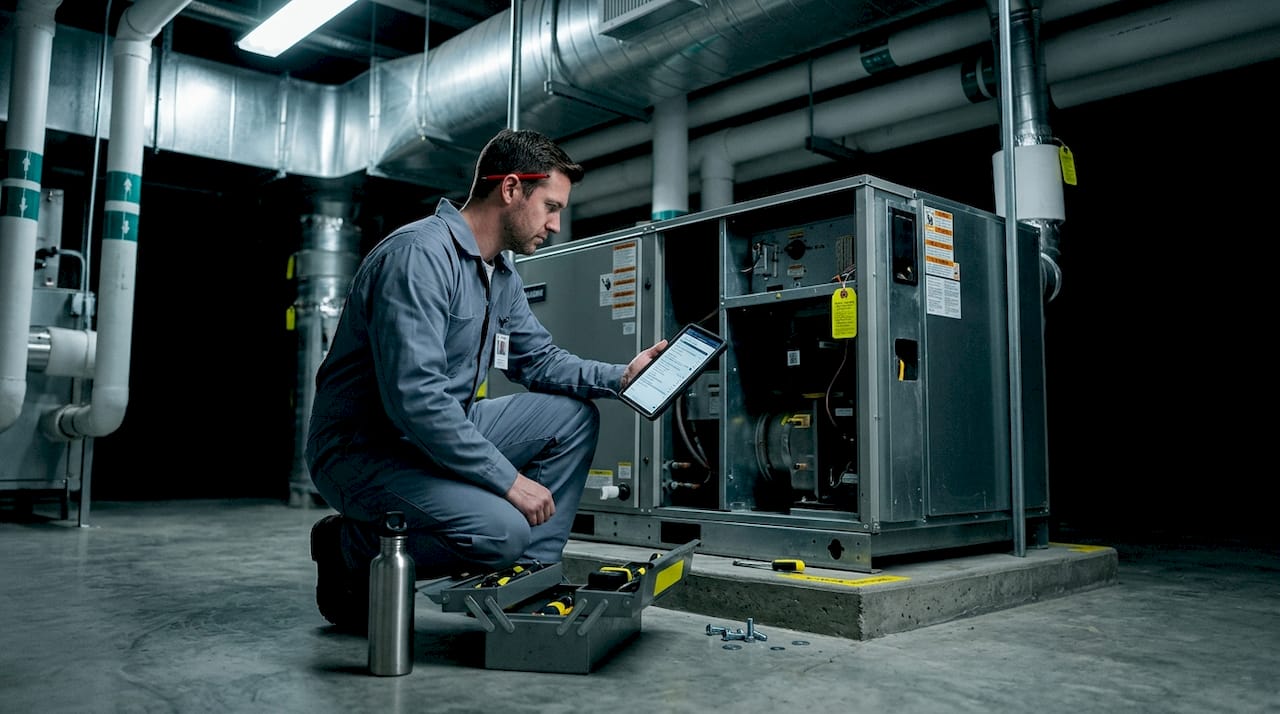
Continuous monitoring data helps facility teams schedule maintenance at optimal intervals rather than waiting for breakdowns. A water pump showing abnormal vibration readings, a compressor running hotter than its baseline, or a circuit drawing more current than normal. These are all signals that a traditional inspection cycle would likely miss.
The maintenance advantages compound over time:
- Early detection of mechanical wear reduces parts replacement costs
- Scheduled maintenance windows cost a fraction of emergency after-hours repairs
- Fewer equipment failures mean fewer tenant disruptions and complaint tickets
- Maintenance histories stored in the system support better capital planning decisions
Pro Tip: Set baseline performance parameters for your critical equipment during the first 30 days after installation. Any deviation beyond a defined threshold should trigger a low-priority alert for your maintenance team. This gives you an early-warning system calibrated to your specific assets, not generic industry averages.
Beyond individual equipment health, remote monitoring optimizes technician dispatch by routing the most urgent work orders first. Your team spends less time traveling to low-priority locations and more time resolving issues that actually affect building performance.
5. Operational efficiency through better resource allocation
The role of remote monitoring goes well beyond surveillance. It fundamentally changes how facility teams allocate their time and labor. When every alert comes with context, including which asset triggered it, what the severity level is, and what the recommended response is, your staff can make faster decisions with better outcomes.
Structured alarm prioritization means teams address the most severe issues first, which improves overall productivity and asset reliability across the portfolio. Rather than dispatching a technician based on a vague report from a tenant, you send them with a specific diagnosis and the right equipment.
This efficiency extends to reporting as well. Automated data logs replace manual inspection reports, freeing up management time for higher-value work. Portfolio-level dashboards give you the information you need for board reports, insurance documentation, and regulatory compliance without additional data collection effort.
6. Scalability and data reliability as portfolios grow
One of the less-discussed pros of remote monitoring systems is scalability. A system that works well for five properties needs to work just as well for fifty. That requires consistent data transmission and reliable telemetry from every connected device.
Here is what to verify before scaling your monitoring infrastructure:
- Data cadence: Confirm that sensors transmit readings at adequate frequency. Insufficient data frequency reduces your ability to detect and respond to developing issues in time.
- Redundant connectivity: If your primary network connection fails, does the system fail over to a backup? A monitoring gap during a security incident is a serious vulnerability.
- Device compatibility: As you add properties, will new devices integrate cleanly with your existing platform, or will you manage multiple disconnected systems?
- Data completeness: Gaps in telemetry reduce operational value. Missing data points are not neutral. They are blind spots that carry real risk.
- Platform support: Does your vendor offer account management or technical support scaled to your portfolio size?
Investing in reliable network wiring at each property before deploying monitoring hardware is one of the most practical steps you can take to protect data reliability at scale. A monitoring system is only as good as the connection carrying its data.
My honest take on what makes remote monitoring actually work
I have seen property managers invest in monitoring systems and walk away frustrated six months later. Not because the technology failed. Because the implementation did.
The most common mistake is treating remote monitoring as a passive tool. You install the cameras and sensors, set up the alerts, and assume the system will do the work. It will not. The benefits of remote monitoring only materialize when alerts are mapped to specific response procedures and routed to the people who can act on them.
Alert prioritization is not optional. I have worked with teams that received hundreds of notifications per day with no differentiation between a door sensor triggering in a supply closet and a fire alarm in the mechanical room. The result is that staff tune everything out. Critical events get missed. The system becomes expensive background noise.
What actually works is treating monitoring data as an input to your operational workflow, not a separate system running in parallel. When alerts map directly to SOPs and route to the right team automatically, response times drop and outcomes improve. That is when facility managers start talking about ROI. Not when the cameras go up.
If you are evaluating a remote monitoring solution right now, ask your vendor one question: how does your platform differentiate between alert types and route them to the appropriate responders? If they cannot answer that clearly, keep looking.
— Aaron
How Lowvoltagecorp helps facility managers get this right
Getting the technology right from the start saves you from expensive retrofits and system replacements later. Lowvoltagecorp specializes in the installation, repair, and maintenance of security cameras, wired and wireless networks, motorized gates, and cell boosters across South Florida properties. Every service is designed with facility and property managers in mind.
Whether you are upgrading aging camera infrastructure, improving network reliability to support monitoring at scale, or adding access control to high-traffic entry points, Lowvoltagecorp delivers solutions calibrated to your portfolio size and operational priorities. Explore cost-saving security upgrades built specifically for South Florida property owners, or review energy-efficient security tips to reduce operational costs while strengthening your monitoring setup. Reach out to discuss a solution built around your specific properties.
FAQ
What are the main advantages of remote monitoring for facility managers?
The main advantages include real-time portfolio visibility, smarter alarm management, predictive maintenance, and reduced operational costs. These benefits replace reactive management with a proactive, data-driven approach to facility operations.
How does remote monitoring reduce security risks?
Remote monitoring uses continuous sensor data and intelligent alert filtering to surface verified threats while suppressing false alarms. This gives security teams faster, more accurate information to act on without the distraction of constant low-priority notifications.
What is alarm fatigue and how does remote monitoring address it?
Alarm fatigue occurs when staff receive too many undifferentiated alerts and begin ignoring them. Remote monitoring systems address this through tiered alert prioritization that routes critical notifications separately from routine ones, keeping staff focused on genuine threats.
How scalable are remote monitoring systems for growing property portfolios?
Modern remote monitoring platforms are designed to support multiple sites and devices, but scalability depends on reliable data transmission and network infrastructure at each property. Verifying data cadence and connectivity redundancy before expanding is critical to maintaining monitoring quality.
Does remote monitoring lower maintenance costs?
Yes. By detecting equipment anomalies early, remote monitoring allows maintenance teams to schedule repairs before failures occur. This reduces emergency repair costs, after-hours contractor rates, and tenant disruption significantly over time.