Low voltage systems are quietly running the modern world, and most people don’t realize just how much they depend on them. The applications of low voltage span everything from the security camera watching your front door to the structured cabling powering your office network. Yet the common assumption is that low voltage means simple, limited, or unimportant. That assumption is wrong. These systems drive security, connectivity, automation, and efficiency across homes, businesses, and industrial facilities. This article breaks down what low voltage actually does in practice, where it’s headed, and why professionals who ignore it fall behind.
Table of Contents
- Key takeaways
- Applications of low voltage: the foundation
- Residential and commercial uses of low voltage
- Industrial and infrastructure applications
- Innovations shaping low voltage technology
- My take on low voltage after years in the field
- Work with Lowvoltagecorp for your low voltage needs
- FAQ
Key takeaways
| Point | Details |
|---|---|
| Low voltage covers more than you think | Systems under 50 V AC power security cameras, data networks, lighting, and automation across residential and commercial buildings. |
| Safety and efficiency go hand in hand | Low voltage reduces shock and fire risk while consuming significantly less energy than standard power circuits. |
| PoE is reshaping deployment | Power over Ethernet delivers both power and data over one cable, simplifying installation for cameras, access points, and IoT devices. |
| Industrial use is growing fast | Switchgear, building automation, and PLCs all rely on low voltage technology to control large-scale infrastructure. |
| Professional installation matters | Correct wiring standards and code compliance directly affect system reliability, safety, and long-term performance. |
Applications of low voltage: the foundation
Before understanding where low voltage technology goes, you need to understand what it actually is. Low voltage generally describes circuits operating at roughly 50 V AC or less, or about 120 V DC or less. These circuits handle controls and communications rather than general power delivery.
That distinction matters more than people realize. Definitions vary by jurisdiction and code, so the applicable regulatory framework always needs to be confirmed before installation. In the U.S., NEC Article 725 governs Class 1, Class 2, and Class 3 remote-control, signaling, and power-limited circuits. Class 2 wiring, for example, caps out at 100 VA and uses those limits to reduce fire and shock hazards without the same conduit and insulation requirements as full-power wiring.
Why do low voltage systems dominate in control and communication? Because lower voltages mean safer environments for installers and end users, less infrastructure overhead, and better compatibility with sensitive electronics like sensors, controllers, and microprocessors.
Pro Tip: When planning any low voltage installation, always verify which NEC article or local amendment applies to your specific circuit type. Misclassifying a circuit can create code violations that cost far more to fix after the fact.
Key regulatory and safety benefits include:
- Reduced risk of electrical shock during installation and maintenance
- Lower fire risk from insulation breakdown or accidental contact
- Lighter, more flexible cable options that simplify runs through walls and conduit
- Compatibility with data, control, and sensor devices that require stable, low-power input
- Easier permitting in many jurisdictions compared to high-voltage work
Residential and commercial uses of low voltage
This is where most people encounter low voltage technology directly, even if they don’t recognize it. Common low-voltage systems in homes and businesses include CCTV cameras, doorbells, fire alarms, data networks, access control, HVAC controls, and landscape lighting. All of them typically operate under 50 volts.
Here are the major residential and commercial low voltage applications examples that define modern buildings:
-
Security cameras and access control. IP cameras and card readers run on low voltage circuits, often powered directly through PoE. They give property owners real-time visibility and controlled entry without running dedicated high-voltage circuits to every device location.
-
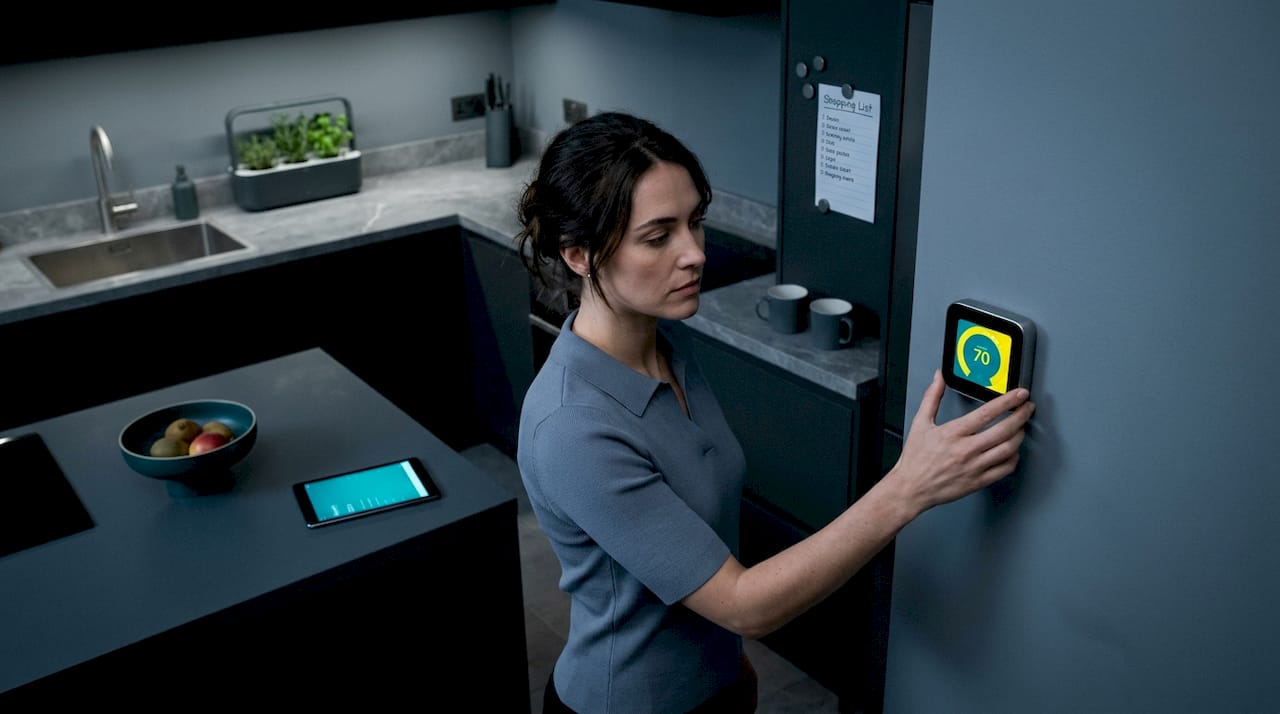
Smart home automation. Thermostats, motorized shades, smart lighting switches, and video doorbells all operate on low voltage. A Z-Wave thermostat running at 24 V or a Ring doorbell running on existing low-voltage doorbell wiring represents how is low voltage used in everyday consumer products.
-
Structured cabling and data networks. Structured cabling for data transmission uses twisted pair and Ethernet cables as the backbone of modern communication in homes and offices. Cat6 and Cat6A runs feeding workstations, wireless access points, and IP phones are all low voltage circuit applications in practice. Check out low voltage cable types to understand which cabling works best for each scenario.
-
Low voltage lighting applications. Landscape lighting, under-cabinet LED strips, and pathway fixtures running at 12 V or 24 V DC are among the clearest applications in low voltage lighting. They consume a fraction of the energy of line-voltage fixtures and are far safer to work around in wet or outdoor areas.
-
Motorized gates. Residential and commercial gate operators use low voltage control wiring to connect keypads, loop detectors, safety sensors, and remote receivers back to the gate controller board.
-
Cell signal boosters. A cell booster system runs its interior antennas and amplifier on low voltage DC power, often drawing under 3 amps at 12 to 15 V.
Pro Tip: If you’re retrofitting a home or commercial space with security cameras or smart devices, map your data network first. Running Cat6 alongside the camera cable during the same pull saves hours of work compared to going back later.
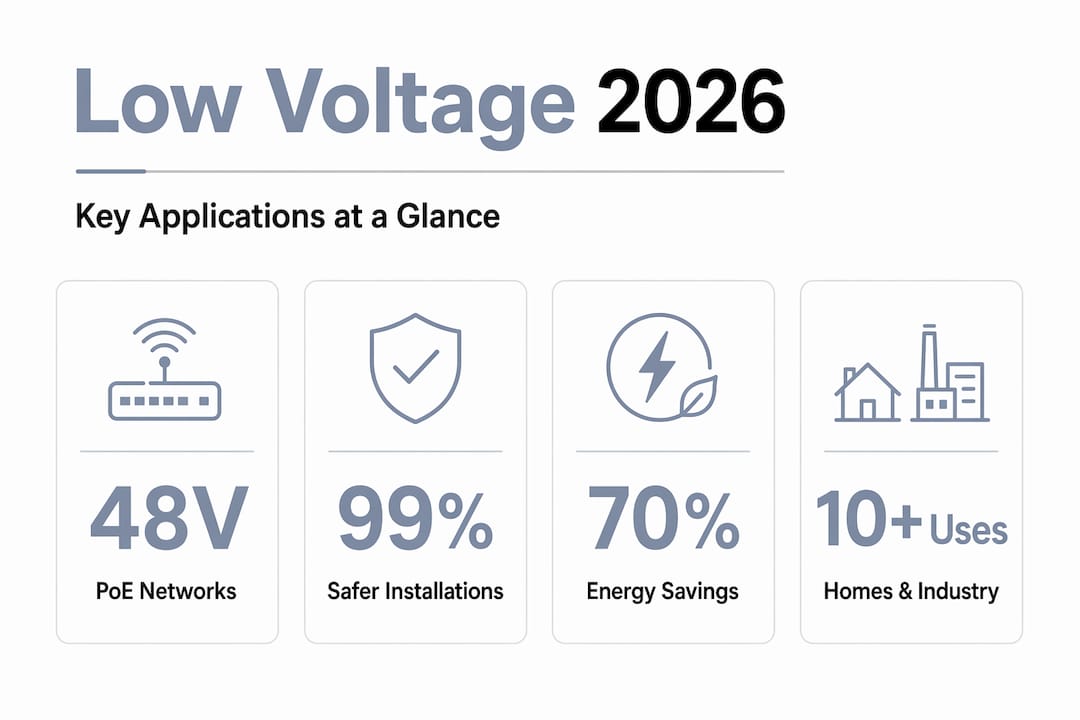
Low-voltage systems improve safety by reducing the risk of severe shock and fire, are energy efficient, require less infrastructure, and support smart home integration and renewable energy. That combination of benefits explains why so many modern building systems have migrated to low voltage infrastructure over the past decade.
Industrial and infrastructure applications
Low voltage technology scales up dramatically in industrial and infrastructure settings, and this is where most people underestimate its reach. Low voltage technology spans diverse installer workflows covering security, fire alarms, broadband infrastructure, and home entertainment, making it far broader than a niche specialty.
Low voltage switchgear and power distribution
Low voltage switchgear is used for power distribution, control, and protection in factories, commercial buildings, data centers, and infrastructure. These systems are designed for circuits up to about 1000 V, supporting 230 V residential and 400 V industrial systems with stable power distribution. Switchgear panels contain breakers, fuses, contactors, and metering equipment that protect downstream equipment and isolate faults without shutting down an entire facility.
Building automation and PLCs
Programmable logic controllers (PLCs) use low voltage signal wiring to monitor sensors, control actuators, and automate HVAC, lighting, and access systems in large commercial buildings. The control wiring running to sensors and output devices operates at 24 V DC or 24 V AC in most modern systems, keeping the control layer safely separated from the line-voltage equipment it manages.
Here is a comparison of common industrial low voltage systems by use case:
| System | Operating voltage | Primary function |
|---|---|---|
| PLC control wiring | 24 V DC | Sensor input, actuator output, automation logic |
| Fire alarm circuits | 24 V DC | Detection, notification, suppression triggering |
| Low voltage switchgear | Up to 1000 V AC | Power distribution and fault protection |
| Building automation | 24 V AC/DC | HVAC, lighting, and access control |
| Data center cabling | 1 to 48 V DC | Signal transmission and PoE device power |
Additional industrial low voltage applications examples worth noting:
- Renewable energy integration, where inverters and charge controllers use low voltage DC buses before stepping up to grid voltage
- Voltage regulation in low-voltage grids to stabilize power in areas stressed by solar feed-in or EV charging, without requiring expensive cable reinforcement
- Fire alarm systems in commercial buildings, which depend entirely on supervised low voltage circuits to detect faults and trigger response
Innovations shaping low voltage technology
The most significant shift happening right now in low voltage technology is the expansion of Power over Ethernet (PoE). PoE delivers power and data over a single Ethernet cable at 48 V DC, supporting IP cameras, wireless access points, VoIP phones, and industrial human-machine interfaces (HMIs). PoE standards range from 15.4 W for basic PoE all the way to 60 to 90 W for PoE++, which opens the door to more demanding devices.
That matters for anyone installing security systems or networks today. A PoE-powered camera needs only one cable run. No separate power outlet, no junction box, no AC adapter. The switch does the work.
PoE supports high-power applications in industrial and commercial deployments, including IoT gateways and edge computing devices, giving facilities a scalable path to smart network infrastructure without tearing into walls for additional power circuits.
Beyond PoE, several trends are pushing low voltage technology further:
- Smart city integration. Streetlights, traffic sensors, environmental monitors, and parking systems increasingly run on low voltage circuits tied to centralized management platforms.
- Edge computing. Low voltage IoT devices at the network edge process data locally, reducing latency and bandwidth requirements for facilities management.
- Wireless low voltage protocols. Zigbee, Z-Wave, and Thread operate within low power radio bands, extending low voltage concepts into wireless home and building automation without traditional wiring.
- Energy monitoring. Low voltage current sensors and sub-metering equipment let commercial buildings track consumption at the circuit level, supporting sustainability reporting and cost reduction.
- EV charging infrastructure. Control and communication circuits in EV charging stations rely on low voltage signal wiring for user authentication, session management, and grid communication.
If you’re managing a property or planning a new installation, network wiring for connectivity is a practical starting point for understanding how today’s structured cabling supports all of these converging technologies.
My take on low voltage after years in the field
I’ve worked with these systems long enough to know that low voltage gets dismissed in conversations where it absolutely shouldn’t be. People focus on the panel, the conduit, the service entrance. Then they treat the low voltage side like an afterthought, and that’s where installs fall apart.
The camera system that goes offline every time it rains. The gate that stops responding because a control wire wasn’t terminated cleanly. The office network running on bargain cable that can’t sustain gigabit speeds. Every one of those problems traces back to someone not taking the low voltage work seriously enough during the build-out.
What I’ve learned is that the most expensive low voltage mistakes aren’t equipment choices. They’re planning failures. Running the wrong cable for the distance, skipping conduit in a location that needs it, and not labeling anything. These seem like small calls in the moment. They become very large problems six months later when something needs to be diagnosed or expanded.
The other thing I’d push back on is the idea that low voltage work is easy enough to DIY or outsource to whoever is cheapest. The code requirements, the system integration complexity, and the performance expectations for modern security and network systems have all gone up. This work rewards people who stay current on the technology and take the installation seriously from day one.
For anyone managing property or running a facility, investing in quality low voltage installation upfront saves real money. Not eventually. Now, in reduced callbacks, fewer outages, and systems that actually do what they’re supposed to do.
— Aaron
Work with Lowvoltagecorp for your low voltage needs
If you’ve been weighing an upgrade to your security, networking, or gate systems, the practical uses of low voltage technology covered in this article only deliver results when the installation is done correctly. Lowvoltagecorp specializes in exactly this work across South Florida, including security camera installation, motorized gate systems, wired and wireless networks, and cell signal boosters.
Whether you need a single camera added to an existing system or a full structured cabling overhaul for a commercial property, the team at Lowvoltagecorp handles it with the right tools and code-compliant methods. Check out security upgrade options to see how property owners are reducing costs while improving protection. For connectivity, wired network solutions covers the specific advantages of hardwired low voltage infrastructure for South Florida properties.
FAQ
What are the most common applications of low voltage?
The most common applications include security cameras, access control systems, data networks, smart home devices, fire alarms, landscape lighting, and cell signal boosters. All of these typically operate under 50 V AC and are governed by NEC Article 725 in the United States.
How is low voltage used in smart home systems?
Low voltage powers thermostats, video doorbells, smart lighting controls, motorized shades, and wireless access points in smart home setups. Most of these devices run on 12 to 24 V DC or receive power through PoE from a network switch.
What is Power over Ethernet and why does it matter?
Power over Ethernet (PoE) delivers both electrical power and data over a single Ethernet cable at 48 V DC, eliminating the need for separate power outlets at each device. It supports IP cameras, wireless access points, and IoT devices with power ranging from 15.4 W to 90 W depending on the PoE standard used.
What is the difference between low voltage and line voltage?
Line voltage refers to standard household circuits running at 120 or 240 V AC, used for appliances and general power outlets. Low voltage circuits operate at 50 V AC or less and are used for communications, control, and signal applications where full line voltage is unnecessary and less safe.
Can low voltage systems support industrial applications?
Yes. Low voltage switchgear, PLCs, fire alarm systems, and building automation all operate on low voltage signal and control circuits in industrial and commercial facilities. These systems manage equipment running at much higher voltages while keeping the control layer safe and accessible for technicians.