The role of network redundancy is simple: it keeps critical traffic moving when a piece of your network fails, by giving that traffic an alternate path or system to use instead. That’s the whole job. Downtime is not cheap. Industry estimates routinely put enterprise outage costs at thousands of dollars per minute, and a single failed switch or severed fiber line shouldn’t be able to take down a property’s cameras, gate access, or building network for hours.
Done right, redundancy delivers three concrete wins:
- Minimizes downtime by rerouting traffic the instant a link or device fails
- Protects revenue and operations that depend on cameras, access control, and connectivity staying live
- Allows maintenance without an outage window, since you can service one path while the other carries load
The tradeoff is real: redundancy adds cost and complexity, and it only works if you actually test it. A backup you’ve never failed over to on purpose is a backup you don’t actually have. Practitioners at Low Voltage Corp see this constantly on commercial properties across South Florida, where a “redundant” second circuit turns out to share the same conduit as the primary one.
Key Takeaways
Network redundancy keeps critical services online by giving traffic an alternate path the moment a primary component fails, but only if that path is genuinely diverse and regularly tested.
| Point | Details |
|---|---|
| Redundancy vs. resiliency | Redundancy duplicates hardware or paths; resiliency is self-recovery that doesn’t always need duplicate parts. |
| Match architecture to risk | Use active-active or N+1 for critical sites, active-passive or DIA plus LTE for branches. |
| Verify real diversity | Request carrier route maps and dual-entry confirmation before trusting a “redundant” circuit. |
| Test on a fixed cadence | Run monthly planned failovers and quarterly unannounced ones to confirm backups actually work. |
| Watch for over-redundancy | Too many BGP paths can slow convergence, so simpler, verified designs beat piling on links. |
Table of Contents
- Network Redundancy Explained: How It Differs From Resiliency and Backup
- Types of Network Redundancy: Matching Architecture to Risk
- Designing True Redundancy: Diversity Rules That Actually Hold Up
- Failover Protocols and Tools: What Actually Triggers the Switch
- Testing Network Redundancy: The Cadence That Separates Real Protection From False Confidence
- Common Pitfalls: Where Redundancy Plans Break Down
- A Practitioner’s Checklist for Site Surveys and Ongoing Maintenance
- What the Data Actually Supports, and What It Doesn’t
- Frequently Asked Questions
- Sources
Network Redundancy Explained: How It Differs From Resiliency and Backup
These three terms get used interchangeably, and that’s where a lot of budget gets wasted. Network redundancy means duplicating physical or logical infrastructure, extra hardware or extra paths, so a failure has somewhere to fail over to. A second firewall sitting idle until the primary drops is redundancy. A second ISP circuit terminating at your building is redundancy.
Resiliency is a different concept. It refers to a system’s ability to detect a problem and recover on its own, sometimes without any duplicate components at all. TechTarget draws this distinction clearly: resiliency is about self-healing behavior, while redundancy is about having a spare part ready to take over.
Backup is neither of those. Backup protects data, not uptime. You can have a perfect nightly backup of your access control database and still lose all camera coverage for six hours because you have no redundant network path.
Here’s why the distinction matters in practice:
- Dual firewalls address redundancy (hardware failover)
- Redundant ISP circuits address redundancy (path failover)
- Dual NICs on a server address redundancy (interface failover)
- None of these protect a single byte of data if a drive fails
When you’re budgeting for uptime, redundancy is what shows up in your Recovery Time Objective (RTO), how fast service resumes, and it works alongside your Recovery Point Objective (RPO), which governs data loss tolerance. They’re related metrics but solve different problems.
Types of Network Redundancy: Matching Architecture to Risk
Not every site needs the same level of protection, and buying more redundancy than a location warrants is just as much a mistake as buying too little. Four architectures cover most real-world deployments:
- Active-active: Both circuits or devices carry live traffic simultaneously, splitting the load. If one fails, the other absorbs everything with no failover delay. This fits mission-critical sites, headquarters, data centers, anywhere an outage is unacceptable even for seconds.
- Active-passive: One path carries traffic while a second sits in hot standby, ready to take over. It’s cheaper than active-active but introduces a failover window, however brief, and the standby path can sit unused (and untested) for months.
- N+1 redundancy: You provision one extra unit beyond what’s needed to run the load, common in data center power and cooling, and increasingly in network gear at colocation facilities. It tolerates a single failure without scrambling for emergency hardware.
- Geographic or site redundancy: Infrastructure is duplicated at a physically separate location entirely. This is what disaster recovery actually requires, since a fire, flood, or regional outage takes out everything at one site regardless of how many redundant circuits terminate there.
According to SociumIT’s architecture guide, most enterprises land on some mix of active-active, active-passive, and N+1 depending on the site’s criticality, and small branch locations often do fine on a simpler pattern, a primary Direct Internet Access (DIA) circuit backed by LTE, that a headquarters building would never rely on alone.
Designing True Redundancy: Diversity Rules That Actually Hold Up
This is where most redundancy plans quietly fail. You can pay for two circuits and still have zero real protection if both run through the same conduit under the parking lot. True diversity means physically separate paths, separate carriers where possible, and separate points of entry into the building.
Verify diversity before you sign anything:
- Request carrier route maps showing the physical path each circuit takes
- Confirm dual building entry points, not two cables entering through the same sleeve
- Ask about Shared Risk Link Groups (SRLGs), the technical term for infrastructure that looks separate on paper but fails together
- Get written diversity confirmation from the carrier, not a verbal assurance from a sales rep
Cisco’s high-availability guidance treats SRLG-awareness as a baseline requirement for any redundancy claim to be credible, not a nice-to-have for large enterprises only.
Mixing transport types adds another layer of protection. Fiber, cable broadband, and LTE or 5G rarely fail from the same root cause, so combining them reduces correlated failure risk in a way that two fiber circuits from the same provider never will. That’s also why SD-WAN solutions have become popular for tying mixed transports together intelligently.

Expect to pay for it. SociumIT’s data puts the added connectivity spend for genuine redundancy 40% to 80% higher than a single-path setup, depending on the architecture. Budget it in tiers: full active-active diverse DIA for headquarters, active-passive with LTE backup for branch offices, and document every diversity confirmation in the service contract itself, not just in an email thread that gets lost.
Failover Protocols and Tools: What Actually Triggers the Switch
Redundant hardware is useless without a mechanism that detects failure and reroutes traffic automatically. A few technologies do most of the work here.
HSRP and VRRP operate at the control-plane level, letting two routers or firewalls share a virtual IP address so one can silently take over if the other goes dark. Clustering does something similar for load balancers and firewalls, keeping session state synchronized so users don’t get logged out mid-failover.
BGP handles path redundancy across ISPs, but more paths isn’t automatically better. Cisco’s own high-availability research warns that excessive redundant BGP paths increase route processing overhead and can delay convergence, the exact opposite of what redundancy is supposed to deliver. The fix is disciplined design: limit unnecessary path propagation and test convergence under simulated failures rather than assuming more routes equals more safety.
SD-WAN sits above all of this as an overlay, offering application-aware routing and failover that’s often sub-second. But per SociumIT, SD-WAN still depends on genuinely diverse transport underneath it; it can’t manufacture diversity that doesn’t physically exist.
Link Aggregation (LACP) bundles multiple physical connections between two devices so a single cable or port failure doesn’t drop the link entirely.
- HSRP/VRRP: router and firewall-level failover
- BGP: ISP and path-level failover, tune carefully
- SD-WAN: application-aware overlay across mixed transports
- LACP: device-level link bundling
Pro Tip: Before you sign off on any BGP-based redundancy design, ask your provider to run a simulated path failure and show you the actual convergence time. “It should fail over automatically” is not a test result.
Testing Network Redundancy: The Cadence That Separates Real Protection From False Confidence
A redundant path nobody has ever tested is a hope, not a plan. Domotz’s research on IT infrastructure resilience points out that a lot of organizations are paying for backup connectivity that has never actually been forced to carry live traffic.
A workable testing cadence looks like this:
- Weekly automated health checks on all redundant links, confirming they’re up and reachable
- Monthly planned failovers, deliberately taking down the primary path during a low-traffic window to confirm the backup takes over cleanly
- Quarterly unannounced failovers, testing whether staff and systems respond correctly without advance warning
- Annual full disaster recovery run, simulating a complete site failure to validate geographic redundancy end to end
Monitoring in between tests matters just as much as the tests themselves. Track latency, packet loss, interface errors, and route flaps, with alert thresholds tuned so a degrading backup path gets flagged before it’s needed, not after. Selector’s guidance on redundancy strategies emphasizes topology-aware observability specifically because silent failures on backup paths are common and easy to miss.
Every test needs a runbook: confirm the new path actually carries traffic, check that active sessions survive the switch, verify DNS resolves correctly, and run a real application-level check, not just a ping. Document what broke and fix it before the next test.
Pro Tip: Log every failover test in a simple spreadsheet: date, what failed, what worked, what didn’t. After three or four cycles, patterns emerge that tell you exactly which link is degrading before it fails for real.
Common Pitfalls: Where Redundancy Plans Break Down
False diversity tops the list. Two circuits that look separate on an invoice but run through the same trench or splice point will fail together, and Cisco’s high-availability documentation calls this out as one of the most frequent causes of redundancy failing when it’s actually needed.
Over-redundancy is the opposite mistake. Piling on extra BGP paths without discipline inflates route tables and slows convergence, destabilizing the very control plane you’re trying to protect.
Untested backups and stale configs rot quietly. A firewall failover rule that worked at installation can break after a firmware update nobody validated against the redundant path.
The fix across all three: keep the design as simple as the site’s risk tolerance allows, document every diversity claim, monitor continuously, and automate what you can. Complexity you can’t verify is not protection, it’s a liability wearing a protection costume.
A Practitioner’s Checklist for Site Surveys and Ongoing Maintenance
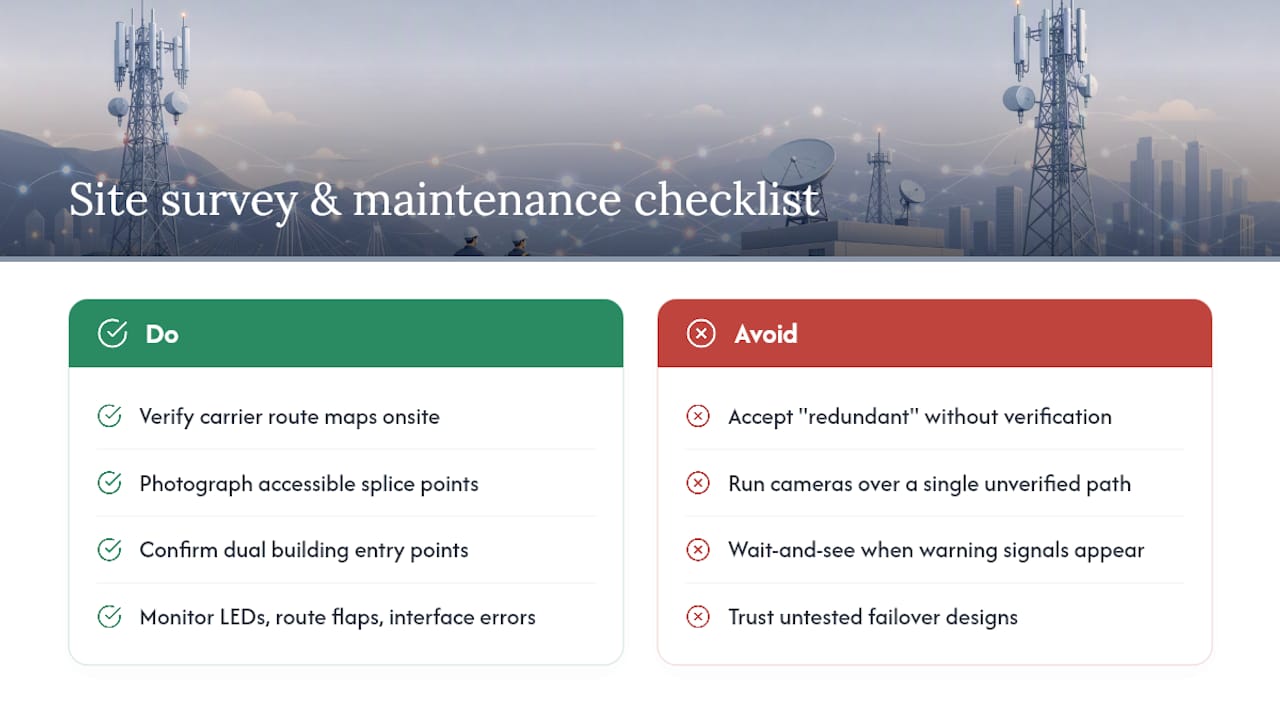
Low Voltage Corp’s field teams treat redundancy verification as a physical inspection, not a paperwork exercise. A proper site survey includes carrier route maps, photographs of splice points where accessible, and confirmed dual building entry points before anyone signs off on a “redundant” design. Our network installation guidance for IT professionals covers the cabling and entry-point questions worth asking before a contract is finalized.
On the maintenance side, three signals tend to precede a redundant path failing when you actually need it: irregular LED patterns on switch or router interfaces, repeated route flaps in the logs, and a rising count of interface errors. Any one of those is worth a service call, not a wait-and-see.
For a small branch office, DIA paired with LTE backup covers most risk at a reasonable cost. Once that site starts handling access control, video storage, or anything the business can’t operate without for even an hour, it’s time to escalate to dual diverse DIA.
If your property’s cameras or gate access run over a single unverified path, that’s the gap worth closing first. Security camera wiring done right starts with the same diversity questions covered above, before a single camera ever gets mounted.
Redundant infrastructure only earns its cost when someone verifies it, monitors it, and tests it on a real schedule, which is exactly the gap a qualified low-voltage contractor is built to close. If your South Florida property’s cameras, gates, or network connectivity run on a path nobody has stress-tested, Low Voltage Corp can survey your existing setup, confirm real diversity, and build a failover design sized to what your building actually needs, not an overbuilt system you’re paying too much for or a fragile one you’re trusting too much.
What the Data Actually Supports, and What It Doesn’t
The conventional advice on redundancy treats it like insurance: buy it, forget it, feel safer. That framing is backward. Redundant hardware that’s never failed over on purpose is closer to a lottery ticket than insurance, you’re hoping it pays out, but nobody’s checked whether it can.
What the research here actually supports is that testing discipline matters more than architecture choice. A site with a modest active-passive setup that gets failed over every month will outperform a site with an elaborate active-active design nobody has touched since installation. The hardware isn’t the hard part. The operational habit of proving it works is.
I’d also push back on the instinct to over-engineer small sites. Not every branch office needs dual diverse DIA. A well-monitored DIA-plus-LTE setup, tested on schedule, beats an expensive redundant design that’s poorly maintained. Spend the premium budget where an outage actually costs something, headquarters, data centers, anywhere access control or surveillance can’t tolerate a gap, and keep the rest simple enough that your team can verify it without a consultant.
If you take one thing from all of this: schedule your first failover test before you finish reading the vendor’s redundancy pitch. The design matters less than proof it works.
Frequently Asked Questions
What is the primary role of network redundancy?
The role of network redundancy is to keep critical services running when a network component fails, by rerouting traffic to a duplicate path, device, or circuit automatically or through a quick manual failover.
How does network redundancy work in practice?
A protocol like HSRP, VRRP, or BGP detects that a primary path has failed and shifts traffic to a standby or parallel path, often within seconds if the failover is properly configured and tested.
What’s the difference between network redundancy and network resiliency?
Redundancy duplicates hardware or paths so there’s a backup to fail over to. Resiliency is a system’s built-in ability to detect problems and recover, which doesn’t always require any duplicate equipment at all.
Do small businesses need the same redundancy as large enterprises?
No. A small branch site typically does fine with a primary DIA connection backed by LTE, while headquarters or data center environments that can’t tolerate any downtime usually justify dual diverse DIA in an active-active setup.
How often should redundant network paths be tested?
A solid cadence includes weekly automated health checks, monthly planned failovers, quarterly unannounced failovers, and an annual full disaster recovery test to confirm every layer of redundancy actually works.
Sources
- Network redundancy vs. resiliency: What’s the difference? | TechTarget
- Architectural Best Practices for Ensuring High Availability (Cisco Live BRKSPG-2080)
- Enterprise Network Redundancy Guide 2026: Architectures & Best Practices | SociumIT