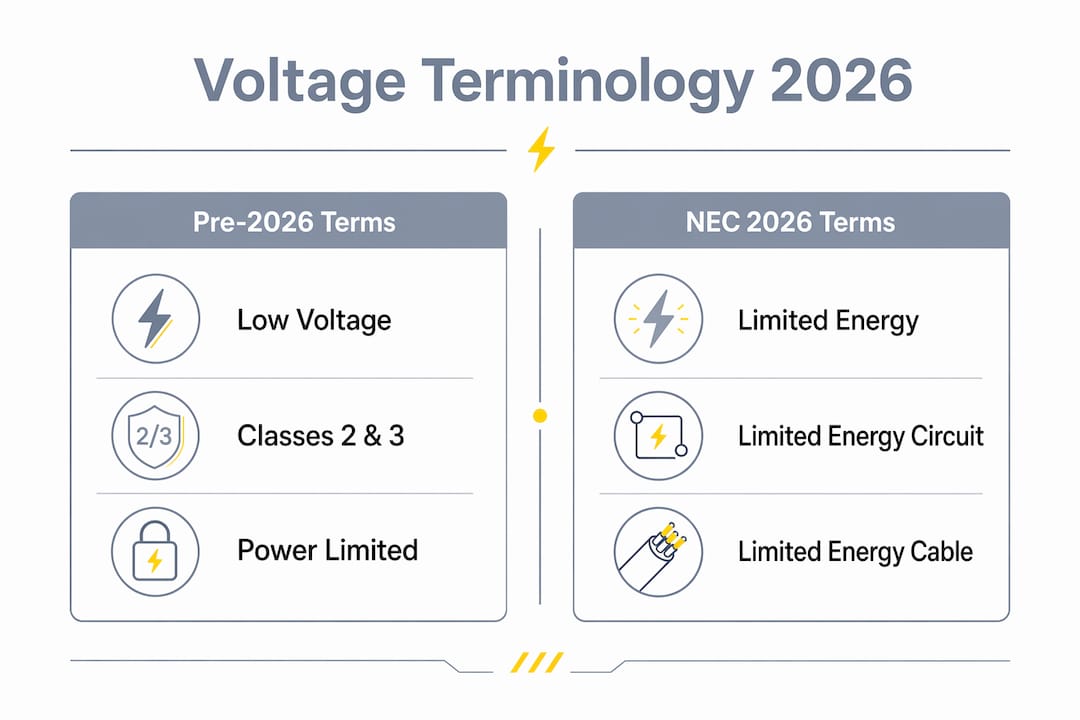
Low voltage terminology in 2026 is no longer defined by voltage thresholds alone. The NEC 2026 officially replaces “low voltage” with “limited energy” as the governing classification for these systems, shifting the entire framework from a voltage-based label to a hazard-based risk model. For technicians, contractors, and designers working with security cameras, PoE networks, motorized gates, and converged ICT systems, this change rewrites how you document, label, and inspect your work. Understanding the new 2026 electrical terms is not optional. It is the baseline for compliance.
What is low voltage terminology in 2026, and why did it change?
The phrase “low voltage” has always carried multiple meanings depending on context, and that ambiguity finally became a code problem. NEC 2026 replaces “low voltage” with “limited energy” as the primary system classification, focusing on how much energy a circuit can deliver under fault conditions rather than what voltage it operates at. A circuit running at 48 V DC can still cause a fire if its energy output is uncontrolled. Voltage alone never told the full story.
The NEC’s core insight is that voltage alone does not determine electrical hazard. Energy capacity and fault behavior are the real risk factors. This is why the new framework makes sense for modern systems where PoE switches, Class 4 fault-managed power, and converged building networks operate at voltages that look “low” but carry enough energy to ignite materials or injure workers.
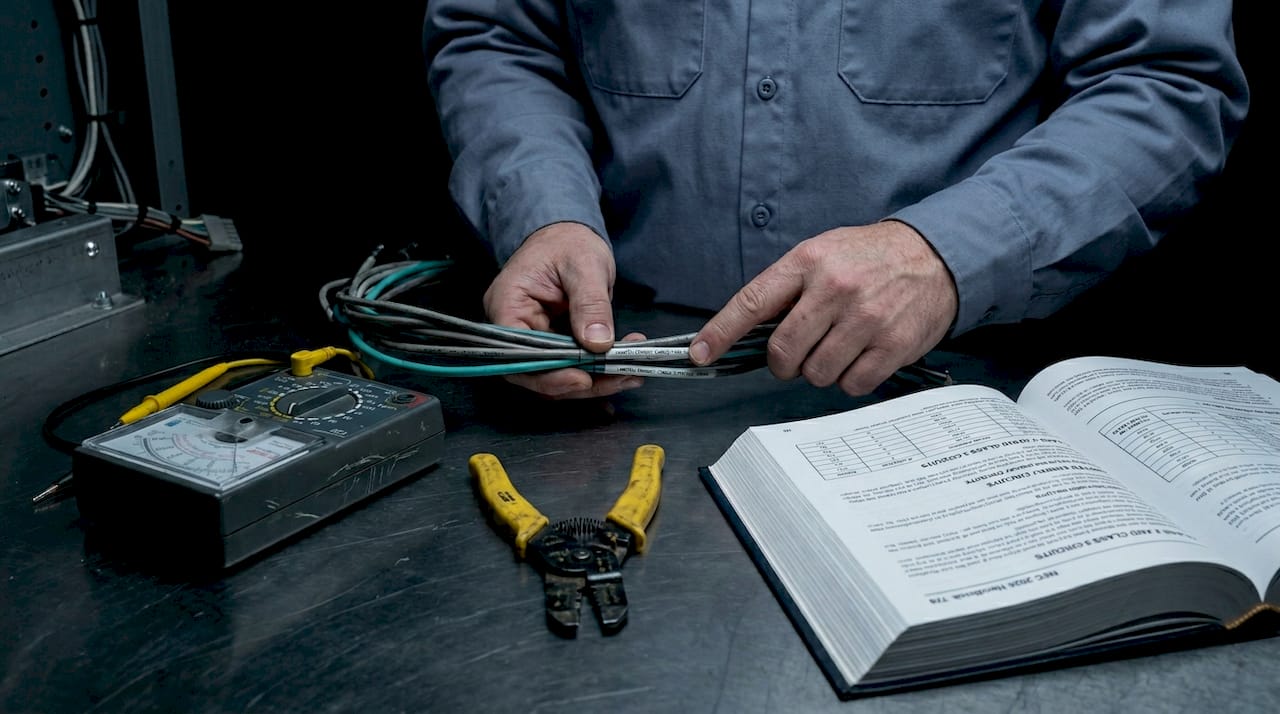
NEC Article 100 in 2026 formally defines “Limited Energy Cable,” “Limited Energy Circuit,” and updates Classes 2, 3, and 4 to reflect fault-managed power and converged ICT applications. These definitions are not cosmetic. They change which code articles apply to your installation, which cable types are permitted, and how inspectors evaluate your work. If you are still writing “low voltage” on submittals and permit applications, you are already behind.
| Term (Pre-2026) | Term (NEC 2026) | Classification Basis |
|---|---|---|
| Low voltage circuit | Limited energy circuit | Energy output and fault behavior |
| Low voltage cable | Limited energy cable | Hazard rating and energy capacity |
| Class 2 / Class 3 | Updated Class 2, 3, 4 | Fault-managed power integration |
| Low voltage system | Limited energy system | Risk-based hazard classification |
Pro Tip: Start updating your submittal templates and inspection checklists now. Replace every instance of “low voltage” with “limited energy” where NEC 2026 applies, and note the specific Article 100 definition in your documentation to prevent AHJ pushback.
How do IEC 61140 and international standards compare to NEC 2026?
Professionals working across jurisdictions need to hold two frameworks in their heads simultaneously. IEC 61140:2016 defines Extra Low Voltage (ELV) as 50 V AC or less, or 120 V DC or less, and Low Voltage (LV) as greater than 50 V AC up to 1,000 V RMS and greater than 120 V DC up to 1,500 V. These are shock-protection voltage bands, not installation code scopes. The distinction matters because you cannot apply IEC 61140 voltage bands directly to NEC code articles without understanding what each standard is actually measuring.
IEC 60038 and the EU Low Voltage Directive recently aligned with IEC 61140 by formally defining low voltage as 1,000 V AC or less and 1,500 V DC or less. Their focus remains on voltage thresholds for equipment and distribution systems. NEC 2026 takes a different path entirely by classifying systems based on hazard and energy output, not voltage bands. This is the fundamental divergence between US and international code philosophy in 2026.
NEC 110.26 scopes electrical installations at 1,000 volts AC or less, which gives practitioners a practical installation threshold. But that threshold does not define limited energy. A 120 V circuit feeding a lighting panel falls under NEC 110.26 but is not a limited energy circuit. A 48 V PoE system may qualify as limited energy under Article 100 definitions. The voltage number and the classification are separate questions.
| Standard | Voltage Threshold | Classification Basis | Jurisdiction |
|---|---|---|---|
| IEC 61140:2016 ELV | ≤50 V AC / ≤120 V DC | Shock protection | International |
| IEC 61140:2016 LV | >50 V AC to 1,000 V RMS | Shock protection | International |
| IEC 60038 / EU LVD | ≤1,000 V AC / ≤1,500 V DC | Equipment voltage range | EU / International |
| NEC 2026 Limited Energy | Varies by class | Hazard and fault behavior | United States |
IEC 61140 is the international benchmark for shock-protection voltage bands, but NEC 2026 updates go further by defining systems with a focus on risk categorization rather than voltage alone. For contractors bidding on projects with international design teams or multinational clients, you need to clarify which standard governs each system at the outset of every project. Assuming alignment between IEC and NEC voltage language is a common source of specification errors.
How does the terminology shift affect installation and documentation?
The practical impact of the 2026 electrical terms change lands hardest on documentation and field labeling. The NEC 2026 terminology shift affects labeling, documentation, permit scopes, and enforcement practices, requiring consistent use of “limited energy” language instead of “low voltage.” Inspectors and authorities having jurisdiction (AHJs) are already being trained on the new language. Submittals that use outdated terminology create friction at every review stage.
Here is where the workflow changes are most significant for field professionals:
- Labeling. Junction boxes, conduit, and cable runs for limited energy circuits require updated labels. “LV” or “low voltage” markings no longer align with NEC 2026 language and may trigger inspector questions.
- Submittals and drawings. Electrical drawings must reference “limited energy circuit” and cite the applicable NEC Article 100 definition. Designers using legacy title blocks or spec templates need to update them before the first permit submission.
- Inspection checklists. AHJs are updating their review forms. Contractors who coordinate early with local inspectors on terminology expectations avoid re-inspection costs.
- Separation and coordination. Limited energy circuits still require physical separation from power circuits, but the classification now drives which separation rules apply. Hazard-based classification changes how you calculate required separation distances in converged systems.
- ICT and PoE systems. Power over Ethernet installations, structured cabling, and converged building networks all fall under limited energy definitions. Every PoE switch, IP camera run, and network drop in a commercial project is now documented under this framework.
Failing to differentiate between ELV, LV, and limited energy classifications can lead to specifying improper equipment or misapplying code articles, causing inspection failures or safety risks. This is not a theoretical concern. Contractors who install security camera systems or wired networks under the wrong classification risk failed inspections and liability exposure on occupied buildings.
Pro Tip: Coordinate with your AHJ and design team before the first submittal on any 2026 project. Ask specifically how the local jurisdiction is enforcing limited energy language and whether they have updated their permit application forms. Getting this answer early saves you a re-submission.
Updating documentation and labeling to reflect limited energy terminology is the single most immediate compliance action contractors can take. It costs nothing and prevents the most common inspection friction points.
What emerging technologies are shaped by limited energy definitions?
The terminology shift did not happen in a vacuum. Specific technologies drove the NEC’s decision to move away from voltage-based classification, and understanding those technologies tells you where the industry is heading. You can explore low voltage applications in 2026 to see how these systems are already deployed in modern buildings.
PoE and fault-managed Class 4 power are the primary drivers of the terminology shift, combining power and data delivery under limited energy safety frameworks. These technologies rely on the hazard-based framework to enable innovation while maintaining safety. Here is what that means for the systems you install and maintain:
- Power over Ethernet (PoE). IEEE 802.3bt PoE delivers up to 90 W per port over Cat6 or Cat6A cable. At that power level, cable heating and fire risk are real concerns. Limited energy classification gives inspectors and designers a clear framework for evaluating these installations.
- Class 4 fault-managed power. This emerging standard uses active fault detection to cut power within microseconds of a fault event, enabling higher-power DC distribution over standard building wire. NEC 2026 Article 100 updates accommodate Class 4 as a limited energy system.
- Converged ICT infrastructure. Buildings increasingly run security cameras, access control, wireless networks, and building automation over shared cable infrastructure. Limited energy classification provides a single framework for documenting and inspecting these converged systems.
- IoT and intelligent building systems. Sensors, controllers, and edge devices in smart buildings operate at voltages and power levels that fit the limited energy model. The new terminology gives designers a consistent classification for these devices across a project.
- ESD protection advancements. Electrostatic discharge protection requirements are evolving alongside limited energy definitions, particularly for sensitive ICT equipment in converged infrastructure. Proper ESD coordination is now part of limited energy system design.
The common low voltage terms that governed these systems for decades are being replaced by a vocabulary built around how systems behave under stress, not what voltage they run at. Professionals who learn this vocabulary now will have a clear advantage in design reviews, inspections, and client communication through the rest of the decade.
Key takeaways
Low voltage terminology in 2026 is defined by NEC Article 100’s hazard-based “limited energy” classification, replacing voltage-threshold labels across all US installation code applications.
| Point | Details |
|---|---|
| NEC 2026 core change | “Low voltage” is replaced by “limited energy,” classifying systems by energy output and fault behavior. |
| IEC 61140 still applies internationally | ELV (≤50 V AC) and LV (up to 1,000 V AC) bands remain valid for shock-protection contexts outside the US. |
| Documentation must be updated | Labels, submittals, and permit applications must use “limited energy” language to pass NEC 2026 inspections. |
| PoE and Class 4 power drove the change | Technologies delivering high power over data cable made voltage-only classification inadequate for safety. |
| Early AHJ coordination prevents re-work | Aligning terminology with local inspectors before first submittal eliminates the most common compliance delays. |
Why this terminology shift is bigger than most contractors realize
I have been working with limited energy systems under the old “low voltage” label for years, and the honest observation is that the vocabulary never matched the reality of what these systems could do. A PoE switch feeding 30 IP cameras in a commercial building is not a “low voltage” system in any meaningful safety sense. It is a power distribution system with specific fault risks, and it deserves a classification that reflects that.
What concerns me about the 2026 transition is the pace of adoption in the field. Code language changes faster than training programs, faster than submittal templates, and much faster than the habits of experienced installers who have used “low voltage” for their entire careers. The contractors who will struggle are not the ones who lack technical knowledge. They are the ones who underestimate how much the documentation and inspection side of the business will change.
My advice is to treat this as a communication problem as much as a technical one. Your clients, your design partners, and your AHJs all need to hear the new language from you consistently. When you use “limited energy” correctly and confidently in project meetings, you signal that your team is current. That matters for winning work and for avoiding costly re-inspections on projects that are otherwise installed correctly.
The future of this space is converged infrastructure where power, data, and control systems share physical pathways and documentation frameworks. Limited energy classification is the foundation that makes that convergence safe and inspectable. Getting fluent in it now is not just compliance. It is preparation for where the industry is going.
— Aaron
How Lowvoltagecorp helps you stay ahead of 2026 standards
Lowvoltagecorp specializes in the installation, repair, and maintenance of the exact systems most affected by the 2026 limited energy terminology shift: security cameras, motorized gates, wired and wireless networks, and cell boosters. Every project the team handles is documented and installed to current NEC standards, with labeling and submittals that reflect the updated limited energy framework.
If your current system was installed under pre-2026 “low voltage” classifications and you need a compliance review, or if you are planning a new installation and want it done right the first time, Lowvoltagecorp is ready to help. The team also handles fast troubleshooting and repair for gates, cameras, and networks when something goes wrong. Contact Lowvoltagecorp to discuss your project and get it aligned with 2026 standards from day one.
FAQ
What does “limited energy” mean in NEC 2026?
“Limited energy” is the NEC 2026 classification for circuits previously called “low voltage,” defined by energy output and fault behavior rather than voltage level. NEC Article 100 formally defines limited energy circuits, limited energy cables, and updated Classes 2, 3, and 4 under this framework.
How does NEC 2026 differ from IEC 61140 voltage definitions?
IEC 61140:2016 classifies systems by voltage bands for shock protection, defining ELV as 50 V AC or less and LV up to 1,000 V AC. NEC 2026 goes further by classifying systems based on hazard risk and fault behavior, making the two standards complementary but not interchangeable.
Does the terminology change affect PoE and network installations?
PoE systems and converged ICT infrastructure fall directly under the NEC 2026 limited energy framework. IEEE 802.3bt PoE delivering up to 90 W per port requires hazard-based classification, and all documentation for these systems must use updated limited energy language to pass inspection.
What do contractors need to update for NEC 2026 compliance?
Contractors must update labeling on junction boxes and cable runs, revise submittal templates and permit applications to use “limited energy” language, and coordinate with AHJs on local enforcement practices before the first project submission.
Is “low voltage” still a valid term in 2026?
“Low voltage” remains valid in international contexts under IEC 61140 and IEC 60038 for voltage band classification. Within US NEC installation code applications, “limited energy” is the correct term for systems previously called low voltage, and using outdated language on permits and submittals creates compliance risk.