Facility zoning for networks is the practice of dividing physical space within a building or campus into designated areas, each with its own network infrastructure rules, equipment placement, and access controls. Network administrators call this practice “network segmentation by zone,” and it covers everything from VLAN assignments tied to physical rooms to the local zoning regulations that govern where data centers and wireless towers can be built. Both dimensions matter. Get the physical layout wrong and you get broadcast storms and security gaps. Get the regulatory side wrong and you face permit denials, litigation, and costly redesigns. This guide covers both.
What are typical zoning regulations for network facilities?
Local zoning regulations define what you can build, where you can build it, and how large it can be. Network administrators planning a new data center or wireless infrastructure deployment must understand three industrial zoning classifications: light industrial, general industrial, and heavy industrial. Each classification carries different rules on lot coverage, building height, and permitted uses.
Industrial zoning typically allows lot coverage between 60% and 100% and building heights up to 150 feet. That ceiling matters for tower installations and rooftop antenna arrays. Special land use reviews are triggered for projects over 15,000 sq ft, even when the use is permitted by right. That threshold catches many mid-size data center expansions that administrators assume will sail through permitting.

Parking and loading dock standards also apply. Light industrial facilities typically require 1 parking space per 1,000–2,000 sq ft of office space and 1 loading dock per 25,000–50,000 sq ft. These numbers affect site planning for facilities with large server rooms and regular hardware delivery schedules.
Wireless infrastructure adds another layer. Local governments process wireless network applications under shot clock deadlines set by federal law. Missing those deadlines can trigger automatic approvals or expose municipalities to litigation. For IT teams coordinating with carriers or building their own distributed antenna systems, understanding these timelines prevents project delays.
Key regulatory requirements to track for any network facility project:
- Industrial classification: Confirm whether your facility falls under light, general, or heavy industrial zoning before submitting any permit application.
- Lot coverage and height limits: Verify the maximum footprint and height allowed on your parcel.
- Special land use review: Budget time and legal fees for public hearings if your project exceeds 15,000 sq ft.
- Parking and loading standards: Confirm dock and parking ratios meet local code for your facility size.
- Shot clock compliance: Track federal wireless application deadlines to avoid automatic approvals or litigation.
- Public consultation periods: Some jurisdictions require a minimum 6-week consultation period for new network-connected developments.
Pro Tip: Request a zoning verification letter from your local authority before finalizing site selection. This letter gives you a legally binding interpretation of current regulations, not just what an outdated zoning map shows.
How does facility zoning enhance network performance and security?
Physical zoning directly shapes network performance. When you assign specific network zones to physical areas, such as a server room, an office floor, or a warehouse, you reduce broadcast traffic by keeping local traffic local. Fewer broadcast packets crossing zone boundaries means less congestion and faster response times for end users.
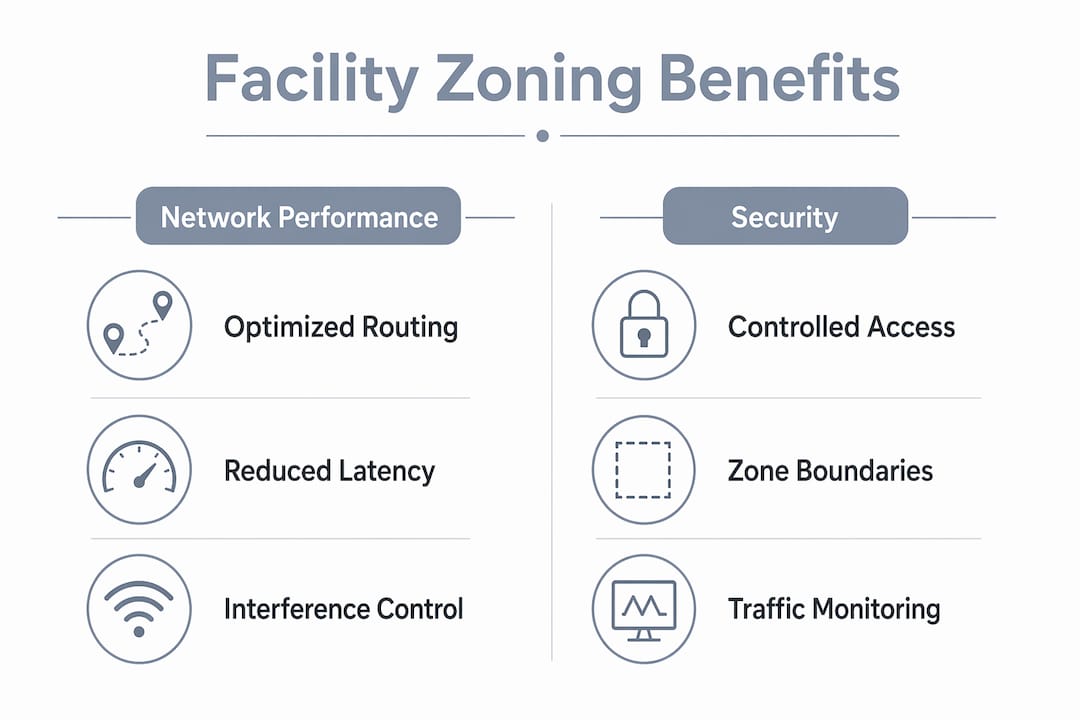
Security improves for the same reason. A zone boundary is a control point. Traffic crossing from the warehouse floor to the finance office must pass through a firewall or access control list. Without physical zoning guiding that logical segmentation, IT teams often end up with flat networks where a compromised device in the loading dock can reach payroll servers. Pairing physical zones with VLAN segmentation closes that gap.
The table below compares zoning strategies for wired and wireless networks in large facilities:
| Factor | Wired network zoning | Wireless network zoning |
|---|---|---|
| Zone boundary enforcement | Switch ports and patch panels define hard boundaries | Access point placement and SSID policies define soft boundaries |
| Interference management | Minimal; physical cable runs are isolated | Requires RF planning to prevent channel overlap between zones |
| Security control point | Managed switches with port-based VLANs | Wireless controllers with zone-based firewall rules |
| Maintenance complexity | Higher upfront cabling cost, lower ongoing management | Lower cabling cost, higher ongoing RF tuning requirement |
| Compliance documentation | Cable plant records and switch configs | RF site surveys and controller policy exports |
Environmental factors also affect zoning decisions. Facilities with heavy machinery generate electrical interference that degrades wireless signals. Placing wireless access points in a zone away from industrial equipment, and routing wired runs through conduit in those same areas, is standard practice for network infrastructure maintenance in manufacturing environments.
Pro Tip: Document your physical zone boundaries in a floor plan and tie each zone to its corresponding VLAN ID. When a security incident occurs, that map cuts investigation time significantly.
What practical steps should IT professionals take when planning network facility zoning?
Planning network facility layout requires both technical and regulatory work. Skipping either creates problems that surface at the worst time, usually during a permit hearing or a network audit.
-
Research local zoning maps and ordinances early. Pull the current zoning map for your site before committing to a location. Zoning maps change, and what was light industrial two years ago may now carry stricter conditions.
-
Request a zoning verification letter. A zoning verification letter provides a legally binding interpretation of current regulations. Do not rely on the map alone.
-
Plan for special land use reviews. Any project over 15,000 sq ft likely triggers a special land use review. Budget for attorney fees, engineering reports, and public hearing preparation well before your target go-live date.
-
Prepare mitigation plans for noise, light, and visual impacts. Local governments now require direct mitigation studies for sound, light, and visual impacts rather than accepting setbacks as a substitute. Prepare these during the initial entitlement phase, not after opposition emerges.
-
Negotiate setbacks with mitigation measures. Offering sound walls or landscaping buffers can preserve more of your facility footprint for network equipment. Setback negotiations work best when you bring a concrete mitigation proposal to the table.
-
Budget for decommissioning. Many zoning ordinances now require decommissioning plans with proof of funds before approving network facility applications. Factor end-of-life removal costs into your project budget from day one.
-
Monitor local policy and community sentiment. Monitoring local policies and community opposition early allows you to adjust plans before public hearings. Developers who catch opposition signals on social media and in planning commission agendas avoid costly last-minute redesigns.
What legal challenges affect zoning for network infrastructure?
Legal risk in network facility zoning comes from multiple directions. Federal law limits what local governments can do with small wireless facility applications, but macro-site siting still gives local authorities meaningful discretion. That discretion means a well-connected neighbor or a vocal community group can influence a permit decision in ways that federal preemption does not prevent.
Litigation timelines are long. Zoning approval challenges can last up to two years after approval, as seen in Ohio cases. That timeline affects financing, lease agreements, and equipment procurement schedules. IT teams coordinating with legal counsel need to build that risk window into project plans.
Key legal pitfalls to avoid:
- Misclassifying your facility type: Proper classification as telecommunications or light utility avoids being grouped into heavy industrial categories with far stricter requirements.
- Ignoring grandfathering clauses: New zoning amendments may not apply to existing facilities if vested rights or grandfathering protections exist. Check for these before assuming a facility must comply with new rules.
- Skipping decommissioning documentation: Missing this requirement can void a permit application entirely.
- Failing to maintain defensible records: Local governments need clear, documented reasons for permit denials. Without a defensible record, denial decisions face higher litigation risk from applicants.
- Overlooking preferred location lists: Wireless zoning ordinances that include preferred location lists give local governments a clear, defensible permitting path. Applicants who propose sites on those lists move faster through approval.
Zoning compliance for facilities is not a one-time task. Local ordinances evolve, and a facility that was fully compliant three years ago may now require a variance or a new conditional use permit.
Key Takeaways
Effective facility zoning for networks requires matching physical space planning with local regulatory compliance from the first day of project planning.
| Point | Details |
|---|---|
| Start with zoning verification | Request a zoning verification letter before finalizing any site to get a legally binding regulatory interpretation. |
| Plan for special land use reviews | Projects over 15,000 sq ft trigger public hearings; budget time and legal fees early. |
| Pair physical zones with VLANs | Matching physical zone boundaries to VLAN assignments reduces broadcast traffic and closes security gaps. |
| Prepare mitigation plans upfront | Local governments now require direct impact studies for noise, light, and visual effects during the entitlement phase. |
| Budget for decommissioning | Many jurisdictions require proof of decommissioning funds before approving network facility permits. |
What I’ve learned from watching zoning derail good network projects
Most IT professionals I talk to treat facility zoning as a facilities management problem, not a network problem. That split in ownership is where projects go sideways. The network team designs a perfect segmentation plan, the facilities team submits a permit application, and nobody realizes the site triggers a special land use review until the hearing notice arrives. By then, the equipment is ordered and the lease is signed.
The fix is simple but requires discipline. Network administrators need to be in the room during site selection, not just during infrastructure design. The physical zone boundaries you draw on a floor plan have to match what the local zoning code allows you to build. A warehouse zone that looks perfect for a server room expansion may sit in a general industrial district that requires a conditional use permit for data processing equipment.
Mitigation planning is the other area where I see consistent underinvestment. Local governments are no longer satisfied with setbacks as a proxy for impact control. They want noise studies, visual impact assessments, and landscaping plans. Bringing those documents to the first public hearing, rather than scrambling to produce them after opposition appears, changes the tone of the entire process.
Community engagement matters more than most IT teams expect. A data center or wireless tower project that surprises neighbors generates opposition that a technically sound application cannot overcome on its own. Monitor planning commission agendas, attend community meetings, and present your mitigation plans before anyone asks for them. That approach shortens approval timelines and builds the kind of goodwill that makes future projects easier.
— Aaron
How Lowvoltagecorp supports your network facility planning
Lowvoltagecorp specializes in the installation, repair, and maintenance of wired and wireless networks, security cameras, motorized gates, and cell boosters across large facilities. When your zoning plan defines where infrastructure goes, Lowvoltagecorp handles the physical build with the precision that compliance-driven projects require.

Whether you are designing zone boundaries for a new facility or upgrading an existing network to match a revised floor plan, Lowvoltagecorp brings hands-on low voltage expertise to every phase. The team understands how physical layout decisions affect both network performance and permit compliance. For South Florida property managers and IT teams looking to reduce costs while meeting zoning requirements, the security upgrade options at Lowvoltagecorp are worth a close look. Contact Lowvoltagecorp to discuss your facility’s network zoning needs before your next project kicks off.
FAQ
What is facility zoning for networks?
Facility zoning for networks is the process of dividing physical space within a building into designated areas, each with specific network infrastructure rules, equipment placement, and access controls. It combines physical layout planning with logical segmentation tools like VLANs.
When does a network facility project require a special land use review?
A special land use review is typically required when a project exceeds 15,000 sq ft, even if the use is permitted by right under the current industrial zoning classification. Budget for public hearings and legal fees when your project approaches that threshold.
What is a zoning verification letter and why does it matter?
A zoning verification letter is a legally binding document from your local authority that confirms the current zoning regulations for a specific parcel. It is more reliable than zoning maps, which are often outdated.
How do VLANs relate to physical facility zoning?
VLANs create logical network boundaries that mirror physical zone boundaries in a facility. Pairing VLAN assignments with physical zones reduces broadcast traffic and enforces access controls between areas like server rooms, office floors, and warehouses.
What legal risks come with wireless facility zoning?
Local governments retain meaningful discretion over macro-site wireless siting, and zoning approval challenges can extend up to two years after a permit is granted. Misclassifying a facility type or skipping decommissioning documentation are the most common triggers for permit denial and litigation.