Most facility managers and property owners think of low voltage as simply “safer electricity.” That framing sells it short by a wide margin. Low voltage systems are the operational backbone of modern commercial and institutional facilities, powering everything from security cameras and access control to fire alarms, structured cabling networks, and motorized gate systems. Get them right, and your facility runs smoother, stays compliant, and costs less to maintain. Get them wrong, and you’re looking at failed inspections, recurring repair bills, and security gaps that compound over time. This guide walks you through what you actually need to know.
Table of Contents
- What qualifies as low voltage in facilities?
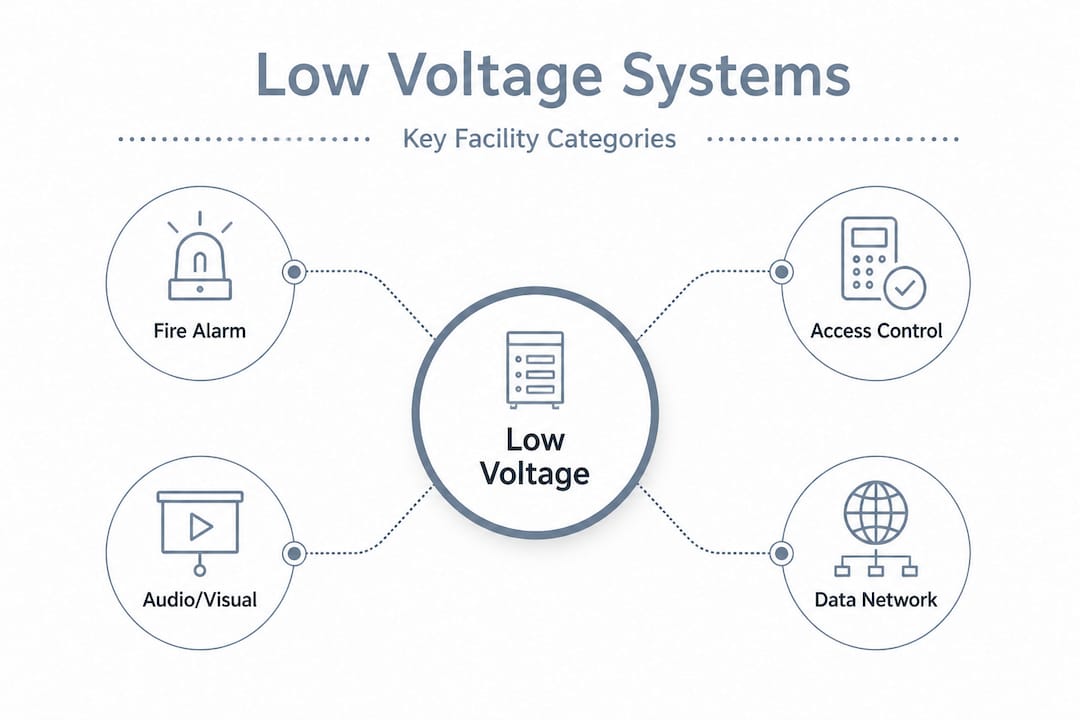
- Key systems powered by low voltage
- Safety, compliance, and system engineering
- Data analytics: transforming operational efficiency
- Why getting low voltage right matters most in South Florida facilities
- Bring advanced low voltage solutions to your facility
- Frequently asked questions
Key Takeaways
| Point | Details |
|---|---|
| More than just wiring | Low voltage systems form the backbone for security, life safety, and communications in modern facilities. |
| Compliance starts with design | Proper classification and power limitation are essential for safe, code-compliant installations. |
| Analytics drive efficiency | Data-driven monitoring radically cuts false alarms and compliance time, saving operational costs. |
| South Florida needs expert planning | Local property managers must address unique code and weather challenges with integrated low voltage solutions. |
What qualifies as low voltage in facilities?
With that context, let’s break down what actually falls under “low voltage” in today’s facilities.
In electrical terms, low voltage typically refers to systems operating at 50 volts or below, though the National Electrical Code (NEC) draws distinctions based on use and power supply type rather than raw voltage alone. Line voltage systems, the kind that power HVAC equipment, lighting fixtures, and motors, typically operate at 120V to 480V. Low voltage systems operate below these thresholds and are governed by different NEC articles, specifically Articles 725, 760, 800, and 820, depending on the system type.
The key distinction is not just the number on a voltmeter. It is how the circuit is powered, how it is protected, and what it controls. A low voltage infrastructure serving an access control panel and a line voltage circuit feeding a 20-ton rooftop unit have fundamentally different installation requirements, inspection procedures, and maintenance protocols.
| System type | Typical voltage range | Governing NEC article |
|---|---|---|
| Fire alarm signaling | 24V DC | Article 760 |
| Access control | 12V to 24V DC | Article 725 |
| Structured cabling (data) | Up to 50V PoE | Article 800 |
| Security cameras (PoE) | 48V DC | Article 800 |
| Audio/visual distribution | 25V to 70V | Article 725 |
| Motorized gates | 24V control circuits | Article 725 |
Core components that fall under this classification include:
- Fire alarm signaling circuits, which connect initiating devices to control panels
- Access control hardware, including card readers, electric strikes, and door controllers
- Structured cabling, which carries data, voice, and video signals across a facility
- Security camera systems, including IP cameras and their associated network switches
- Motorized gate control wiring, including loop detectors and safety edge sensors
- Cell booster distribution cabling, which extends wireless carrier signals indoors
As the National Electrical Authority notes, low voltage electrical systems are the infrastructure for core communications and life-safety/security functions. Understanding this framing shifts how you think about budget priorities, contractor qualifications, and long-term maintenance planning.
Key systems powered by low voltage
Understanding what qualifies as low voltage helps clarify which critical systems rely on these safe, efficient installs.
Fire alarm systems depend entirely on low voltage infrastructure. Every smoke detector, heat detector, and manual pull station in your building is a fire alarm initiating device that feeds a signal back to a central fire alarm control panel (FACP). When any one of these devices activates, it triggers notification appliances like horns and strobes, while also sending a signal to a central monitoring station. The wiring connecting all of these components is classified under NEC Article 760 and must meet specific circuit integrity requirements. In South Florida’s high-humidity environment, the condition and routing of this wiring matters enormously.
Security and access control systems are another major low voltage category. A typical commercial access control installation includes electromagnetic locks, card readers, request-to-exit sensors, and a door controller that communicates with a central server. More advanced setups integrate with video surveillance, allowing you to pull a camera view when a door access event occurs. Per established system standards, fire alarm circuits, access control, and audiovisual wiring all fall under the low voltage umbrella, which means a single qualified contractor can handle all of them, reducing the coordination headaches that come with splitting work between vendors.
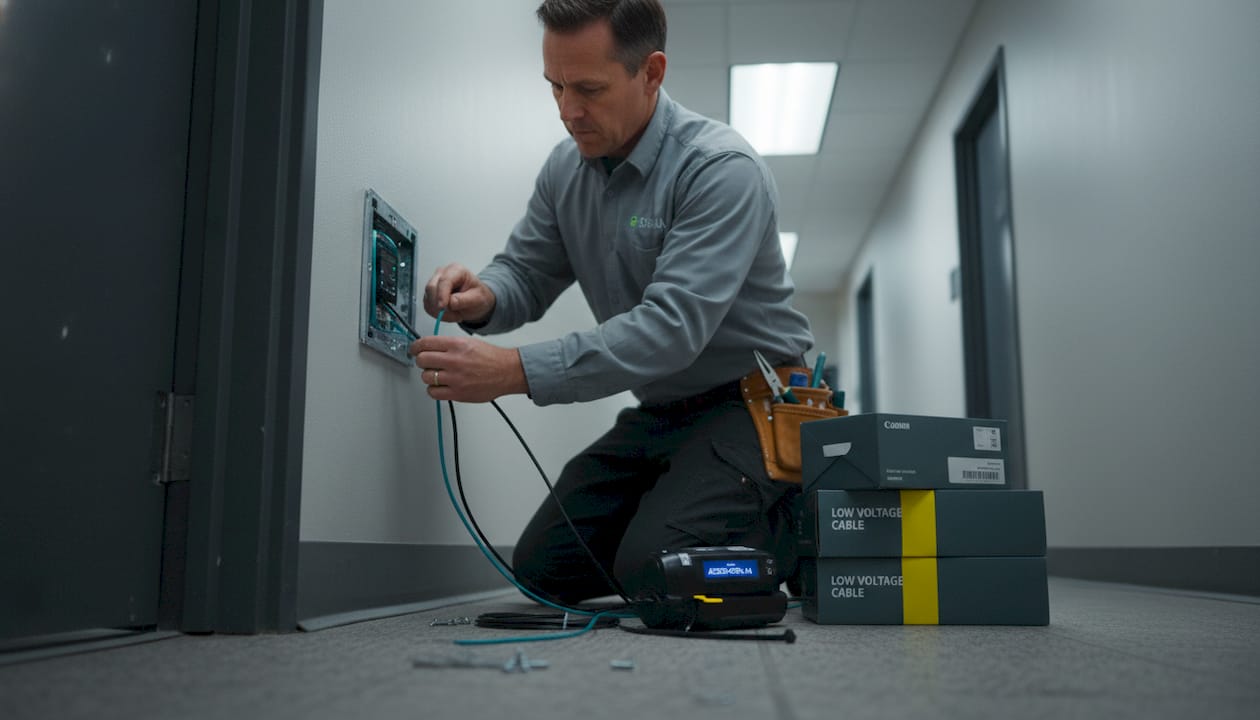
Audio/visual and communications systems include distributed speaker systems, intercom networks, and the data cabling that connects your facility’s computers, VoIP phones, and wireless access points. Structured cabling, typically Category 6 or 6A for modern facilities, forms the physical foundation of every wired network. Poor cabling quality here doesn’t just slow down your internet. It introduces latency, packet loss, and connectivity failures that interrupt operations and are frustratingly difficult to diagnose after the fact.
| System | Primary function | Key devices |
|---|---|---|
| Fire alarm | Life-safety notification and monitoring | Smoke detectors, pull stations, FACP |
| Access control | Entry management and audit trail | Card readers, electric strikes, controllers |
| Security cameras | Visual surveillance and incident documentation | IP cameras, NVRs, PoE switches |
| Structured cabling | Data, voice, and video transport | Cat6/6A cables, patch panels, switches |
| Motorized gates | Perimeter access control | Gate operators, loop detectors, keypads |
| Cell signal boosters | Indoor wireless coverage | Donor antennas, amplifiers, distribution cables |
Pro Tip: When evaluating vendors for any of these systems, ask specifically whether they hold a low voltage contractor license in Florida. The state requires it, and hiring unlicensed contractors can void your system warranties and create liability issues during insurance claims.
Safety, compliance, and system engineering
Now that we’ve covered the systems and components, let’s look at the key role of low voltage engineering in meeting compliance and safety mandates.
Many people assume that low voltage wiring is automatically safe because the voltage is low. This misses the point. Safety in these systems comes from power limitation, which is a design methodology that controls both voltage and current output from a power supply. A Class 2 power supply inherently limits voltage and current to levels that prevent ignition and shock hazard, not just because the numbers are small, but because the supply itself cannot deliver enough energy to cause harm under fault conditions.
Class 2 versus Class 3 classification matters because it determines which NEC articles apply, what wiring methods are permitted, and what separation from power wiring is required. Getting this wrong during installation is a costly mistake. Misclassifying a system as Class 2 when it actually requires Class 3 protections, or vice versa, can result in failed inspections, mandatory rework, and in the worst cases, citations from the authority having jurisdiction (AHJ).
Here is a step-by-step view of how proper classification works in practice:
- Identify the power source. Determine whether the supply is a listed Class 2 or Class 3 transformer, power supply unit, or combination power supply.
- Verify the output parameters. Check that voltage and VA (volt-ampere) ratings align with NEC Table 11(A) or 11(B) requirements for the intended class.
- Select appropriate wiring methods. Class 2 wiring has more flexibility than Class 3 in terms of raceway requirements and separation from other circuits.
- Document all circuit origins. Mark panel schedules, junction boxes, and device locations to facilitate future inspection and maintenance.
- Coordinate with the AHJ early. In Miami-Dade, Broward, and Palm Beach counties, local amendments to the NEC can add requirements that aren’t visible in the base code.
Per guidance on facility code compliance, misclassified systems don’t just fail inspections. They also change the cost structure of repairs significantly, because reclassifying and rewiring an installed system requires pulling new permits and potentially replacing conduit and cabling that was installed under the wrong standard.
“Compliance and operational efficiency can trade off depending on code classification and wiring practices.” Getting both right from day one is always less expensive than fixing a misclassified install after the fact.
Pro Tip: Always request as-built drawings and panel schedules from your low voltage contractor after project completion. In South Florida’s busy construction and renovation environment, facilities with complete documentation consistently pass inspections faster and spend less time on compliance audits.
Data analytics: transforming operational efficiency
Safety and compliance are essential, but the next evolution is using low voltage platforms to optimize day-to-day performance and costs.
Most facility managers are surprised to learn how much operational data their existing low voltage systems generate. Fire alarm control panels, access control servers, and IP camera systems all produce event logs, fault records, and diagnostic data that, when analyzed properly, reveal patterns that drive smarter maintenance decisions.
The impact of analytics-driven fire alarm management is quantifiable. Data and analytics platforms applied to fire alarm systems can cut false alarms by 58%, a number that matters in South Florida where false alarm fees from local fire departments can reach hundreds of dollars per incident and repeated false alarms invite regulatory scrutiny. Beyond the financial savings, reducing false alarms means fewer unnecessary building evacuations, which directly protects productivity and tenant satisfaction.
Key performance indicators (KPIs) that a data-driven facility management approach should track include:
- False alarm rate: How often alarms activate without a real emergency. High rates indicate detector aging, environmental sensitivity, or installation issues.
- Mean time to acknowledge (MTTA): How long it takes for a monitored signal to receive a response. Long MTTA times suggest monitoring gaps.
- Mean time to repair (MTTR): How quickly faults are resolved after detection. This directly correlates to downtime risk.
- Compliance cycle completion rate: What percentage of required inspections, tests, and certifications are completed on schedule.
- System uptime percentage: For access control and camera systems, the share of time all devices are functioning normally.
Analytics platforms that connect to your FACP, access control server, or camera NVR (network video recorder) can generate dashboards that surface these metrics automatically. Instead of waiting for a technician’s annual inspection to discover that three smoke detectors in Wing C have been intermittently reporting faults for six months, you see it in a weekly report and dispatch a service call before it becomes a compliance issue.
The return on investment from integrating analytics early, meaning during initial system installation rather than as a retrofit, is substantially higher. Early integration allows the analytics platform to establish baseline performance metrics before any degradation occurs, making anomalies easier to spot and correct.
Pro Tip: Ask your low voltage contractor whether the systems they install are compatible with open-protocol analytics platforms. Proprietary systems that lock you into a single vendor’s monitoring tools limit your ability to consolidate data and negotiate service contracts over time.
Why getting low voltage right matters most in South Florida facilities
There is a pattern we see consistently in South Florida facilities that have chronic compliance problems, recurring repair costs, or security incidents tied to system failures. Almost without exception, those problems trace back to one of two root causes: shortcuts taken during the original installation, or a failure to treat these interconnected systems as a unified infrastructure rather than separate line items.
South Florida is not a forgiving environment for low voltage systems. High humidity accelerates corrosion in camera housings, gate control panels, and cable terminations. Hurricane-force winds stress conduit and junction box connections. The density of commercial development in Miami-Dade and Broward means AHJ inspectors are under pressure and have little patience for documentation gaps or non-compliant installs. A facility that breezes through inspections in another state may still face violations here.
What most people miss is how interconnected these systems are. A failure in your structured cabling plant doesn’t just knock out internet access. It can take down your IP camera system, disable your access control server, and disrupt your cell booster distribution network simultaneously. Addressing each system in isolation, with different contractors who don’t understand each other’s work, creates exactly the kind of fragmented infrastructure where one failure multiplies into several.
The smarter approach is to treat your low voltage systems as an integrated platform. Commission them together, document them together, and maintain them under a service agreement that covers all of them. When analytics reveal a problem in one system, a contractor who understands the full picture can assess whether adjacent systems are at risk. That kind of proactive management is what keeps the impact of low voltage solutions positive over the long term rather than reactive and expensive.
The uncomfortable truth is that cutting corners on low voltage installation in South Florida doesn’t save money. It transfers cost to a future point in time when the problems are harder to fix and more disruptive to operations.
Bring advanced low voltage solutions to your facility
If the insights above have clarified the stakes, the next step is a conversation with a team that understands the full scope of low voltage infrastructure in South Florida’s specific operating environment.
Low Voltage Corp specializes in the installation, repair, and maintenance of security cameras, motorized gates, wired and wireless networks, and cell signal boosters. Whether you’re commissioning a new facility, upgrading aging infrastructure, or troubleshooting compliance issues on existing systems, the team brings hands-on expertise in all of the systems covered in this guide. Serving facility managers and property owners throughout South Florida, Low Voltage Corp offers tailored assessments that identify where your current infrastructure falls short and what it will take to bring it up to standard. Reach out today to schedule a consultation.
Frequently asked questions
What systems in a building typically use low voltage wiring?
Common systems include fire alarm circuits, security access controls, audiovisual distribution, structured cabling for data networks, motorized gate control circuits, and IP-based camera systems powered by PoE switches.
Why is “power limitation” more important than just using lower voltage?
Limiting voltage and current together through a listed Class 2 power supply prevents both shock and ignition hazards under fault conditions, ensuring code compliance and protecting connected equipment in ways that simply reducing voltage alone does not.
How do data analytics improve fire alarm system performance?
Analytics platforms can cut false alarms by 58%, reduce mean time to repair, and make compliance reporting faster and more reliable by surfacing fault trends before they become inspection violations.
What are the risks of misclassifying a low voltage system during installation?
Misclassification can trigger code violations and rework costs that far exceed the original installation budget, and may also result in failed inspections, voided warranties, and liability exposure if a life-safety system fails during an incident.