Property managers and facility teams in South Florida face a growing challenge: keeping every system online, secure, and performing at full capacity around the clock. Security cameras, access control panels, VoIP phones, and building management systems all demand dependable connectivity. When a network hiccup takes down a gate controller or disrupts surveillance footage, the liability exposure is immediate and real. That pressure makes the wired versus wireless decision far more than a technical question. It is an operational and financial one that directly affects your tenants, your staff, and your bottom line.
Table of Contents
- Consistent speed and performance
- Enhanced security for your facilities
- High availability and business continuity
- Wired vs. wireless: Summary comparison
- When to choose wired: Real-world scenarios
- Our perspective: Balancing wired and wireless for optimal facility outcomes
- Upgrade your property’s connectivity with trusted wired network solutions
- Frequently asked questions
Key Takeaways
| Point | Details |
|---|---|
| Consistent performance | Wired networks minimize latency and ensure reliability for property management operations. |
| Stronger security | Physical infrastructure limits security risks and supports mission-critical systems. |
| High uptime | Wired solutions can be engineered for near-zero annual downtime, protecting business continuity. |
| Situational advantages | Wired networks excel for fixed endpoints and high-interference environments. |
| Hybrid approach | Combining wired and wireless enables flexible yet secure facility connectivity. |
Consistent speed and performance
When you’re managing a commercial property, a shopping center, or a multi-building residential complex, your network is not just moving emails. It is supporting live video streams from security cameras, coordinating access control events, running VoIP phone systems for your office staff, and in some cases, managing HVAC and lighting automation. Every one of those applications demands stable, predictable throughput.
Wireless networks are convenient, but they carry a fundamental weakness: shared airspace. Every nearby router, cordless device, microwave oven, or competing Wi-Fi network adds interference and congestion. In dense urban or suburban South Florida environments, where apartment buildings, retail centers, and office parks sit close together, that interference is constant and unpredictable.
Wired Ethernet is generally more consistent than Wi-Fi for latency and jitter, which matters directly for real-time applications like VoIP calls, security camera feeds, and always-on property operations. Latency is the delay in data transmission, and jitter is the variation in that delay. For a security camera recording a 1080p or 4K feed, jitter causes dropped frames and corrupted footage. For a VoIP call in your leasing office, latency and jitter create choppy, unusable audio.
Key performance advantages of wired networks in property management:
- Dedicated bandwidth per cable run, with no shared airspace competing for signal
- Consistent latency under 1 millisecond on local network segments, compared to 10 to 50 milliseconds on wireless
- No degradation during peak usage hours when tenants or staff flood the network
- Predictable behavior even as you add more connected devices to the facility
“A wired connection does not care whether the neighboring property just installed a new Wi-Fi router or whether your tenant is streaming 4K video. The cable carries what you put into it, consistently, every time.”
For property managers running 24/7 operations, that consistency is not a luxury. It is the foundation that every other system relies on.
Enhanced security for your facilities
Speed matters, but in property management, security matters more. Your network carries sensitive data: access control logs, tenant records, surveillance footage, and sometimes payment systems. The network infrastructure itself is a security boundary, and how you build it determines how well you defend it.
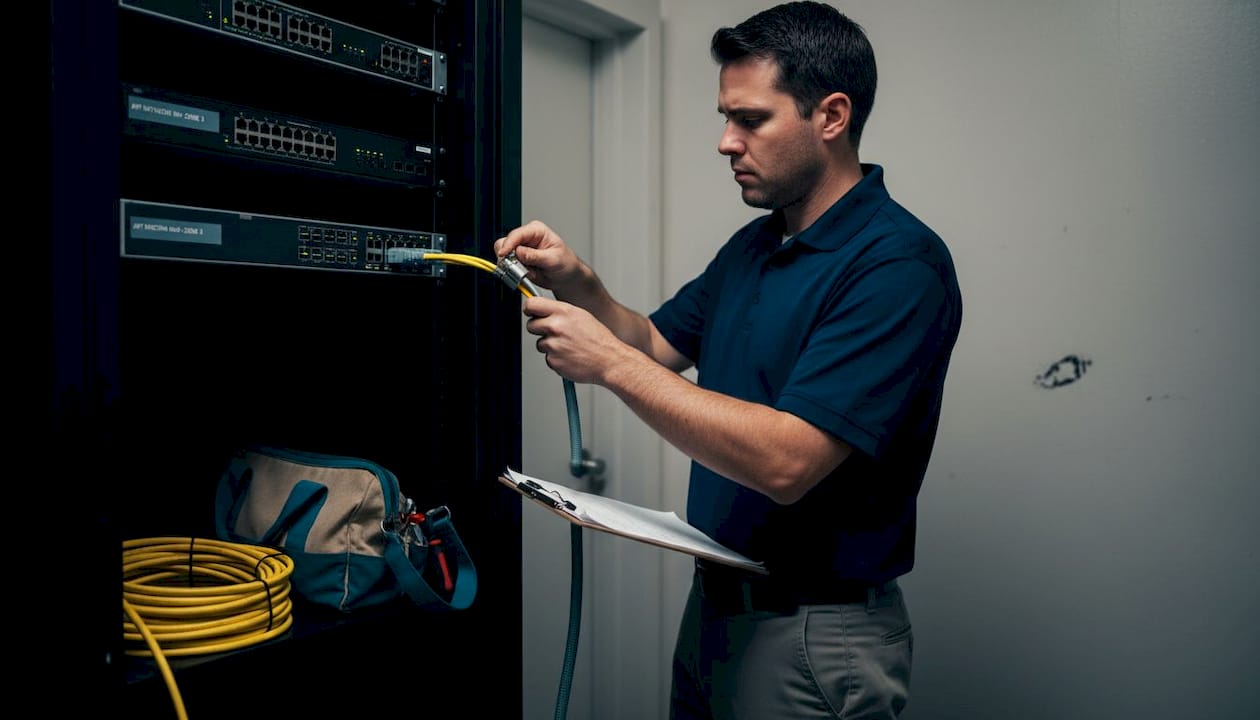
Wireless networks, by their nature, broadcast signals into open space. A determined attacker sitting in a parking lot or an adjacent building can attempt to intercept traffic or probe for vulnerabilities without ever stepping inside your property. Modern Wi-Fi encryption has improved dramatically, but the attack surface remains broader than wired.
Wired links offer a stronger security posture because attackers typically need physical access to the wired infrastructure to intercept or connect to the network. That single requirement raises the difficulty of an attack significantly. A criminal cannot sit in a car and sniff your Ethernet traffic the way they might probe a wireless signal.
For facility managers running security-critical infrastructure, the practical advantages of wired networks include:
- Access control systems locked to the physical network with no wireless attack surface
- Security camera feeds transmitted over dedicated cable runs, not shared airwaves
- Smart locks and motorized gate controllers operating over authenticated, physical connections
- Reduced exposure to rogue access point attacks, which require an attacker to introduce a wireless device to your network
Pro Tip: Conduct a physical audit of all network cabling and patch panels at least once per year. Look for unauthorized connections, damaged cable runs, or open ports on network switches. A single unlocked patch panel in a shared utility closet can undermine even the most carefully designed network security plan. Label every cable, document every run, and restrict access to your network infrastructure rooms with the same care you apply to your server room.
Wired networks also pair naturally with the security camera and motorized gate systems that many South Florida properties rely on for perimeter control. When those systems sit on a wired backbone, they operate with higher reliability and lower vulnerability than they would on a shared wireless network.
High availability and business continuity
Every hour your network is down costs you money. For a property management operation, downtime means security cameras go blind, access control systems may fail open or closed, leasing staff lose phone service, and building management automation stops responding. In a Florida market where tenant expectations are high and competition is intense, that kind of disruption is not tolerable.
Wired networks are fundamentally easier to engineer for high availability than wireless systems. You can run redundant cable paths, install dual network switches with failover configuration, and use uninterruptible power supplies to keep network hardware online during power fluctuations. Wireless access points introduce more failure points and depend on the same wired backbone beneath them anyway.
Availability math matters more than most managers realize. The difference between 99.9% uptime and 99.999% uptime is not academic. It translates to a concrete difference in annual downtime that affects your operations directly.
| Availability level | Annual downtime | Common term |
|---|---|---|
| 99% | ~87.6 hours | Basic reliability |
| 99.9% | ~8.76 hours | Standard business |
| 99.99% | ~52.6 minutes | High availability |
| 99.999% | ~5.26 minutes | Mission critical |
Steps for engineering high availability into your wired network:
- Install redundant cable runs between your core network switch and critical endpoints like camera systems and gate controllers.
- Use managed switches with link aggregation, which bonds multiple cables together so that one cable failure does not take the connection offline.
- Configure spanning tree protocol on your network switches to prevent loops while automatically rerouting traffic around a failed connection.
- Deploy UPS units at every network closet so that a power fluctuation does not cause a network restart that leaves your facility unprotected for several minutes.
- Document your network topology so that any technician can identify and isolate a failure quickly, reducing mean time to repair.
The goal is not perfection. The goal is building a network that fails gracefully, recovers quickly, and keeps your most critical systems online even when something goes wrong.
Wired vs. wireless: Summary comparison
After exploring individual benefits, it is useful to see these two technologies side by side. Both wired and wireless networks have legitimate roles in a modern property. The question is which technology you assign to which job.
Wireless can still be secure and sufficiently performant with modern Wi-Fi standards and proper configuration, but Ethernet’s advantage is strongest for fixed endpoints and for minimizing latency, jitter, and interference sensitivity.
| Factor | Wired Ethernet | Wireless Wi-Fi |
|---|---|---|
| Speed consistency | Highly consistent | Variable by environment |
| Latency and jitter | Very low, predictable | Higher, subject to interference |
| Security posture | Requires physical access to breach | Broader remote attack surface |
| Ease of installation | Requires cable runs | Faster deployment for mobile needs |
| Redundancy options | Easier to engineer | More complex to make resilient |
| Best use cases | Fixed endpoints, cameras, access control | Mobile devices, guest networks, coverage areas |
| Maintenance | Physical inspection, less ongoing tuning | Ongoing channel and configuration management |
The takeaway for property managers is straightforward. Use wired infrastructure for any endpoint that stays in a fixed location and handles security-critical or operationally essential functions. Wireless is a strong complement for mobile staff devices, tenant Wi-Fi access, and coverage in areas where running cable is impractical.
When to choose wired: Real-world scenarios
Knowing the benefits is useful. Knowing exactly when to apply them is more useful. Here are the specific situations where South Florida property managers consistently see the best return from wired network investment.
Fixed security cameras are the clearest case. A camera recording continuously to a network video recorder needs stable, low-jitter connectivity. A wireless camera in a busy retail center will experience interference during peak hours precisely when you need the clearest footage. Wired runs eliminate that risk entirely.
Access control and motorized gate systems are equally clear. A gate controller that loses its network connection because a wireless signal dropped has failed at its core function. Physical infrastructure keeps these systems responsive under all conditions.
VoIP phone systems in leasing offices and management suites benefit directly from the consistent latency wired Ethernet delivers, especially for real-time voice applications where even a few hundred milliseconds of jitter makes calls unusable.
High-density areas like lobbies, conference rooms, or amenity spaces where dozens of devices compete for wireless spectrum benefit from wired connections to fixed devices, freeing wireless capacity for mobile users.
Steps to implement a smart wired and wireless hybrid:
- Map every fixed endpoint in your property: cameras, access readers, gate controllers, VoIP phones, printers, and building automation devices. These all get wired connections.
- Identify areas where tenants or staff need mobile access and plan wireless access point placement for those zones.
- Run your wired backbone first, using Cat6 or Cat6A cable for future-proofing, since these support 10-gigabit speeds at distances up to 55 meters or 180 feet.
- Connect wireless access points to your wired backbone so that Wi-Fi coverage depends on the stable physical network beneath it.
- Segment your network with VLANs, which are virtual local area networks that separate security camera traffic from tenant Wi-Fi traffic so that a problem on one segment does not affect the other.
Pro Tip: When budgeting a network upgrade, price out the cable runs to every fixed endpoint before you invest in wireless access points. The cable infrastructure is the most labor-intensive part of the job, and doing it right the first time is far less expensive than retrofitting it later. A structured cabling system installed with proper documentation also makes future troubleshooting and expansion dramatically faster.
Our perspective: Balancing wired and wireless for optimal facility outcomes
The industry conversation around wired versus wireless often treats the two as competitors. In our experience working with property managers and facility teams across South Florida, that framing leads to poor decisions and wasted budget.
The properties that perform best are not the ones that went all-wired or all-wireless. They are the ones that assigned each technology to its correct role and engineered the handoff between them deliberately. The wired backbone carries the load that cannot afford to fail: security cameras, gate controllers, access systems, and VoIP. The wireless layer sits on top of that backbone and serves mobile users and guest-facing connectivity without burdening the critical infrastructure.
What frustrates us is seeing properties cut corners on cabling to save money upfront, then spend more on wireless extenders, signal boosters, and troubleshooting calls over the following years. Wireless problems in a built environment are notoriously difficult to diagnose and fix. A broken Ethernet run is straightforward: you test the cable, find the fault, and repair it. A wireless problem that only appears during peak hours on a Tuesday afternoon can take days to isolate.
The most honest advice we can give is this: build your wired infrastructure as if you plan to depend on it for the next twenty years, because you will. South Florida properties face heat, humidity, and hurricane conditions that stress all infrastructure. Wired networks, when installed with quality cable, proper terminations, and sealed enclosures, outlast wireless hardware by a wide margin.
The hybrid approach is not a compromise. It is the correct engineering answer for modern property management. Wired where it matters. Wireless where it helps. Planned and documented so that any technician can understand and maintain the system without starting from scratch.
Upgrade your property’s connectivity with trusted wired network solutions
Your property’s security and operational continuity depend on the infrastructure running beneath every camera, gate, and access panel. Getting that infrastructure right requires local knowledge, quality materials, and experienced installation that holds up to South Florida’s demanding conditions.

At Low Voltage Electrician, we specialize in wired and wireless network installation, repair, and maintenance for commercial properties and facilities across South Florida. From structured cabling for security camera systems to full network backbone upgrades that support motorized gates and access control, our team designs solutions around your specific facility layout and operational requirements. Connect with the South Florida wired network specialists who understand the unique demands of property management in this region and can help you plan an infrastructure upgrade that will serve your facility for years to come.
Frequently asked questions
Are wired networks significantly more secure than Wi-Fi in commercial properties?
Yes, wired networks require physical access to infrastructure, making unauthorized remote access far more difficult compared to wireless systems, which broadcast signals into open airspace.
How does wired network uptime compare to wireless for property operations?
Wired networks are considerably easier to engineer for high availability, and understanding availability math shows that the gap between 99.9% and 99.999% uptime translates to hours versus minutes of annual downtime for your facility.
Can wireless networks ever be secure enough for facility management?
Wireless can be secure with modern Wi-Fi standards and proper configuration, but wired remains the stronger choice for fixed endpoints where minimizing latency, jitter, and attack surface is critical.
What are common scenarios where wired networks outperform wireless?
Wired Ethernet is consistently superior for real-time applications including security cameras, access control systems, motorized gate controllers, and VoIP phones in commercial properties across South Florida.