Picture this: a fire alarm triggers on the 14th floor of your Miami high-rise, and the first responders’ radios go silent the moment they step into the stairwell. The dispatcher can’t reach the crew inside. Minutes pass. That scenario is not hypothetical. It happens in buildings where signal coverage was never properly addressed, and it puts lives, licenses, and occupancy certificates on the line. This guide walks you through every practical step to design, install, test, and maintain a signal boosting system that keeps your property safe, operational, and fully compliant with South Florida’s strict requirements.
Table of Contents
- Understanding why signal boosting is critical
- Gathering your tools and understanding requirements
- Step-by-step signal boosting: Installation and setup
- Verifying performance and staying compliant
- Solving common signal boosting challenges in South Florida
- What most property managers miss about signal boosting
- Get expert help with your signal boosting project
- Frequently asked questions
Key Takeaways
| Point | Details |
|---|---|
| Prioritize local compliance | Meeting local and FCC regulations is essential for legal occupancy and security. |
| Plan for South Florida construction | Account for concrete and hurricane-proof elements when designing signal solutions. |
| Test and document annually | Regular testing is required to maintain compliance and avoid costly occupancy delays. |
| Choose PoE over WiFi | Professional-grade Power over Ethernet offers more reliable performance than WiFi-based boosters. |
| Avoid common installation mistakes | Proper installation and antenna placement prevent costly regulatory and operational problems. |
Understanding why signal boosting is critical
South Florida is not a typical market. The combination of hurricane-rated construction, dense urban layouts, and aggressive code enforcement creates a signal environment that punishes underprepared property managers fast. Reinforced concrete walls, impact-resistant glass, and metal structural elements all absorb and scatter radio frequencies. The result: dead zones in stairwells, parking garages, elevator shafts, and interior rooms where emergency responders and security staff lose communication entirely.
Dead zones are not just inconvenient. They are legally dangerous. Florida’s fire and building codes mandate that first responders maintain reliable radio communication throughout a building. When your facility fails that standard, you risk:
- Denial or revocation of your certificate of occupancy
- Failed fire marshal inspections
- Increased liability exposure in the event of an incident
- Higher insurance premiums or policy cancellations
The regulatory framework centers on ERCES (Emergency Responder Communication Enhancement Systems), which are systems designed to extend public safety radio coverage inside buildings. The core component is a BDA, or bi-directional amplifier. A BDA takes a signal from outside the building, amplifies it, and redistributes it through internal antennas. According to Collier County’s P25 system guidelines, Class A narrowband BDAs are required for ERCES installations, and they must support frequencies from 700 to 2700 MHz with a propagation delay under 32 microseconds, plus mandatory FCC registration.
“Non-compliance with ERCES requirements does not just mean a failed inspection. It means your building cannot legally be occupied until the deficiency is corrected.” This reality should drive every decision you make about signal infrastructure.
Annual testing is equally non-negotiable. Grid tests and battery checks are required under NFPA (National Fire Protection Association) and IFC (International Fire Code) standards, and failing them can block occupancy just as surely as a failed initial installation.
Now that we recognize the urgency, let’s clarify what you’ll need to get started.
Gathering your tools and understanding requirements
Before you touch a single cable, you need a clear picture of what the job demands. Skipping this phase is the single most common reason property managers end up paying for expensive remediation work after inspections.
Required BDA device specifications for South Florida ERCES compliance include:
- Class A narrowband BDA (not Class B)
- Uplink squelch capability to prevent noise from being amplified back to the tower
- Frequency support from 700 MHz to 2700 MHz
- Propagation delay under 32 microseconds
- FCC registration documentation, completed before system activation
Per Collier County’s installation guidelines, these are not optional features. They are baseline requirements for any compliant installation in the region.
Tools and materials you’ll need:
- Signal strength meter and spectrum analyzer for site survey work
- Donor antenna (outdoor, directional, pointed at the nearest public safety tower)
- Internal distribution antennas (omnidirectional, spaced for full coverage)
- Low-loss coaxial cable (typically LMR-400 or equivalent)
- PoE (Power over Ethernet) capable switches and cabling for network-connected components
- Grid testing equipment for post-installation verification
- Backup battery system rated for minimum 12-hour operation
| Component | Specification | Why it matters |
|---|---|---|
| BDA class | Class A narrowband | Meets P25 and ERCES code |
| Frequency range | 700 to 2700 MHz | Covers all public safety bands |
| Propagation delay | Under 32 microseconds | Prevents P25 digital signal errors |
| Backup power | 12-hour minimum | NFPA 72 compliance |
| Uplink squelch | Required | Prevents reverse noise interference |
Structural and power considerations specific to South Florida deserve extra attention. Hurricane-rated buildings use thicker concrete and more rebar than standard construction, which means signal attenuation (signal loss through materials) is significantly higher than national averages. Plan your antenna density accordingly. You will almost certainly need more internal antennas than a comparable building in a non-hurricane zone.
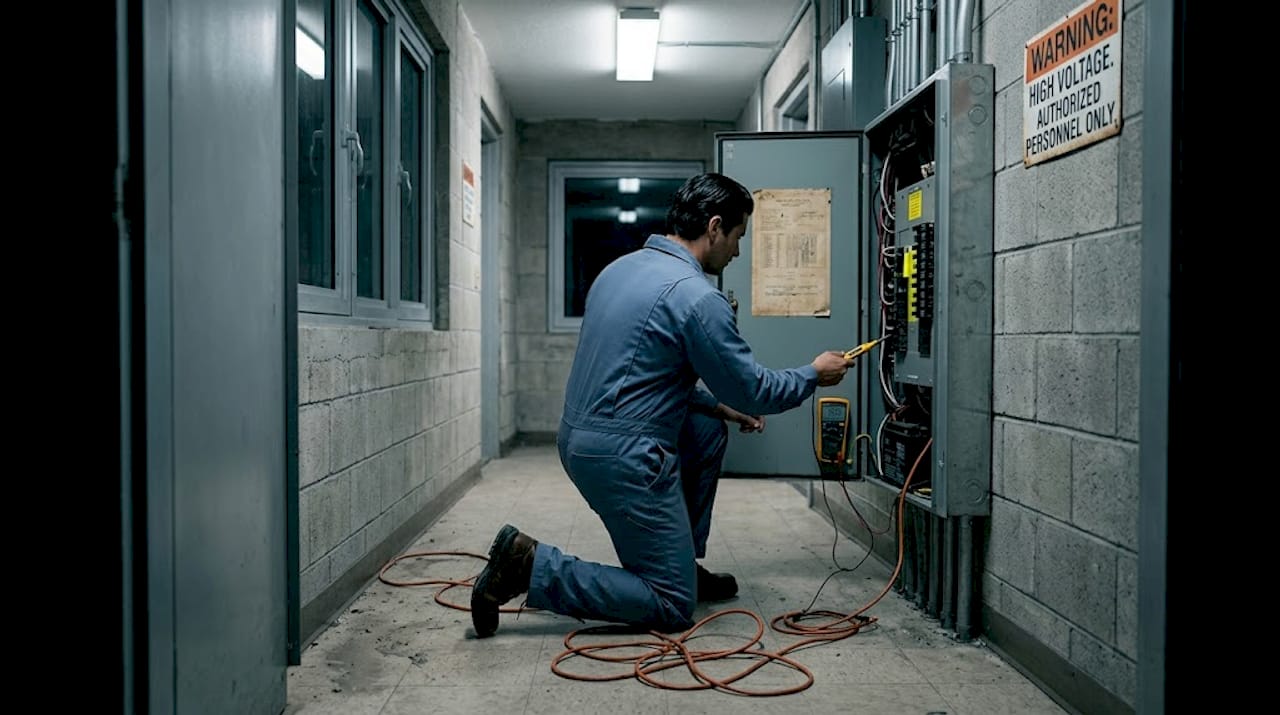
Power planning is equally important. Your BDA and supporting equipment must connect to a dedicated circuit with battery backup. Shared circuits introduce failure points during power events, which are common in South Florida during storm season.
With everything in hand, it’s time for step-by-step installation and setup.
Step-by-step signal boosting: Installation and setup
A clean installation follows a logical sequence. Skipping steps or rushing the donor antenna placement creates interference problems that are expensive to diagnose and fix after the fact.
-
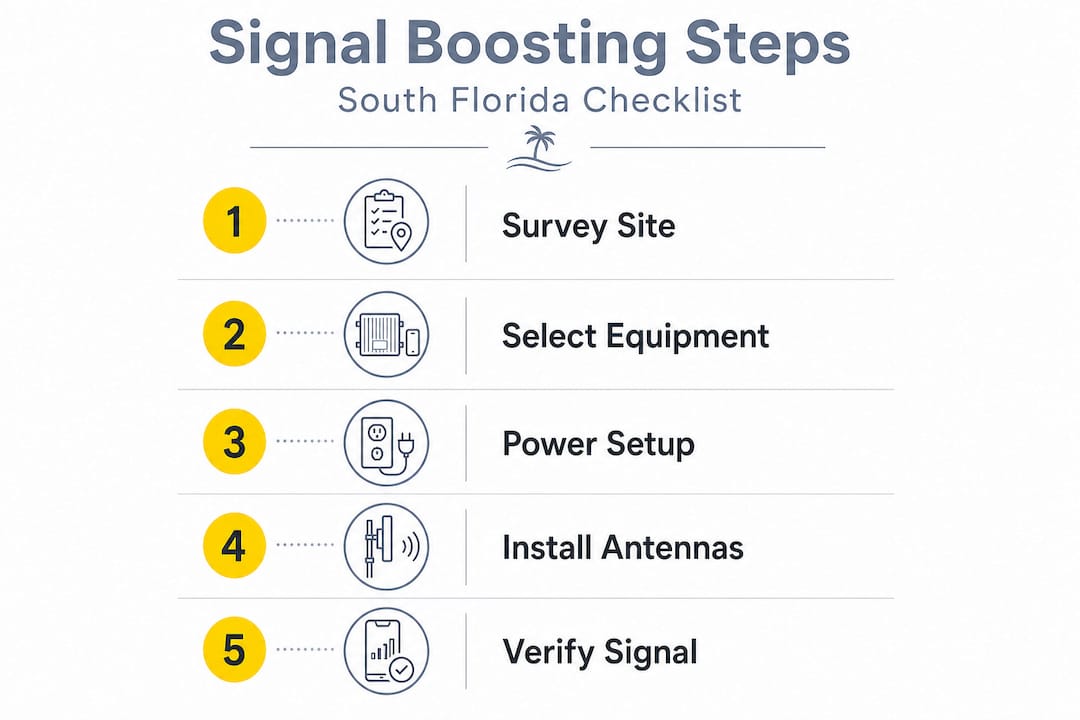
Conduct a pre-installation signal survey. Walk the entire property with a signal meter. Map every area where public safety radio signal drops below the required threshold. Document these locations with photos and floor plan markings. This survey becomes your installation blueprint.
-
Identify and mount the donor antenna. The donor antenna goes on the roof or exterior wall, pointed directly at the nearest public safety radio tower. Keep it as far as physically possible from your internal distribution antennas to prevent signal feedback loops (called oscillation), which can knock your BDA offline.
-
Run coaxial cable from the donor antenna to the BDA unit. Use the lowest-loss cable your budget allows. Every foot of cable costs you signal strength. Minimize bends and avoid running cable parallel to electrical conduit, which introduces interference.
-
Install the BDA in a secure, climate-controlled equipment room. South Florida heat and humidity destroy electronics faster than almost anywhere else in the country. Proper ventilation and temperature control extend equipment life significantly.
-
Deploy internal distribution antennas throughout the building. Focus first on stairwells, elevator shafts, parking structures, and basement levels. These are the areas where signal dies first and where first responders need it most.
-
Connect backup power and verify battery capacity. Your system must stay operational during a power outage. Test the battery under load before signing off on the installation.
-
Register the system with the FCC and submit required local documentation. Do not activate the system before completing registration. Operating an unregistered BDA is a federal violation.
“Class B boosters present a real risk in professional installations. Without explicit consent from the licensed carrier, a Class B booster can inject harmful noise into the public safety network, violating FCC rules and potentially disrupting emergency communications across a wide area.” This is not a theoretical concern. It has resulted in enforcement actions against building owners who used consumer-grade boosters without understanding the regulatory difference.
Comparison: Class A vs. Class B BDA
| Feature | Class A BDA | Class B BDA |
|---|---|---|
| Regulatory status | ERCES compliant | Not compliant for public safety |
| Uplink squelch | Required and included | Typically absent |
| FCC registration | Mandatory | Consumer registration only |
| Carrier consent required | Yes | Yes, but often ignored |
| Recommended for property managers | Yes | No |
Pro Tip: Run PoE cabling for all network-connected security and communication components rather than relying on WiFi. PoE over WiFi eliminates the wireless interference variables that cause intermittent failures in high-density residential and commercial buildings. When a security camera or access control panel loses its WiFi connection at 2 a.m., you have a problem. When it’s hardwired via PoE, you don’t.
Now that the system’s installed, ongoing testing keeps you safe and compliant.
Verifying performance and staying compliant
Installation is only half the job. The testing and documentation phase is what actually keeps you compliant when the fire marshal walks through the door.
-
Perform a full grid test immediately after installation. A grid test involves walking a predetermined path through every area of the building while recording signal strength at regular intervals. Most jurisdictions require coverage at 95% or more of the building’s critical areas.
-
Test backup battery performance under load. Disconnect shore power and verify that the system maintains full operation for the required minimum duration. Document the test start time, end time, and system status throughout.
-
Document everything in a format your AHJ (Authority Having Jurisdiction) accepts. This typically includes floor plan overlays showing signal coverage, test results with timestamps, equipment serial numbers, and FCC registration confirmation.
-
Set your annual testing schedule and stick to it. Annual grid and battery testing is mandatory under NFPA and IFC codes. Missing this cycle is one of the fastest ways to trigger an occupancy block.
-
Keep a physical binder and a digital backup of all test records on-site. Inspectors sometimes arrive without advance notice. Having organized documentation ready demonstrates professionalism and speeds up the inspection process.
Pro Tip: Schedule your annual tests at least 60 days before your building’s certificate of occupancy renewal date. This gives you time to identify and correct any deficiencies before they become a compliance emergency that stops your operations.
Even experts encounter unique hurdles. Next, we tackle common mistakes and advanced troubleshooting.
Solving common signal boosting challenges in South Florida
South Florida’s building stock creates challenges you won’t find in most national installation guides. Here’s what actually shows up in the field.
Concrete and brick attenuation is severe. Hurricane-rated construction uses significantly more reinforced concrete than standard buildings. Signal loss through these walls can exceed 30 dB (decibels), which effectively renders a standard installation useless. The fix is more internal antennas at closer spacing, not a more powerful BDA. More power without better antenna placement just creates hot spots and dead zones.
Donor antenna placement requires careful planning. In dense urban areas like Miami, Broward, and Palm Beach counties, your donor antenna may pick up signals from multiple towers simultaneously. This creates interference that degrades the amplified signal inside the building. Use a directional antenna with a narrow beam width and aim it precisely at your target tower.
- Avoid placing donor antennas near HVAC equipment, which generates radio frequency noise
- Maintain at least 50 feet of vertical or horizontal separation between donor and internal antennas
- Use a spectrum analyzer to verify clean signal before finalizing antenna position
Licensing and professional consultation are not optional extras. Many property managers attempt to handle BDA installations with in-house maintenance staff. This approach almost always results in failed inspections because the technical and regulatory requirements exceed what general maintenance personnel are trained to handle. FCC signal booster rules require that installations be performed by or under the supervision of someone who understands carrier coordination, FCC registration, and local code requirements.
“Using an improperly configured booster in a South Florida building does not just risk a fine. It risks disrupting the public safety radio network that first responders depend on during emergencies. The liability exposure from that scenario is significant.”
Interference fines are real. The FCC actively monitors for unauthorized or improperly configured boosters. Enforcement actions can result in fines, mandatory equipment removal, and in serious cases, criminal referrals. The cost of getting this right the first time is always less than the cost of remediation and fines.
Having mastered the essentials, here’s our expert take on deploying signal boosting in the real world.
What most property managers miss about signal boosting
After working on signal boosting projects across South Florida’s commercial and residential properties, the pattern we see most often is this: property managers treat signal boosting as a one-time checkbox rather than an ongoing infrastructure responsibility. That mindset creates compounding problems.
The biggest misconception is that a WiFi-based solution is “good enough” for security and communication reliability. It isn’t. WiFi networks in multi-tenant buildings are congested, subject to interference from neighboring networks, and vulnerable to outages that happen at the worst possible times. A hardwired PoE infrastructure for your security cameras, access control, and communication equipment gives you a level of reliability and control that no wireless solution can match. When something fails on a PoE network, you know exactly where the break is. With WiFi, you’re chasing ghosts.
The second thing most managers miss is the value of a professional signal survey before making any purchasing decisions. Too many facilities buy equipment based on a vendor’s recommendation, then discover during installation that the building’s structure requires a completely different approach. A pre-purchase survey costs a fraction of what a failed installation and remediation project costs.
Finally, minimal compliance is a trap. Meeting the bare minimum requirements today often means failing the next inspection cycle when codes tighten or your equipment degrades. Building in a margin of coverage and maintaining rigorous documentation from day one is the approach that keeps your occupancy certificate intact and your liability exposure low.
Get expert help with your signal boosting project
Signal boosting done right protects your tenants, your first responders, and your investment. If you’re managing a property in South Florida and you’re not certain your current system meets current ERCES and FCC standards, the time to act is before your next inspection.
At Low Voltage Electrician, we specialize in the installation, repair, and maintenance of cell boosters, security cameras, wired and wireless networks, and motorized gates across South Florida. Our team understands the specific code requirements, structural challenges, and documentation standards that apply to your market. When you’re ready to move forward, professional signal boosting help is one call away. We handle the technical complexity so you can focus on managing your property with confidence.
Frequently asked questions
What certifications are needed before installing a BDA in South Florida?
You must complete FCC registration and meet local ERCES requirements, including Class A narrowband BDA specifications with uplink squelch and proper frequency support, before activating any system.
How often do I need to test my signal boosting system?
Annual grid and battery testing is mandatory under NFPA and IFC codes, and skipping this cycle can result in your building’s occupancy certificate being blocked.
What should I do when my building’s structure blocks signal?
Increase your internal antenna density and consult a professional, because concrete and brick attenuation in hurricane-rated South Florida construction is severe enough to require a site-specific design rather than a standard installation approach.
Why avoid WiFi-based signal boosters?
WiFi-based solutions introduce interference and reliability risks that PoE installations eliminate entirely, making PoE the professional standard for security and communication infrastructure in commercial properties.