Low voltage systems run through nearly every commercial property in South Florida, from security cameras and motorized gates to wireless networks and cell signal boosters. Many property and facility managers assume these systems carry minimal risk because the voltage is low. That assumption is wrong, and OSHA warns explicitly that low voltage does not mean hazard-free. Electrical hazards still exist, and safe-work discipline including planning, appropriate PPE, and correct lockout/tagout procedures applies just as much here as it does with high voltage systems. This article gives you the practical, evidence-based safety tips you need to protect your team and your property.
Table of Contents
- Understand low voltage classifications and rules
- Plan safe work on low voltage systems
- Recognize and control arc flash boundaries
- Handle interface and edge-case hazards
- Implement practical workflow for ongoing safety
- A smarter approach: Why “low voltage equals safe” is outdated
- Next steps: Expert help and solutions
- Frequently asked questions
Key Takeaways
| Point | Details |
|---|---|
| Classification is crucial | Correctly classifying low voltage systems prevents hazards and ensures compliance. |
| Safe work discipline required | Planning, PPE, and lockout/tagout are essential even for low voltage circuits. |
| Arc flash risks persist | Arc flash boundaries apply; relying only on limited approach is not enough. |
| Edge-case hazards matter | Interfaces with higher-energy systems can pose unseen risks to staff. |
| Ongoing workflow improves safety | Written, systematic procedures help maintain safe and functional systems long-term. |
Understand low voltage classifications and rules
Classification is the foundation of every safe low voltage decision you make. Before anyone touches a wire or opens a panel, you need to know exactly what type of system you are dealing with and what rules govern it. Skipping this step is one of the most common and most costly mistakes facility managers make.
The National Electrical Code (NEC) is the primary reference for this. NEC Article 725 establishes the framework for remote-control, signaling, and power-limited circuits, dividing them into Class 1, Class 2, and Class 3 categories. Class 2 and Class 3 circuits are the most common in commercial settings. They are defined not just by voltage but by the energy limitations of their listed power sources. This distinction matters enormously because a circuit’s classification determines how it must be wired, what materials are acceptable, how it must be separated from other circuits, and who is qualified to inspect or work on it.
Misclassification is a serious problem. A circuit that looks like a Class 2 low-power signal line might actually be a Class 1 circuit if its power source is not properly listed or if it has been modified. Working on a misclassified circuit with the wrong assumptions and tools puts your technicians at real risk. Exploring safe low voltage wiring practices before any installation or inspection helps you avoid these traps.
- Class 1 circuits: Operate at up to 600V and carry higher energy; require standard electrical wiring methods.
- Class 2 circuits: Power-limited, generally 30V or less; reduced wiring requirements but still regulated.
- Class 3 circuits: Similar to Class 2 but allow higher voltage up to 150V under specific conditions; stricter installation rules apply.
- Listed power sources: The power supply must be specifically listed for Class 2 or Class 3 use; substituting an unlisted supply changes the classification entirely.
Pro Tip: Always pull up the relevant NEC article before any inspection or installation project, not after. Knowing the classification upfront shapes every decision that follows, from which tools to bring to which personnel are qualified to do the work.
Plan safe work on low voltage systems
Once systems are properly classified, daily work demands disciplined safety practice. Classification tells you what you are dealing with. Safe work planning tells you how to deal with it without getting hurt.
The first step is a thorough risk assessment before any work begins. This means identifying all energized components in the work area, confirming circuit classifications, reviewing system documentation, and evaluating whether the work can be done with the system deenergized. Most low voltage work should be done with the system off. The fact that a circuit is low voltage does not make live work acceptable by default.
Personal protective equipment (PPE) is still required for low voltage work in many scenarios. At minimum, technicians should wear safety glasses, insulated gloves rated for the voltage level, and non-conductive footwear. When working near energized components or in areas where arc flash is a possibility, arc-rated PPE is necessary. Many facility managers underestimate this because they associate full PPE requirements only with high voltage environments.
Lockout/tagout (LOTO) procedures are non-negotiable. LOTO is a formal process that ensures a circuit is truly deenergized and cannot be accidentally re-energized while someone is working on it. It involves physically locking the energy source in the off position and tagging it with a warning. Here is where a critical distinction comes into play:
“Deenergizing is not the same as lockout/tagout.” Simply turning off a switch or unplugging a device does not constitute a proper lockout/tagout. OSHA is explicit that electrical hazards remain real even on low voltage systems, and that correct LOTO discipline is required for true worker protection.
Follow these steps for every low voltage work task:
- Identify all energy sources connected to the circuit or equipment, including backup power and UPS systems.
- Notify affected personnel so no one inadvertently re-energizes the system during work.
- Deenergize the circuit using the appropriate disconnect or breaker.
- Apply lockout/tagout devices to all energy isolation points.
- Verify deenergization using a calibrated voltage tester before touching any conductors.
- Complete the work using appropriate tools and PPE.
- Remove LOTO devices only after confirming the work area is clear and all personnel are safe.
Reviewing low voltage safety methods with your team before starting any project is a smart investment of time that pays off in injury prevention.
Recognize and control arc flash boundaries
Disciplined work practice must include protecting against arc flash risks, not just general electrical hazards. Arc flash is a sudden release of energy caused by an electrical fault. It produces intense heat, blinding light, pressure waves, and molten metal. It can cause severe burns and fatalities even in low voltage environments.
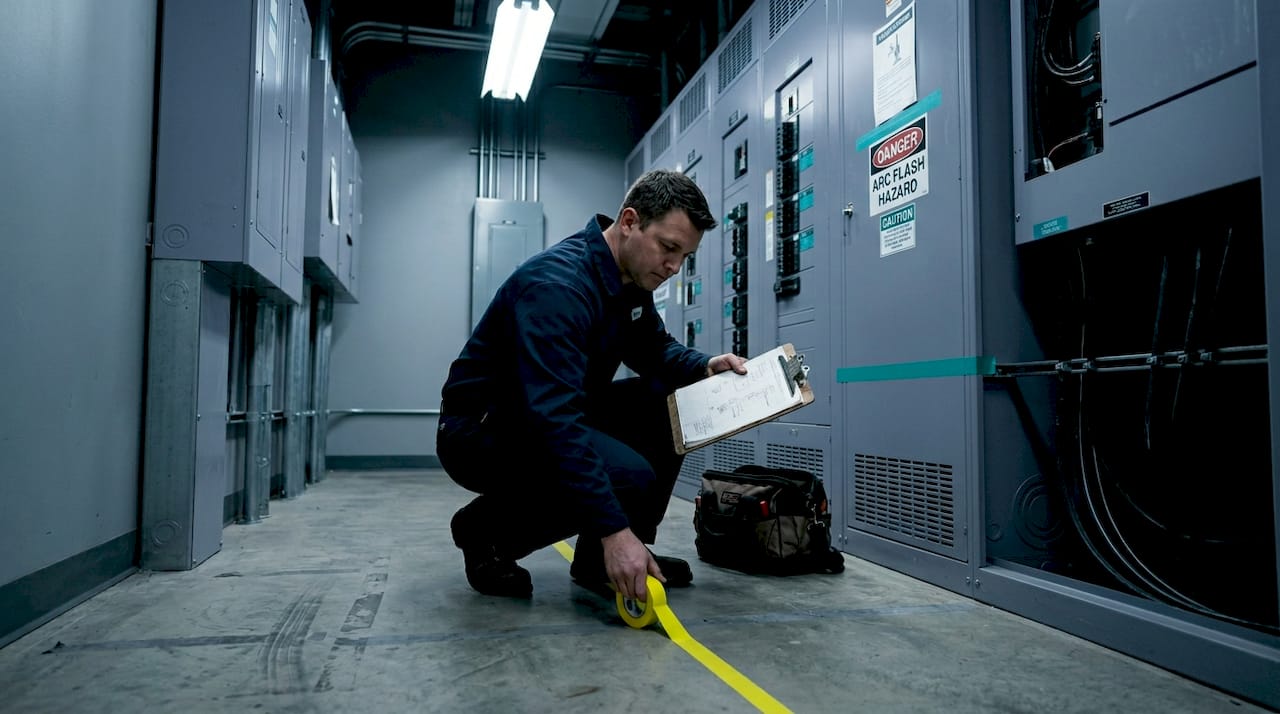
An arc flash boundary is the distance from an energized source within which a person could receive a second-degree burn from an arc flash event. The standard threshold is 1.2 cal/cm² of incident energy, which is the level at which skin damage begins. Anyone inside that boundary during an arc flash event without proper arc-rated PPE is at serious risk of injury.
The mistake many facility managers make is relying only on the concept of a “limited approach boundary,” which defines how close an unqualified person can get to energized equipment. The limited approach boundary is about shock protection. It is not the same as the arc flash boundary, and the two do not always overlap in ways that keep workers safe. Risk assessment and boundary-based protection are both required when electrical work is performed near energized equipment. Relying on limited approach concepts alone can still leave workers inside the arc flash boundary.
| Boundary type | Purpose | Who it applies to | Typical distance (low voltage) |
|---|---|---|---|
| Limited approach | Shock protection | Unqualified persons | Varies by system voltage |
| Restricted approach | Shock protection | Qualified workers only | Closer than limited approach |
| Arc flash boundary | Burn protection from arc | All workers | Based on incident energy calculation |
| Prohibited approach | Treated as contact with live part | Qualified workers, special PPE | Closest to the source |
Use this table as a reference when planning work near energized low voltage equipment. Knowing which boundary applies to which worker category prevents dangerous assumptions. Reviewing safe installation strategies for your specific systems helps you map these boundaries accurately before work begins.
Handle interface and edge-case hazards
Boundary risks also extend to interface scenarios, which deserve focused attention. Some of the most dangerous situations in low voltage work do not involve the low voltage system itself. They involve the places where low voltage circuits meet higher energy components.
Edge-case hazards arise when low voltage circuits interface with higher-energy components such as power distribution cabinets, misidentified circuit types, or improperly managed pathways and penetrations. These scenarios are common in commercial properties, especially in older buildings or facilities that have been retrofitted multiple times.
Consider a technician running a network cable through a conduit that also contains 120V power wiring. The low voltage cable itself poses minimal risk, but the shared conduit creates exposure to a much higher energy source. Or consider a cabinet where a security camera power supply sits next to a 208V distribution block. Opening that cabinet to service the camera creates arc flash and shock exposure that has nothing to do with the camera circuit itself.
Common edge-case scenarios and their risk levels:
| Scenario | Risk level | Key hazard |
|---|---|---|
| Low voltage cable in shared conduit with power wiring | High | Contact with energized power conductors |
| Servicing security equipment in mixed-use cabinets | High | Arc flash from adjacent high-energy components |
| Misidentified circuit type (Class 1 labeled as Class 2) | High | Incorrect PPE and tools for actual energy level |
| Network equipment near HVAC power panels | Medium | Accidental contact during maintenance |
| Penetrations through fire-rated walls without proper sealing | Medium | Code violation and potential fire spread |
| Loose or damaged low voltage connectors near power strips | Low to medium | Short circuit risk if conductor contacts power |
Key areas to watch for edge-case hazards:
- Mixed-use electrical cabinets where low voltage and line voltage equipment share the same enclosure
- Conduit and pathway intersections where different circuit types run in close proximity
- Improperly labeled circuits that were modified after original installation
- Penetrations through walls and floors that were not sealed or documented correctly
- Retrofit installations where new low voltage systems were added without updating system documentation
Pro Tip: Always cross-check your work with current system documentation before opening any cabinet or pulling any cable. If the documentation is outdated or missing, treat the work area as a higher-risk environment until you can verify what is actually there. Keeping up with maintaining low voltage systems through regular audits is one of the best ways to stay ahead of these risks.
Implement practical workflow for ongoing safety
Translating these principles into practice requires a real workflow. Good intentions and general awareness are not enough to protect your team or keep your property in compliance. You need a written, repeatable process that every qualified person on your team follows.
A written workflow for classification and inspection should tie circuit type to inspection requirements and define who is qualified to perform each task. This is not just a best practice. It is a practical compliance tool that protects your organization in the event of an incident or inspection.
Here is a stepwise workflow that works for most commercial facilities:
- Document all low voltage systems by type: security cameras, access control, network, fire alarm, communications, cell boosters, and motorized gates.
- Classify each system using NEC Article 725 and other applicable articles (fire alarm systems fall under Article 760, for example).
- Assign qualified personnel based on classification. Class 2 and Class 3 work may require a licensed low voltage contractor. Fire alarm work requires specific licensing in Florida.
- Establish inspection intervals for each system type. Security cameras and network infrastructure should be inspected at least annually. Motorized gates and access control systems may require more frequent checks.
- Create a pre-work checklist for each task category that covers risk assessment, PPE requirements, LOTO procedures, and boundary identification.
- Log all work performed including who did it, what was found, and what was corrected.
- Review and update documentation after any modification, addition, or incident.
A written workflow also helps you manage contractors. When you hire outside vendors for workflow for safe wiring or installation projects, your documented procedures set clear expectations and give you a basis for evaluating their work.
Benefits of a written workflow include:
- Consistent safety outcomes regardless of which technician performs the work
- Clear accountability for every task and inspection
- Faster onboarding for new staff or contractors
- Documented evidence of compliance during audits or insurance reviews
- Easier identification of gaps or outdated procedures
A smarter approach: Why “low voltage equals safe” is outdated
Here is the uncomfortable truth that most generic safety guides will not tell you: the phrase “low voltage” has become a false comfort for facility managers, and it is actively creating risk in commercial properties across South Florida.
The problem is not that people are reckless. It is that the language itself encourages underestimation. When a manager hears “low voltage,” they mentally file it under “not my biggest concern.” That mental shortcut leads to deferred inspections, skipped LOTO procedures, untrained technicians, and mixed-use cabinets that nobody has audited in years.
OSHA materials explicitly warn against the myth that low voltage equipment cannot produce arcs, reinforcing that safety controls must be task-specific and condition-specific. A 48V DC power supply for a security camera system can still produce a sustained arc if a fault occurs. A network switch powered by a PoE (Power over Ethernet) injector can still cause injury if a technician works on it without proper precautions in a cabinet that also contains line voltage equipment.
The real shift in thinking is this: stop evaluating risk by voltage label and start evaluating it by task and environment. A technician replacing a camera in an isolated outdoor mounting bracket faces very different risks than a technician servicing the same camera’s power supply inside a mixed-use electrical cabinet. Same system. Completely different risk profile.
Every task deserves its own assessment. That is not bureaucracy. That is the actual standard that keeps people safe and keeps your facility compliant.
Next steps: Expert help and solutions
Managing the safety and compliance of low voltage systems across a commercial property is not a one-time project. It is an ongoing responsibility that requires current knowledge, proper tools, and qualified personnel.

At Low Voltage Electrician, we specialize in the installation, repair, and maintenance of the exact systems you manage every day: security cameras, motorized gates, wired and wireless networks, and cell signal boosters. Our team understands South Florida’s commercial environment and the specific compliance requirements that apply here. When you need low voltage safety expertise you can rely on, from a properly documented installation to a full system audit, we are the team that knows how to get it done right and keep your property protected.
Frequently asked questions
What is considered low voltage for commercial buildings?
Low voltage typically means systems operating at 50V or less, but classification and rules depend on NEC Article 725 and the specific circuit purpose, not voltage alone.
Why does lockout/tagout matter for low voltage systems?
Even low voltage circuits can cause shock or arc flash, so lockout/tagout procedures are essential for ensuring true deenergization. OSHA confirms that safe-work discipline applies to all electrical systems regardless of voltage level.
How do arc flash boundaries apply to low voltage systems?
Arc flash boundaries are still relevant for low voltage work because incident energy thresholds and risk assessment requirements apply based on the energy present, not just the voltage rating of the circuit.
What are edge-case hazards in low voltage systems?
Edge-case hazards occur when low voltage circuits interface with higher energy components. OSHA identifies scenarios such as power distribution cabinets, misidentified circuits, and improperly managed conduit pathways as common sources of these risks.
How can managers improve ongoing safety for low voltage systems?
Managers can implement a written classification workflow that ties each circuit type to specific inspection requirements and qualified personnel assignments, creating a consistent, auditable safety process.