Most property and facility managers hear the word “firewall” and immediately think of network security, routers, and IT infrastructure. That mental shortcut makes sense in a world where cybersecurity dominates the conversation. But in low voltage wiring, the word “firewall” means something entirely different, something physical, code-mandated, and directly tied to the safety of your building, your tenants, and your bottom line. Miss it, and you are looking at failed inspections, costly rework, and serious liability exposure.
Table of Contents
- What does firewall mean in low voltage wiring?
- Why is physical separation required? Key risks and code compliance
- Real-world scenarios: Firewalls in South Florida properties
- Physical firewall vs. network firewall: Avoiding common mix-ups
- Why most managers overlook physical firewalling—and what it costs
- Get expert help on firewalls and low voltage projects
- Frequently asked questions
Key Takeaways
| Point | Details |
|---|---|
| Physical firewall defined | A firewall in low voltage means a physical separation protecting cables—not just digital security. |
| Risks of non-compliance | Ignoring firewall standards leads to fire hazards, interference, and legal/inspection troubles. |
| Code-driven necessity | Separation is not optional; it is mandated by national and local building codes. |
| Special cases matter | PoE, fire alarm, and firestopping rules require special attention in real-world upgrades. |
What does firewall mean in low voltage wiring?
When electricians and inspectors talk about a “firewall” in the context of low voltage systems, they are not talking about software or digital protection. They are talking about a physical barrier or required separation between different classes of electrical cables inside your building’s walls, conduits, and cable trays.
Low voltage wiring covers a wide range of systems that property managers deal with every day: security cameras, access control, network cabling, intercom systems, motorized gate controls, and cell signal boosters. These systems run on Class 2 or Class 3 circuits, which operate at significantly lower voltage levels than standard AC power wiring. The problem arises when these cables share pathways with high voltage lines.
“Firewall” in low voltage wiring refers to physical separation per NEC Article 725.136, not a digital security device.
Here is what the physical firewall requirement actually covers:
- Separation distance: Low voltage cables must maintain a minimum physical distance from high voltage conductors inside conduits, raceways, and junction boxes.
- Dedicated pathways: In many installations, low voltage cables must run in their own conduit or cable tray, completely separate from power wiring.
- Barrier materials: Where separation distance cannot be achieved, physical barriers made of approved materials must be installed between cable types.
- Penetration sealing: Where cables pass through fire-rated walls or floors, those penetrations must be sealed with listed firestop materials.
Understanding these requirements is the foundation of a safe, code-compliant installation for any South Florida property. Whether you are managing a commercial office park in Broward County or a multi-family residential complex in Miami-Dade, these rules apply to you.
Why is physical separation required? Key risks and code compliance
Now that you understand what a physical firewall is, let’s talk about why it exists and what happens when it is ignored. The requirements are not arbitrary. They address three specific, well-documented risks that affect real buildings every year.
Risk 1: Electromagnetic interference (EMI)
High voltage AC wiring generates electromagnetic fields. When low voltage signal cables run parallel to power cables without separation, those fields can induce noise into the signal cables. For a security camera system, this means distorted video feeds. For a fire alarm circuit, it could mean false triggers or missed signals. For a network cable, it means dropped packets and unreliable connectivity. EMI is invisible, hard to diagnose after the fact, and entirely preventable with proper separation.
Risk 2: Shock and electrocution hazards
If insulation on a high voltage conductor fails and that conductor contacts a low voltage cable, the voltage can travel along the low voltage cable to connected devices, to wall plates, and potentially to people touching those devices. This is not a theoretical risk. Physical separation is mandated to prevent interference, shock, and fire risks under NEC Article 725.136. The code exists because incidents happened before it was written.
Risk 3: Fire propagation
Cables inside walls and conduits can act as fuel and pathways for fire. When cables from different systems are bundled together without proper separation or firestopping, a fire that starts at one point can travel rapidly through the cable bundle into adjacent spaces. Proper physical firewalling limits this spread and gives occupants more time to evacuate.
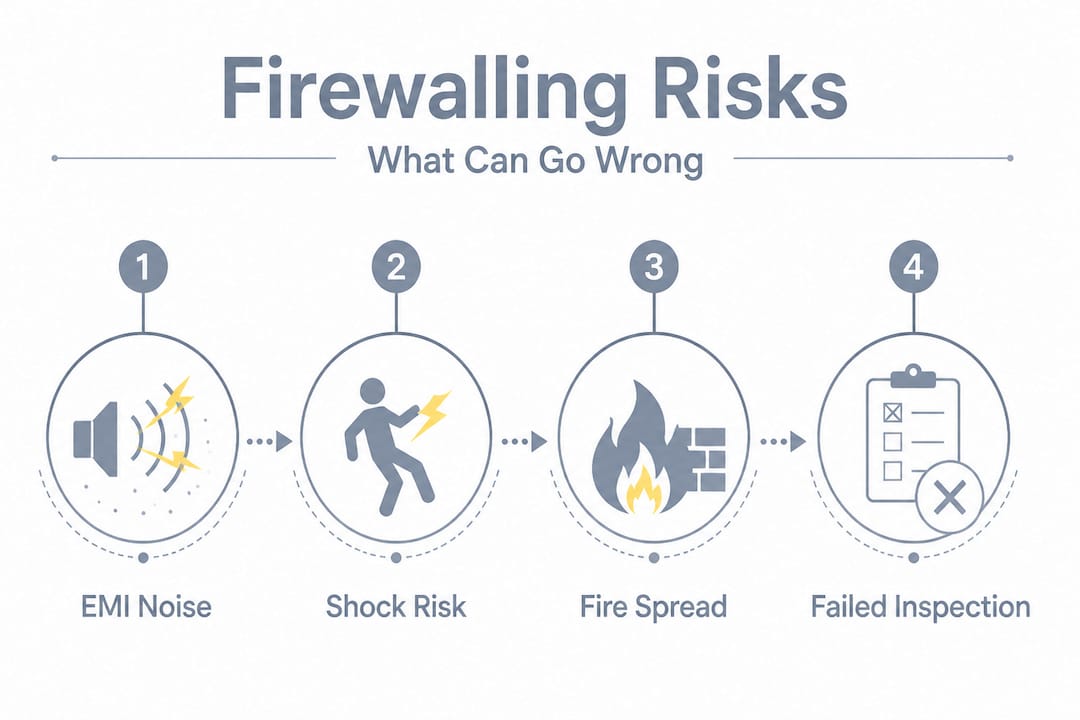
Here is a quick comparison of what compliant versus non-compliant installations look like in practice:
| Factor | Compliant installation | Non-compliant installation |
|---|---|---|
| Cable routing | Separate conduits or trays | Mixed bundles in shared conduit |
| Separation distance | Maintained per NEC 725.136 | Ignored or unknown |
| Penetrations | Firestopped with listed materials | Open or patched with drywall compound |
| Documentation | As-built drawings available | No records kept |
| Inspection outcome | Pass | Fail, with mandatory rework |
Here is the step-by-step process inspectors typically follow when evaluating your low voltage installation:
- Check that low voltage cables are identified and labeled by class.
- Verify separation from high voltage conductors in all shared spaces.
- Inspect junction boxes for mixed wiring.
- Examine all fire-rated wall penetrations for approved firestop materials.
- Review as-built documentation to confirm routing complies with approved plans.
Pro Tip: Before any renovation or new system installation, pull your local code amendments. Florida follows the NEC but Miami-Dade and Broward counties sometimes add requirements on top of the base code. A quick call to the local building department saves you from a surprise during final inspection.
Real-world scenarios: Firewalls in South Florida properties
Let’s bring this out of the code books and into the field. South Florida properties face specific challenges that make firewall compliance more complex than in other regions. High humidity, older building stock in areas like Coral Gables and Fort Lauderdale, and the rapid adoption of smart building technology all create situations where physical firewalling gets complicated fast.
Scenario 1: PoE camera installations
Power over Ethernet (PoE) cameras are now the standard for commercial security systems. They are convenient because data and power travel over the same network cable. But that convenience creates a compliance question. PoE cables carry power, even if it is limited energy. Special cases include PoE cable separation, fire alarm pathway rules, and firestopping penetrations. PoE is treated as limited energy cabling, which means it still requires separation from standard AC power wiring. Running your PoE camera cables alongside the building’s 120V circuits in the same conduit is a code violation, even though the PoE side is “just low voltage.”
Scenario 2: Fire alarm cable routing
Fire alarm systems carry some of the strictest separation and routing requirements of any low voltage system. They must be protected from physical damage, routed away from areas where they could be compromised, and separated from other low voltage systems in many cases. In a high-rise building in Brickell or a hotel in Hollywood, the fire alarm cabling often runs through the same ceiling spaces as security cameras, network cables, and HVAC controls. Getting this routing right requires careful planning before installation, not after.
Scenario 3: Firestopping penetrations during renovation
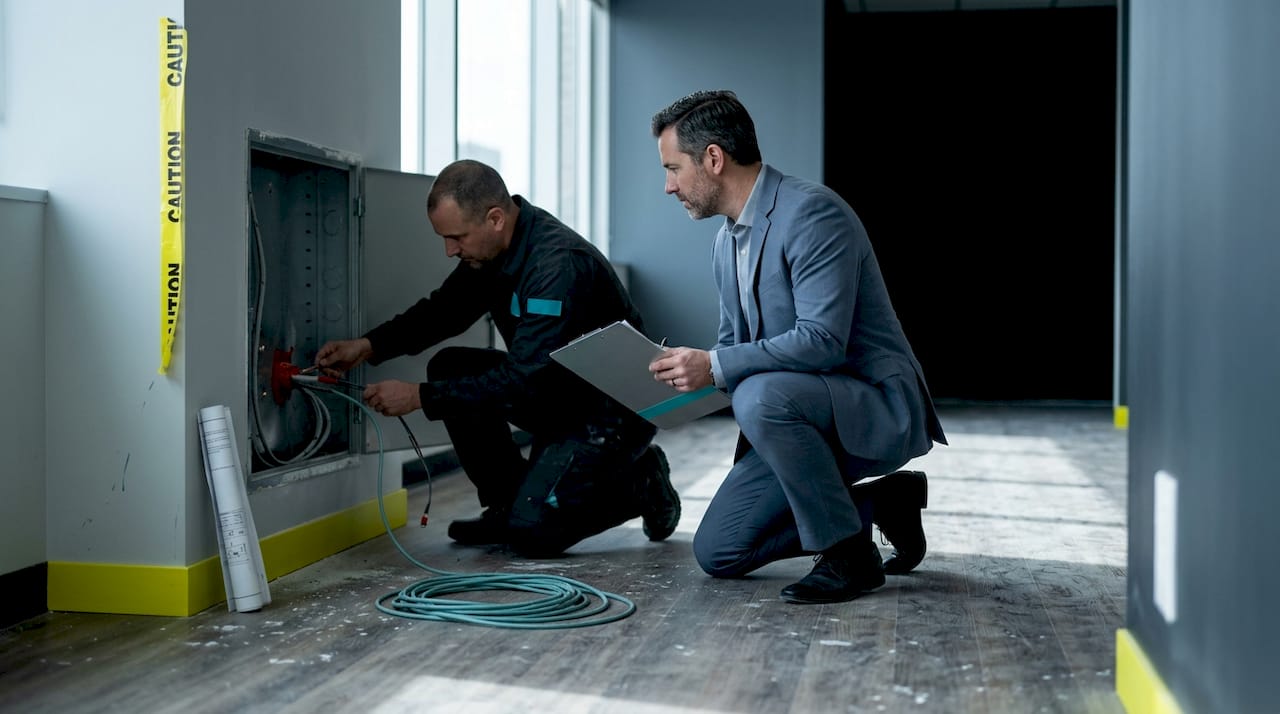
This is the most commonly missed requirement in renovation projects. When you run new network cables or add security cameras to an existing building, those cables often need to pass through fire-rated walls and floor assemblies. Every single penetration must be sealed with a listed firestop system, not just stuffed with insulation or patched with joint compound. Here is a breakdown of common penetration types and what is required:
| Penetration type | Required treatment | Common mistake |
|---|---|---|
| Cable through fire-rated wall | Listed firestop caulk or putty | Drywall compound or nothing |
| Conduit through fire-rated floor | Firestop collar or wrap strip | Conduit left open at floor |
| Cable tray through fire wall | Firestop pillow or mortar | Tray left unsealed |
| Multiple cables in sleeve | Intumescent firestop system | Single cable seal reused |
The key takeaway here is that firestopping is not optional for low voltage cables just because they carry less power. The fire rating of the wall must be maintained regardless of what passes through it.
Physical firewall vs. network firewall: Avoiding common mix-ups
With the real-world applications covered, it is worth directly addressing the terminology confusion that trips up so many property managers and even some contractors.
A network firewall is a hardware device or software system that monitors and controls incoming and outgoing network traffic based on security rules. It protects your digital infrastructure from unauthorized access, malware, and data breaches. This is the firewall your IT team manages.
A physical firewall in the low voltage wiring context is a code-mandated cable separation system. It has nothing to do with digital security. It is about organizing cables, maintaining distances, and sealing penetrations to prevent physical hazards.
Here is where the mix-up causes real problems:
- A contractor unfamiliar with low voltage code might hear “firewall” and think you are asking about network security, leading to a completely wrong scope of work.
- A property manager might assume that because their building has a robust network firewall, the “firewall” requirements for their new camera system are already covered.
- During inspections, mixing up the two concepts can lead to incomplete documentation and failed reviews.
Network firewalls are distinct; low voltage firewalling is a physical separation, not a digital device. When you are briefing contractors or reviewing proposals for low voltage work, always specify which type of firewall you are discussing. It sounds like a small thing, but it prevents costly scope misunderstandings.
Pro Tip: When reviewing a contractor’s proposal for low voltage work, look for explicit mention of NEC Article 725.136 compliance and firestopping methods. If those terms are missing from the proposal, ask directly. A qualified low voltage contractor should reference these standards without prompting.
There is one area where the two concepts do overlap slightly: industrial control systems and building automation networks sometimes use devices called “industrial firewalls” that combine physical network isolation with digital security features. For most South Florida property managers dealing with security cameras, motorized gates, network infrastructure, and cell boosters, this is not relevant. Your focus should stay on the physical separation requirements.
Why most managers overlook physical firewalling—and what it costs
Here is the uncomfortable reality from our experience working on South Florida properties: physical firewalling is the most consistently overlooked aspect of low voltage installations. Not because managers are careless, but because the risk is invisible until something goes wrong.
Digital security threats are visible. You get alerts, breach notifications, and news stories about ransomware. Physical wiring violations sit quietly inside your walls until an inspector finds them, a fire starts, or someone gets hurt. That invisibility creates a false sense of safety.
The cost of ignoring physical firewall requirements is not just the fine from a failed inspection. It is the rework labor to open walls, re-route cables, and install firestopping after the fact. It is the insurance claim that gets denied because your installation was not code-compliant at the time of the incident. It is the liability exposure when a tenant or employee is injured because mixed wiring caused a shock hazard. We have seen renovation projects where the cost of correcting non-compliant low voltage wiring exceeded the original installation budget. That is not an exaggeration.
The managers who avoid these problems share one habit: they treat low voltage wiring with the same rigor they apply to high voltage electrical work. They require documentation, they verify contractor credentials, and they confirm that safe, code-compliant installation practices are followed before walls are closed. That proactive approach costs almost nothing compared to the alternative.
Get expert help on firewalls and low voltage projects
Navigating NEC Article 725.136, local Florida code amendments, and firestopping requirements across a large property is not something you should leave to a general contractor who “also does low voltage.”

Low Voltage Corp specializes in exactly this kind of work for South Florida property and facility managers. From security camera installations and motorized gate systems to structured network wiring and cell signal boosters, every project is handled with code compliance built in from the start, not added as an afterthought. If you are planning a renovation, upgrading your security infrastructure, or just want a compliance review of your existing low voltage systems, Low Voltage Corp solutions are built for your specific environment. Reach out to discuss your property’s needs and get a clear picture of where you stand with current code requirements.
Frequently asked questions
What are the main code requirements for firewalling low voltage cables?
NEC Article 725.136 mandates physical separation between low voltage and high voltage cables to prevent interference, shock, and fire hazards. Local jurisdictions like Miami-Dade and Broward may have additional amendments on top of the base NEC requirements.
How does firewalling affect retrofits or renovations in older buildings?
Retrofits must restore fire-rated separations wherever new cables are added. Penetrations through fire-rated walls require firestopping even for low voltage cables, and older buildings often have existing penetrations that were never properly sealed and must be corrected during the renovation.
Do Power over Ethernet (PoE) cables need firewall separation?
Yes. PoE treated as limited energy cabling still requires separation from AC power wiring, even though the power levels are much lower than standard branch circuits.
How can property managers ensure they follow firewall requirements?
Hire low voltage professionals who explicitly reference NEC Article 725.136 and firestopping standards in their proposals, and always verify local code amendments with your South Florida building department before starting any installation or renovation project.