No, you generally cannot record a private conversation in Florida unless every person involved agrees to it. Florida is one of the strictest all-party consent states in the country under Fla. Stat. § 934.03, and breaking that rule is a third-degree felony carrying significant prison time and substantial fines. If you’re not sure whether you have consent, the safe move is simple: ask first, or don’t hit record.
TL;DR:
- Recording a private conversation in Florida without all-party consent is a third-degree felony, punishable by up to five years in prison and a $5,000 fine per violation.
- Phone calls are protected regardless of location, and participants who secretly record a call violate the law even if they are involved in the conversation.
- Civil lawsuits for damages can be filed alongside criminal charges, with victims able to claim damages, punitive damages, and attorney’s fees for illegal recordings.
- Exceptions to recording rules include law enforcement with proper authorization, minors documenting abuse, open government meetings, and court-ordered interceptions.
- Recording conversations from interstate calls is subject to the strictest consent law applicable, and illegally obtained recordings are generally inadmissible in court or administrative proceedings.
Table of Contents
- What Florida’s Audio Recording Law Actually Covers
- Penalties And Civil Remedies For Illegal Recordings
- When Florida Law Allows Recording Without Consent
- Can You Record Police Officers In Florida?
- Recording Calls Across State Lines: Florida’s Reach
- What Happens To Illegally Recorded Evidence
- How To Get Legal Consent Before You Record
- Security Cameras, Wearables, and Compliant Audio Systems
- Balancing Security Needs And Legal Risk
- Configuring Security Systems The Right Way
- Sources
What Florida’s Audio Recording Law Actually Covers
Florida’s wiretap statute, part of Chapter 934 (security of communications), splits protected conversations into three categories: wire, oral, and electronic communications. Wire communications are phone calls, including cell and landline conversations. Oral communications are in-person conversations where a participant has a reasonable expectation of privacy, like a private meeting behind closed doors. Electronic communications cover things like text-based messaging and other non-voice transmissions traveling over a network.
Here’s the distinction that trips people up most:
- Phone calls get categorical protection. It doesn’t matter where you’re standing or how private the setting feels. If it’s a wire communication, all-party consent applies, period.
- In-person conversations depend on context. A shouting match at a public park bench likely has no reasonable expectation of privacy. A closed-door HR meeting almost certainly does.
- Being on the call doesn’t give you a pass. Florida courts settled this in State v. Tsavaris, ruling that a participant who secretly records a call still violates the statute. Participation is not permission.
That last point catches even careful people off guard. You’d assume that since you’re part of the conversation, you can document your own end of it. Florida law says otherwise.
Penalties And Civil Remedies For Illegal Recordings
Get caught recording without consent in Florida, and you’re not looking at a slap on the wrist. The baseline offense is a third-degree felony, punishable by up to five years in prison and a maximum $5,000 fine per violation. Record three separate private conversations without consent, and you could face three separate felony charges.
There’s a narrow exception that drops the offense to a misdemeanor, tied to certain radio communication interceptions, but it applies in such limited circumstances that most violations still land at felony level.
Criminal exposure is only half the risk. Victims can also sue under § 934.06, and the civil remedies statute stacks up fast:
- Liquidated damages per day of violation or a minimum amount
- Actual damages tied to any provable harm
- Punitive damages where the conduct warrants it
- Attorney’s fees and litigation costs, recoverable by the winning plaintiff
A single unauthorized recording can trigger both a felony charge and a separate civil lawsuit at the same time. That double exposure is what makes Florida’s statute genuinely dangerous for anyone who assumes recording is a low-risk shortcut.
When Florida Law Allows Recording Without Consent
The statute isn’t absolute. It carves out specific, narrow situations where recording without full consent is lawful:
- Law enforcement interceptions. Police acting under proper authorization, including court-ordered wiretaps, fall outside the consent requirement. Private citizens working at an officer’s direction under specific legal authorization may also be covered, but this is not a blanket permission for civilians to record on police behalf.
- Minors documenting abuse. Florida allows narrow exceptions for minors recording conversations to capture evidence of physical abuse, and dissemination of those recordings is tightly restricted.
- Public government meetings. Recording at open meetings of governmental bodies is generally exempt from the all-party rule, as long as the recording doesn’t disrupt proceedings.
- Court-ordered interceptions. A judge can authorize interception under specific legal proceedings, separate from standard law enforcement wiretaps.
Outside these categories, there’s no general exception for private citizens who believe they’re capturing evidence of a crime. Legal guides are explicit on this point: unlike some other states, Florida does not let you record someone secretly just because you suspect wrongdoing.
Can You Record Police Officers In Florida?
Yes, and this is where people often confuse two different legal frameworks. The First Amendment protects your right to record police and public officials performing their duties in public spaces. Reporters Committee guidance confirms this right exists in Florida the same as anywhere else in the country.
But that constitutional right doesn’t erase the wiretap statute. If you’re on the phone with an officer, that’s still a wire communication, and all-party consent rules still apply. Standing across the street filming a traffic stop is different from recording a phone call with a detective.
Practical guidance for safely recording police encounters:
- Stay in public space and keep a reasonable distance that doesn’t interfere with the officer’s duties.
- Record openly rather than secretly. Visible recording avoids any ambiguity about consent expectations.
- Treat phone conversations with officers as wire communications requiring consent, even during an active investigation.
Recording Calls Across State Lines: Florida’s Reach
Interstate calls create a genuine gray zone. Florida courts have applied the principle that interception occurring within Florida falls under Florida law, an idea reinforced by cases like France v. France, which examined how out-of-state recorders can still trigger Florida’s jurisdiction.
If you’re calling someone in a one-party consent state from Florida, or vice versa, you can’t assume the more permissive rule protects you. Courts have leaned toward applying whichever state’s law governs where the interception physically happens, and that can mean Florida’s stricter standard controls even when the other party is elsewhere.
The practical rule for anyone making interstate calls:
- Default to the strictest consent requirement among every state involved in the call.
- Businesses recording customer service calls across state lines should get consent from every participant, not just the one in the most permissive jurisdiction.
- Never assume a call is “safe” to record just because your own state allows one-party consent.
What Happens To Illegally Recorded Evidence
An illegally intercepted recording generally can’t be used against the other party in court. § 934.06 excludes unlawfully obtained communications from most legal and administrative proceedings, and that exclusion extends beyond the recording itself.
- Derivative evidence gets tainted too. If an illegal recording leads investigators to a witness or a document, that downstream evidence can also face exclusion.
- Administrative hearings aren’t exempt. Employment disputes and licensing boards face the same admissibility problems as criminal courts.
- Civil recovery still works either way. A plaintiff whose private conversation was illegally recorded can pursue damages under § 934.10 whether or not the recording ever gets admitted anywhere.
That last point matters: losing the ability to use a recording in court doesn’t erase the underlying violation. The person who made it is still exposed to felony charges and a civil judgment.
How To Get Legal Consent Before You Record
Getting valid consent doesn’t require a notarized document. It requires clarity, and ideally, a record that you asked.
- State it plainly at the start. Something like: “I’d like to record this call for accuracy. Is that okay with everyone?” A clear yes from every participant satisfies the requirement.
- Preserve proof of consent. A follow-up email confirming “as discussed, this call was recorded with everyone’s agreement” creates a paper trail. Verbal consent captured at the start of the recording itself works too, as long as every party’s agreement is audible.
- Have a fallback when consent isn’t available. Take written notes instead, bring a witness to the meeting, or file a formal complaint with the appropriate authority if you believe you’re documenting misconduct.
Pro Tip: If someone hesitates or gives a vague answer when you ask for recording consent, treat that as a no. Ambiguous consent is not consent, and Florida courts won’t read a shrug as agreement.
Security Cameras, Wearables, and Compliant Audio Systems
Audio recording law doesn’t stop at phone calls. Any device that captures a protected communication, security camera microphones, body-worn cameras, smart wearables, falls under § 934.03 the same as a handheld recorder. A hallway camera that happens to pick up a tenant’s private phone call has the same exposure as a person secretly hitting record.
For property managers and homeowners running surveillance systems, a few practices keep installations on the right side of the law:
- Disable audio capture on cameras placed in common areas where private conversations are likely to occur.
- Post visible notice when any device on the property records audio.
- Get documented tenant consent before activating audio in shared or leased spaces.
Pro Tip: If you inherited a system with audio enabled and don’t know why, that’s a signal to have it audited rather than guess. Reviewing camera placement guidelines is a solid starting point before deciding whether audio needs to stay on at all.
Balancing Security Needs And Legal Risk
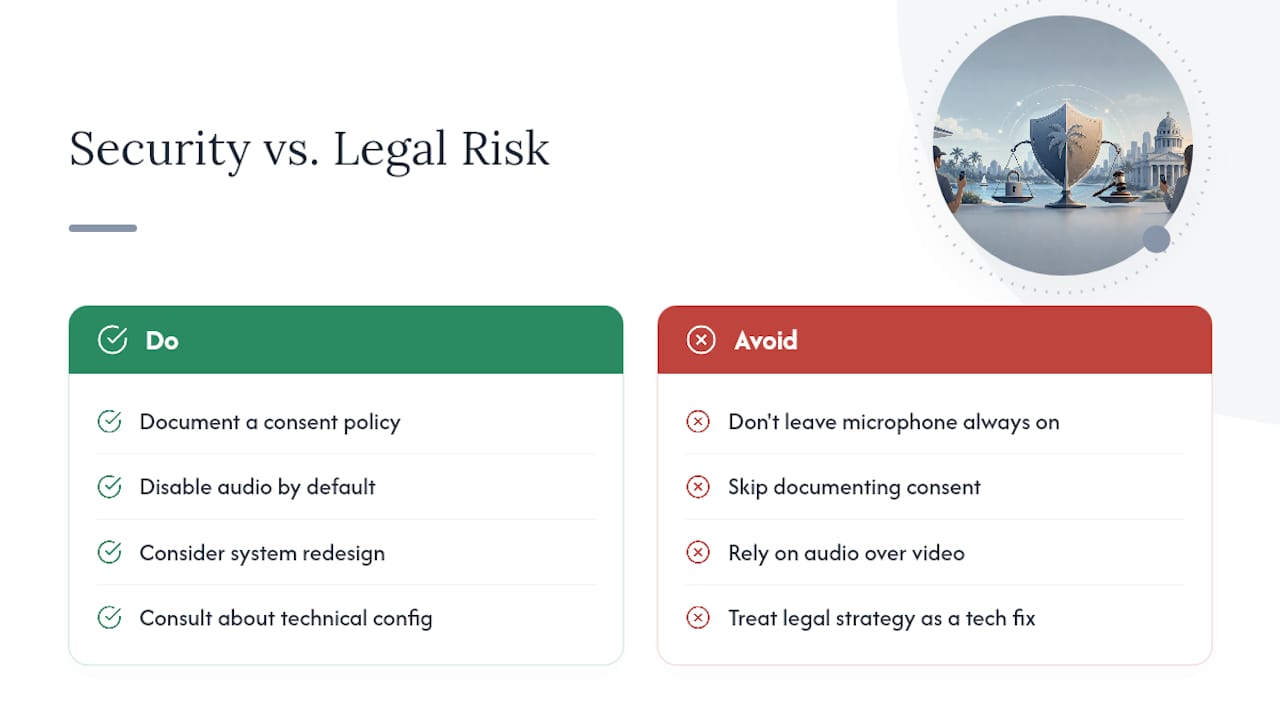
Property managers ask us the same question constantly: “Can I just leave the microphone on to be safe?” The honest answer is that audio almost never adds enough value to justify the felony exposure it creates. Most incidents get resolved through video alone.
We steer clients toward documented consent policies or audio-disabled configurations, because the legal risk of an always-on microphone rarely matches the security benefit. If you’re weighing a system redesign, we’re glad to talk through the technical configuration, not the legal strategy.
— Aaron
Configuring Security Systems The Right Way
There are other paths here, hiring a general IT contractor, buying a consumer camera kit and setting it up yourself, or leaving an existing system exactly as installed and hoping it’s fine. None of those give you a technical partner who thinks about audio compliance as part of the install, not an afterthought.
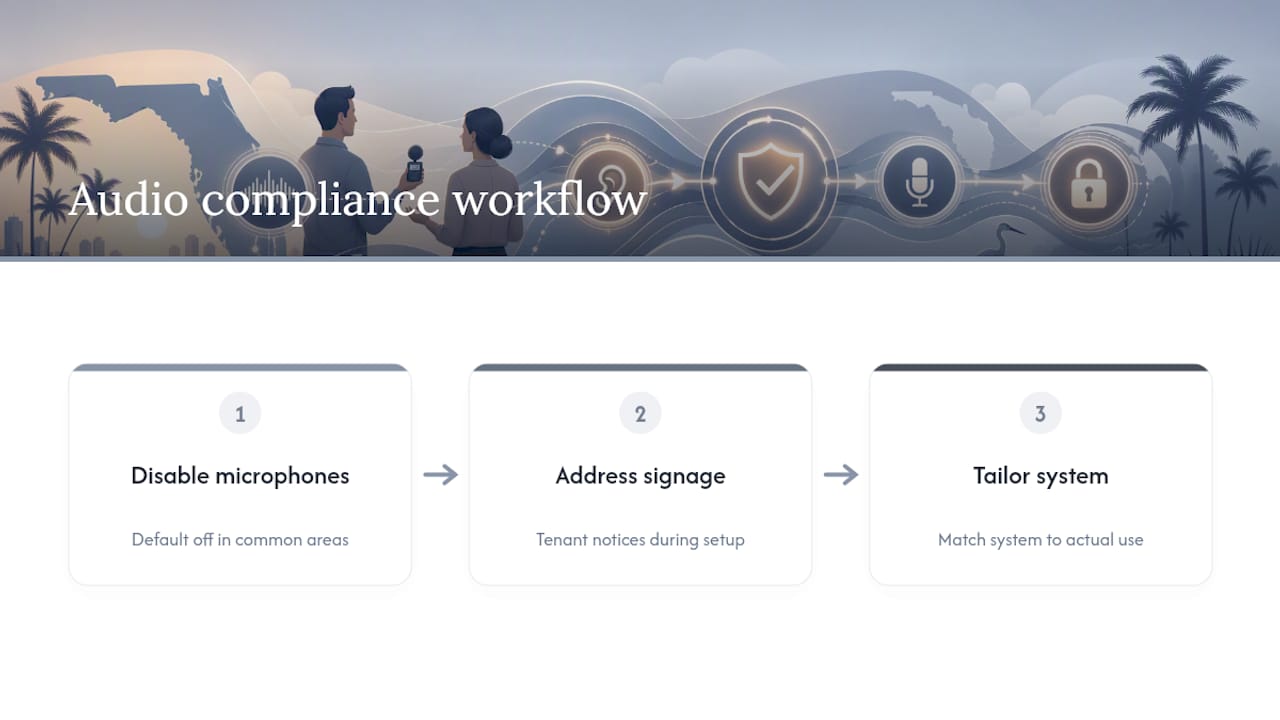
Some companies install and maintain security cameras, motorized gates, wired and wireless networks, and cell signal boosters across South Florida, with audio configuration as part of camera installations. Best practices include disabling microphones by default in common areas, addressing tenant-notice signage during setup, and tailoring systems to match how the space is actually used.
This is technical and installation guidance, not legal advice. If you’re rethinking how your cameras handle audio, start with our camera placement guidelines or reach out to schedule a system review for your property.
This article is general information, not a substitute for advice from a qualified lawyer. Consult a qualified legal professional about your own circumstances before acting on anything here.