A motorized gate troubleshooting guide is the systematic process of diagnosing and resolving faults in automated gate systems to restore safe, reliable operation. Property and facility managers deal with a wide range of gate failures, from dead remotes and misaligned sensors to motor strain and control unit errors. The right approach uses tools like multimeters, force gauges, and dry lubricants to address problems at the source rather than masking symptoms. This guide covers the full picture: quick fixes for common faults, a motorized gate maintenance guide for prevention, safety device compliance, and when to call a professional.
What are the most common motorized gate problems and their quick fixes?
Most gate failures trace back to four root causes: power loss, sensor misalignment, mechanical wear, and control unit misconfiguration. Recognizing which category a fault belongs to cuts your diagnostic time in half.
Power outages or blown fuses cause complete loss of gate response and are the first thing to check when a gate stops reacting to commands entirely. Go to the breaker panel, confirm the circuit is live, and inspect the gate operator’s internal fuse before assuming the motor or control board has failed. A multimeter confirms voltage at the operator in under two minutes.
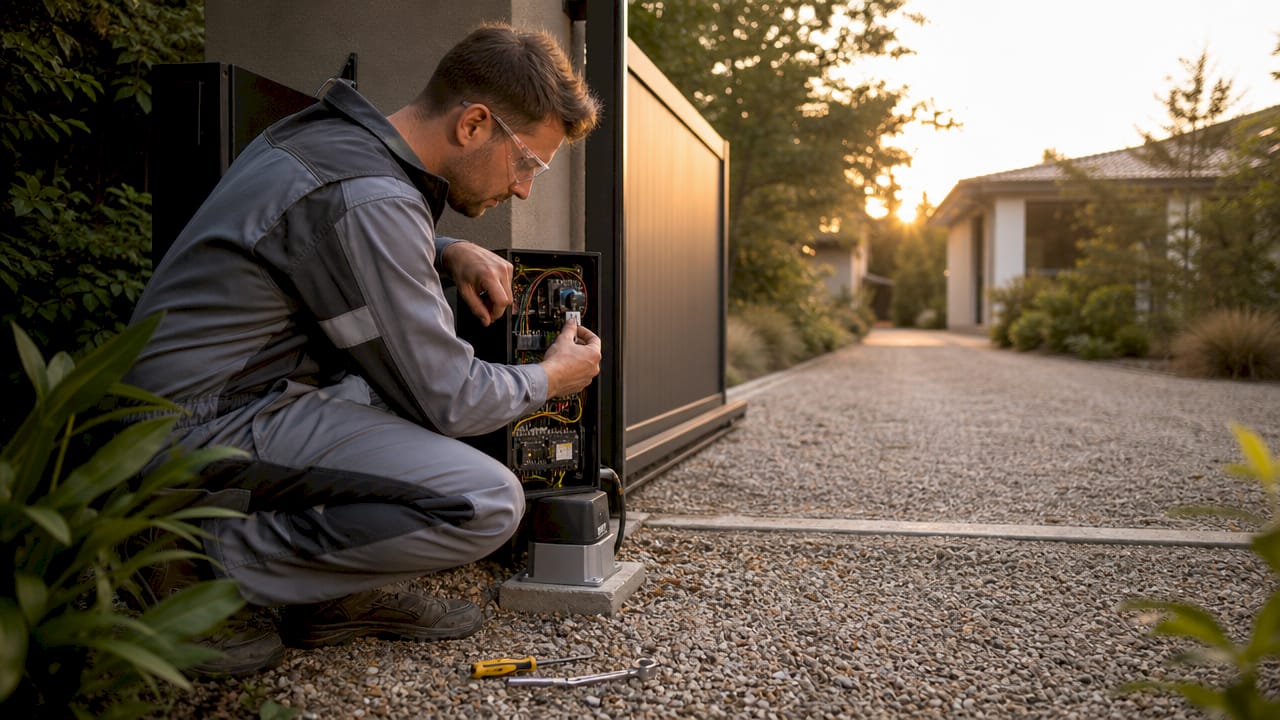
Misaligned photocells are a frequent cause of unexpected gate behavior, including refusal to open or close on command. The fix is straightforward: wipe the lens with a dry cloth, then adjust the transmitter and receiver until the indicator light on the receiver shows a solid signal. This takes less than five minutes and resolves a surprising number of “mystery” faults.
Pro Tip: Always check safety sensor lenses for dust or obstruction before any other diagnostic step. A dirty lens mimics a broken sensor and sends managers down the wrong repair path.
The table below maps the most common symptoms to their likely causes and immediate fixes:
| Symptom | Likely cause | Immediate fix |
|---|---|---|
| Gate does not respond at all | Blown fuse or power loss | Check breaker, test fuse, verify power supply |
| Gate reverses before fully opening | Sensor obstruction or force limit trip | Clean photocell lenses, check for debris in path |
| Jerky or slow movement | Lack of lubrication or worn rack | Lubricate with dry silicone spray, inspect rack teeth |
| Remote control not working | Dead battery or signal interference | Replace battery, test with wall button to isolate |
| Gate opens but will not close | Photocell beam interrupted | Realign sensors, remove obstructions from beam path |
| Unusual grinding noise | Debris in track or worn drive gear | Clear track, inspect gear for wear |
Control units in many gate systems use programmable DIP switches that adjust sensitivity and slowdown behavior. Misconfiguration of these switches produces false stops or erratic movement that looks like a mechanical fault but is actually a software setting. Consult the operator manual before adjusting DIP switches, and document the original settings before making any changes.
How to perform effective routine maintenance to prevent gate failures
Preventive maintenance is the single most cost-effective investment a property manager can make in a gate system. Reactive repairs cost more, take longer, and often happen at the worst possible time.
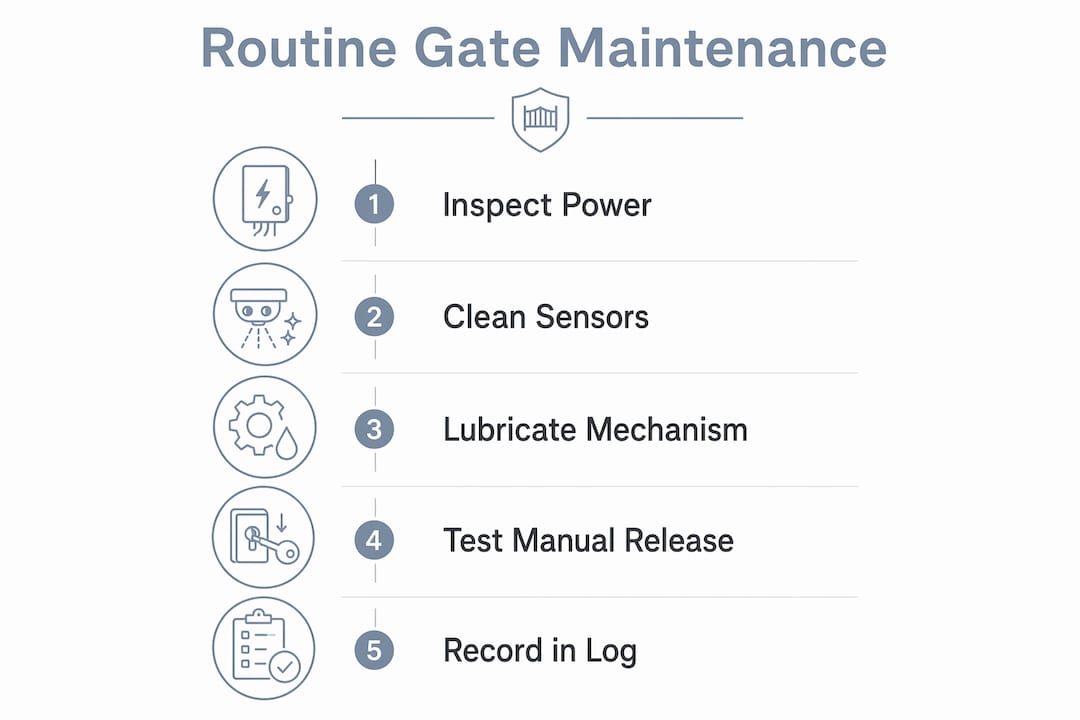
High-traffic gates require maintenance every six months; lower-usage gates need at least an annual service to stay within safety compliance standards. For commercial properties with gates operating dozens of cycles per day, a six-month schedule is not optional. It is the baseline for keeping the system legal and functional.
What to lubricate and what to avoid
Lubrication is one of the most misunderstood parts of gate maintenance. Never apply grease to sliding gate racks. Grease attracts dust and debris, which forms an abrasive paste that accelerates wear on the rack and pinion. Use dry silicone spray or PTFE spray instead. These products protect metal surfaces without accumulating dirt. Hinges, pivot points, and roller bearings on swing and sliding gates benefit from light machine oil applied with a precision nozzle.
Maintenance tools and supplies reference
| Item | Purpose | Frequency of use |
|---|---|---|
| Dry silicone or PTFE spray | Lubricating racks and tracks | Every 3 months |
| Light machine oil | Hinges, pivot points, bearings | Every 3 months |
| Multimeter | Testing voltage and continuity | As needed during diagnostics |
| Force gauge or dynamometer | Measuring gate closing force | Annually or semi-annually |
| Cleaning cloths | Wiping sensor lenses and surfaces | Monthly |
| Torque wrench | Checking bolt tightness on hardware | Annually |
Visual and auditory checks during daily operation catch problems before they become failures. Listen for grinding, clicking, or hesitation during the gate cycle. Watch for uneven movement, sagging, or the gate stopping short of its fully open or closed position. These early signals give you time to schedule a repair rather than respond to an emergency.
Manual releases must be tested quarterly to confirm they operate correctly during a power failure. A manual release that has seized or rusted is useless in an emergency. Test the release key, confirm the gate moves freely by hand, then re-engage the automatic drive. This takes under ten minutes and belongs on every quarterly checklist.
Pro Tip: Keep a maintenance log for each gate on your property. Recording dates, observations, and actions taken creates a paper trail that supports warranty claims and helps technicians diagnose recurring issues faster.
How do safety devices impact troubleshooting and gate operation?
Safety devices are not accessories. They are the primary reason a gate stops, reverses, or refuses to operate, and misunderstanding their role leads to misdiagnosis of faults.
Industry safety data shows 90% of automated gates are found unsafe during inspection, which explains why regulators require at least two independent entrapment protection devices on every automated gate. UL 325 in the United States and the Machinery Directive in Europe both mandate this layered approach. A gate that meets only one of these requirements is not compliant.
Damaged safety edges or photocells cause the controller to disable the gate as a deliberate safety protocol. This is not a malfunction. It is the system working exactly as designed. When a gate suddenly stops operating and no mechanical fault is visible, the first place to look is the safety device circuit, not the motor.
Force sensing alone is insufficient for safety. It must be paired with non-contact devices like photocells or laser scanners to provide adequate protection against crushing hazards. Many managers assume that because the gate reverses on contact, the system is safe. That assumption is incorrect and creates real liability exposure.
Monthly safety checks should include the following steps:
- Test each photocell by passing an object through the beam while the gate is in motion and confirming the gate stops or reverses.
- Press each safety edge firmly and confirm the gate halts immediately.
- Inspect all wiring connections at sensors and the control unit for corrosion, fraying, or loose terminals.
- Confirm sensor mounting brackets are secure and alignment has not shifted from vibration.
- Check that the gate does not exceed the force limits specified in UL 325 by using a calibrated force gauge.
Layering safety devices, including edges, photocells, and light curtains, provides the redundancy required for both legal compliance and practical gate safety in 2026. Source: Quantek
When should you escalate gate issues to a professional technician?
Some gate problems fall outside the scope of property manager diagnostics. Knowing where that line sits protects your warranty, your liability, and the people who use the gate.
Escalate to a qualified gate technician when you encounter any of the following situations:
- The gate reverses repeatedly without any visible obstruction in the sensor path, which points to a control unit fault or a wiring issue inside the operator housing.
- The motor runs but the gate does not move, indicating a stripped drive gear, broken chain, or failed clutch that requires disassembly.
- The control board displays error codes that are not resolved by a standard reset procedure documented in the operator manual.
- Any structural damage to the gate frame, posts, or welds is present. Welding repairs require qualified welders working in controlled conditions, and on-site welds need thorough testing before the gate returns to service.
- The gate fails a force test, meaning it exceeds the maximum allowable closing force under UL 325 standards.
Force tests with dynamometers are critical for legal compliance and must be performed by a technician with calibrated equipment. This is not a test you can approximate with a bathroom scale. Annual or semi-annual professional inspections that include force measurement and safety device certification are the standard for commercial properties. Scheduling these in advance, rather than waiting for a failure, keeps your property compliant and your gate operating predictably. For help diagnosing low voltage gate issues before calling in a technician, Lowvoltagecorp provides a practical starting point.
Key takeaways
Effective motorized gate management requires combining daily observation, scheduled preventive maintenance, layered safety device testing, and professional force certification to maintain compliance and prevent costly failures.
| Point | Details |
|---|---|
| Start with power and sensors | Check breakers, fuses, and photocell alignment before diagnosing motor or control unit faults. |
| Use dry lubricants only | Apply PTFE or silicone spray to racks and tracks; never use grease, which attracts abrasive debris. |
| Test safety devices monthly | Verify photocells, safety edges, and force limits every month to stay compliant with UL 325. |
| Test manual releases quarterly | Confirm emergency releases operate freely to avoid being locked out during a power failure. |
| Escalate structural and electrical faults | Motor failures, control board errors, and weld damage require a certified technician with proper tools. |
What I’ve learned after years of gate diagnostics
After working on motorized gate systems across dozens of commercial and residential properties, the pattern I see most often is this: managers call for a repair when the gate stops working, but the real problem started weeks earlier and was visible to anyone paying attention. A slight hesitation at the start of the cycle, a faint grinding sound, a photocell indicator that flickers instead of holding steady. These are not minor quirks. They are the gate telling you something is wrong.
The misconception I push back on hardest is the idea that force limitation makes a gate safe on its own. I have seen properties where the gate reverses on contact and the manager considers the safety obligation fulfilled. It does not work that way. Force sensing paired with non-contact devices is the standard, and a gate without both is a liability waiting to materialize.
The other thing I tell every property manager I work with: keep your emergency release key accessible and test it yourself every quarter. Do not delegate this and assume it was done. A seized manual release during a power outage is a serious operational and safety problem. Two minutes of testing every three months eliminates that risk entirely.
The managers who have the fewest gate problems are not the ones with the newest equipment. They are the ones who watch their gates every day and act on what they observe.
— Aaron
How Lowvoltagecorp supports your gate maintenance program

Lowvoltagecorp specializes in the installation, repair, and maintenance of motorized gate systems for property and facility managers across South Florida. Whether you need a diagnostic visit to resolve a fault that keeps coming back, a full safety device inspection to meet UL 325 requirements, or a system upgrade that improves reliability and reduces energy costs, the team at Lowvoltagecorp brings the right tools and experience to the job. Explore cost-saving gate upgrades designed specifically for property managers who need results without overspending. For managers looking to improve overall site security alongside gate performance, Lowvoltagecorp also covers energy-efficient security solutions that reduce operating costs long term.
FAQ
What is the first step in motorized gate troubleshooting?
Check the power supply first. A blown fuse or tripped breaker is the most common cause of a gate that stops responding entirely, and it takes under two minutes to confirm with a multimeter.
How often should motorized gates be professionally serviced?
High-traffic gates require professional maintenance every six months; standard gates need at least an annual service that includes force testing and safety device certification per UL 325.
Why does my gate reverse before fully closing?
The most likely cause is a photocell beam interruption or a force limit trip. Clean the sensor lenses, check for debris in the gate path, and confirm the force settings in the control unit are within the manufacturer’s specified range.
Can I lubricate my sliding gate rack with standard grease?
No. Grease on a sliding gate rack attracts dust and creates an abrasive compound that damages the rack and pinion. Use dry silicone spray or PTFE spray instead for lasting protection without debris buildup.
When does a gate fault require a professional technician?
Call a technician when the gate fails a force test, the motor runs without moving the gate, the control board shows unresolved error codes, or any structural weld damage is present. These faults require calibrated tools and certified expertise.