If you work with security cameras, motorized gates, or structured cabling, low voltage codes and standards are something you cannot afford to misread. The assumption that low voltage wiring sits outside normal electrical code enforcement has caused more inspection failures and rework than any other misconception in the field. The NEC, IEC, and BS 7671 all apply, and your local Authority Having Jurisdiction (AHJ) may layer additional requirements on top. This guide breaks down what actually governs your installations, what changed in 2026, and how to stay compliant across jurisdictions.
Key takeaways
| Point | Details |
|---|---|
| Low voltage is not code-exempt | NEC Article 725, IRC 2024, and international standards all impose specific installation rules. |
| Class matters more than voltage | Class 2, 3, and the new Class 4 circuits each carry distinct wiring, separation, and power limits. |
| Your local NEC edition may differ | Contractors must confirm which NEC edition their AHJ has adopted before starting any job. |
| BS 7671 Amendment 4 is live | UK electricians face new chapters on battery storage, PoE cabling, and ICT earthing as of April 2026. |
| Separation is non-negotiable | Low voltage cables cannot share raceways with line voltage conductors without listed barriers or exceptions. |
Low voltage codes and standards: definitions and foundations
Before you can apply any code correctly, you need to know how “low voltage” is actually defined, because that definition changes depending on which standard you are reading.

The IEC defines low voltage as 0 to 1000 V AC, which is a broad range that includes most residential and commercial distribution. BS 7671, the UK wiring regulations standard, narrows the definition to voltages greater than 50V AC but not exceeding 1000V AC. The NEC takes a different approach entirely and focuses more on circuit classification than a single voltage threshold.
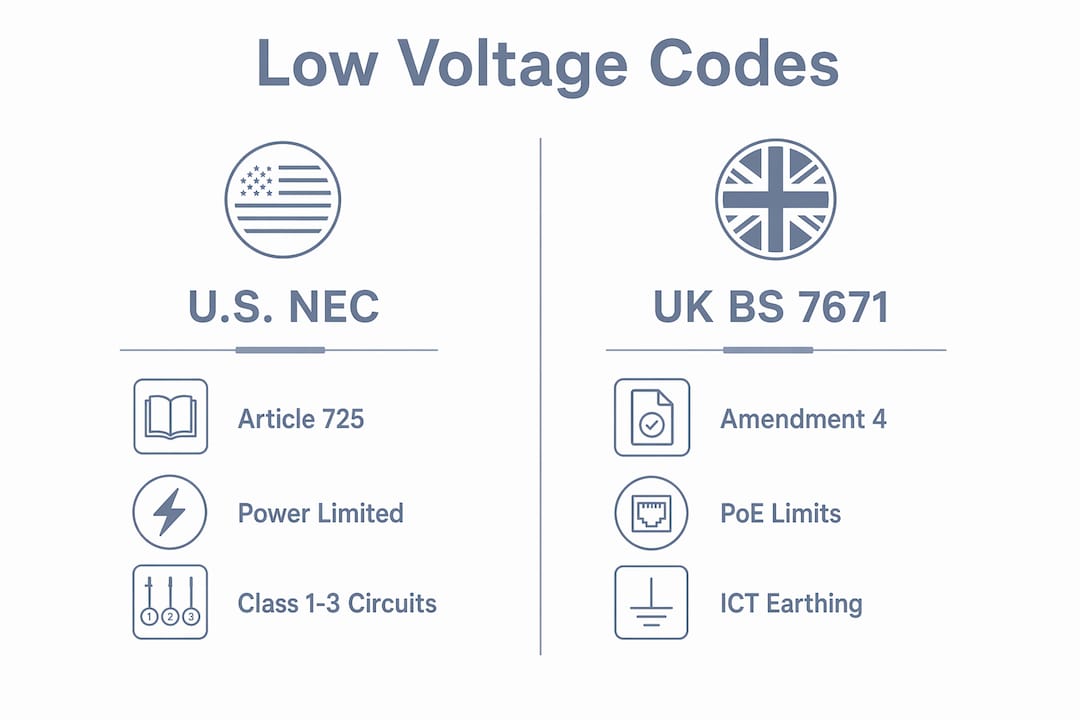
Here is how the NEC classifies low voltage circuits under Article 725:
- Class 1 circuits: Operate at up to 600V and carry higher power levels. These require full conduit protection and conductor sizing similar to branch circuits.
- Class 2 circuits: Limited to 100VA or less and 30V AC (or 60V DC). This is where most thermostat wiring, access control, and PoE-based systems fall.
- Class 3 circuits: Same voltage limits as Class 2 but allow up to 100VA from listed Class 3 power supplies. Used for higher-power signaling systems.
- Class 4 circuits: A newer classification introduced in NEC 2023 and carried into 2026 describing fault-managed power systems such as PoE lighting. Adoption and installer awareness remain limited across jurisdictions.
UL and NFPA standards also apply to power supplies feeding these circuits. A UL Listed Class 2 power supply is the gatekeeper that allows you to install Class 2 cabling without conduit in many situations. Use a non-listed supply and you lose that installation flexibility immediately.
Pro Tip: Always check the UL listing on your power supply before specifying cable type and routing method. The listing determines your installation rules, not the output voltage alone.
Key NEC requirements for low voltage installations
NEC Article 725 is the primary rulebook for remote control, signaling, and power-limited circuits in the United States. Understanding its provisions keeps your installations compliant and your inspections clean.
Class 2 wiring must be separated from Class 1 wiring unless you use listed barriers or approved mixed-use raceways. This is not optional and not a suggestion. Running a Class 2 security camera cable through the same conduit as a 120V branch circuit is an NEC violation, period.
Key Article 725 requirements to know:
- Voltage and power limits: Class 2 circuits top out at 30V AC / 60V DC with power under 100VA from a listed source. Exceeding these limits reclassifies the circuit and changes your entire compliance approach.
- Conductor ampacity: Class 2 cables are not sized for ampacity the same way branch circuits are. Instead, the listed power supply controls the fault current, which is why separation from line voltage is still required.
- Conduit requirements: Article 725 allows Class 2 wiring without conduit in many situations, but local amendments in cities like Chicago require conduit regardless. Never assume the base NEC rules apply everywhere.
- 2026 NEC updates: The 2026 cycle expands GFCI requirements and refines conduit rules across Article 210, affecting some low voltage branch circuit connections. Review your HVAC and outdoor outlet connections carefully under the revised article.
One point that trips up experienced contractors: NEC is not federal law. Your AHJ controls which edition is enforced. Some states are still on NEC 2017. Others have moved to 2023. Assuming your jurisdiction is on the latest edition is a mistake that creates real compliance risk.
Pro Tip: Before pulling a permit, call the local building department and ask specifically which NEC edition they enforce and whether they have any local amendments for low voltage work. That five-minute call saves hours of rework.
International standards and 2026 BS 7671 updates
The UK’s wiring regulations standard, BS 7671:2018, received a significant update in April 2026. Amendment 4 introduces new chapters covering battery energy storage systems, ICT earthing arrangements, and Power over Ethernet (PoE) cabling, all areas where low voltage installation standards have lagged behind actual field practice.
Here is what Amendment 4 adds that contractors need to act on:
- Battery storage systems now have their own dedicated chapter addressing earthing, overcurrent protection, and arc fault detection for low voltage DC circuits.
- ICT earthing requirements clarify how structured cabling systems connect to the building’s main earthing terminal, reducing the risk of ground loop interference in security and network installations.
- PoE cabling gets formal recognition with temperature rise guidance for bundled cables, which directly affects how you route and bundle Cat6 runs in conduit or trays.
- Medical location updates revise protection requirements for low voltage circuits serving life safety equipment.
There is a transition period, meaning installations designed before April 2026 under the previous edition can still comply under the old rules for a defined period. But for new projects starting after April 2026, the updated standard applies. Keeping current with evolving standards is not optional for any contractor working in the UK market.
| Requirement area | NEC 2026 (U.S.) | BS 7671 A4 (UK) |
|---|---|---|
| PoE cabling guidance | Class 4 circuits, limited AHJ adoption | Formal chapter with bundling and temperature limits |
| Battery storage | Evolving through local adoption | Dedicated new chapter, mandatory for new work |
| Separation from line voltage | Article 725, strict raceway rules | Maintained, with clarified earthing requirements |
| Voltage drop limits | No fixed percentage, sizing guidance varies | 3% for lighting, 5% for power circuits |
Practical compliance challenges across jurisdictions
The two-layer compliance model is where most contractors get into trouble. You have the electrical wiring rules, NEC or BS 7671, and then you have your local AHJ’s permit and licensing requirements, which can differ significantly from the base code.
Licensing is one of the most contentious areas. Low voltage contractor licensing varies by state, with some jurisdictions requiring full electrical licenses for low voltage work and others maintaining separate low voltage license categories. Delaware’s recent public debate over how low voltage work should be defined and regulated is a clear example of how unsettled this area remains nationwide.
Common compliance pitfalls in the field:
- Incorrect raceway sharing: IRC 2024 prohibits low voltage cables from sharing raceways or junction box openings with line voltage conductors unless specifically permitted. Contractors running security camera cable through a shared box with 120V wiring fail this requirement routinely.
- Wrong NEC edition assumed: AHJ adoption varies widely, with some jurisdictions enforcing editions that are two or three cycles behind the current publication. Designing to NEC 2023 in a 2017 jurisdiction creates confusion at inspection.
- Voltage drop miscalculations: Proper conductor sizing for long runs is often underestimated on low voltage circuits. BS 7671 sets lighting circuits at a 3% voltage drop limit and power circuits at 5%. While the NEC does not set a fixed percentage, similar principles apply to ensure system performance.
- Permit skipping: Many contractors mistakenly believe low voltage work does not require permits. Whether a permit is required depends entirely on local ordinance, not on the voltage of the circuit.
Pro Tip: Keep a jurisdiction log for every market you work in. Note the adopted NEC edition, local low voltage licensing requirements, and any amendments that affect your typical work scope. Update it every time you confirm a new detail from a building department.
Best practices for installation and inspection readiness
Getting through inspection the first time requires more than knowing the code. It requires translating that knowledge into consistent field practice. Here is a sequence that works:
- Confirm conductor sizing before ordering materials. For long camera runs or gate controller wiring, calculate voltage drop based on actual run length and current draw. Undersized conductors fail performance checks even when they pass visual inspection.
- Maintain physical separation throughout. Route low voltage cabling at least 2 inches away from parallel line voltage conductors where no barrier exists. Use listed dividers or dedicated raceways when separation is not physically possible.
- Use listed barriers in mixed-use raceways. Where the code allows sharing, as in some plenum or conduit applications, you must use listed barriers for raceway separation. Document the product listing and keep it available for the inspector.
- Select cable appropriate for the environment. Plenum-rated cable for air handling spaces, riser-rated for vertical runs, and outdoor-rated for any exterior exposure. Using appropriate cable types matched to the environment is a code requirement, not just a best practice.
- Run a pre-inspection checklist. Walk the job before the inspector does. Verify every junction box is accessible, every splice is properly terminated, all cable is labeled, and no low voltage cable shares an opening with line voltage conductors without specific authorization.
Continuity testing after installation closes out the technical side. Testing wired connections before the inspector arrives lets you find and fix any issues without the clock running.
My perspective on navigating code complexity in the field
I’ve watched experienced contractors get surprised by code enforcement on low voltage work more times than I can count. The honest truth is that the “low voltage means fewer rules” assumption is still widespread, and it costs people real money.
What I’ve learned working on security camera systems, gate controllers, and structured cabling is that the code complexity is not really about voltage level. It’s about circuit classification, power supply listing, and who your AHJ is. Two identical security camera installations in neighboring counties can have completely different permit and inspection requirements.
My advice: treat every low voltage job with the same pre-job research discipline you would apply to a line voltage project. Confirm your adopted code edition, understand your local licensing requirements, and do not assume that because a job looks simple it is simple from a compliance standpoint.
The BS 7671 Amendment 4 changes on PoE bundling and ICT earthing are a good example of standards catching up to real field conditions. I think we will see the NEC move similarly on Class 4 circuits over the next few cycles. Staying ahead of that curve means reading the code before the inspector does.
— Aaron
How Lowvoltagecorp helps you stay compliant
Lowvoltagecorp works directly with contractors and property managers across South Florida on security camera installations, motorized gates, structured cabling, and cell signal systems. Every project is handled with the current NEC requirements and local AHJ rules in mind, so you are not discovering compliance gaps during inspection.

If you are dealing with aging systems that no longer meet current wiring safety guidelines, the cost-saving security upgrades Lowvoltagecorp offers are designed to bring your property up to code without unnecessary expense. For network infrastructure, explore the wired network benefits that come with properly installed and code-compliant low voltage cabling. And if you have active issues with gates, cameras, or network drops, the fast-fix service addresses them with professionals who know the local code. Contact Lowvoltagecorp for a consultation tailored to your project scope.
FAQ
What does NEC Article 725 govern?
NEC Article 725 covers Class 1, Class 2, and Class 3 remote control, signaling, and power-limited circuits, including separation requirements from line voltage conductors and conduit rules.
Does low voltage wiring require permits?
Whether a permit is required depends on your local jurisdiction’s ordinance, not the voltage level. Many localities require permits for low voltage work including security and structured cabling.
What is the difference between Class 2 and Class 3 circuits?
Both operate at the same voltage limits, but Class 3 circuits allow higher power output from listed power supplies and may serve higher-demand signaling applications than Class 2.
What does BS 7671 Amendment 4 change for electricians?
BS 7671 Amendment 4 adds new chapters on battery storage systems, PoE cabling temperature limits, and ICT earthing, effective for new installations from April 2026.
How do I confirm which NEC edition my jurisdiction enforces?
Contact your local building or electrical inspection department directly. NEC adoption varies by state and sometimes by municipality, making a direct confirmation call the only reliable method.