Most property managers think about electrical systems in binary terms: the power is either on or it works. That framing causes them to miss one of the most consequential investments available today. Understanding why property managers need low voltage is not a technical exercise. It is a business decision that touches security costs, maintenance efficiency, tenant retention, and long-term property value. Low voltage systems cover everything from security cameras and motorized gates to managed WiFi networks and cell signal boosters, and the properties running them are pulling ahead of the ones that are not.
Table of Contents
- Key takeaways
- Why property managers need low voltage: understanding the basics
- Security benefits that actually move the needle
- Maintenance efficiency and operational savings
- Tenant satisfaction and property value through connectivity
- My take: stop treating this as an IT problem
- How Lowvoltagecorp helps property managers get this right
- FAQ
Key takeaways
| Point | Details |
|---|---|
| Low voltage is different by design | These systems operate at safe, code-distinct voltages and require dedicated planning from the start of any renovation or build. |
| Security costs drop significantly | Remote video monitoring on low voltage infrastructure replaces expensive guard staffing while providing 24/7 active coverage. |
| Smart controls cut energy bills | Integrated low voltage sensors and controls can reduce commercial energy use by 10 to 30 percent, directly improving NOI. |
| Connectivity is now a utility | Tenants treat reliable WiFi like running water; low voltage cabling is the infrastructure that makes property-wide networks possible. |
| Early adoption builds competitive advantage | Properties with modern low voltage systems command stronger tenant interest and higher perceived value in today’s rental market. |
Why property managers need low voltage: understanding the basics
Before you can make smart decisions about low voltage technology for property management, you need to understand what separates these systems from the standard electrical wiring already in your buildings.
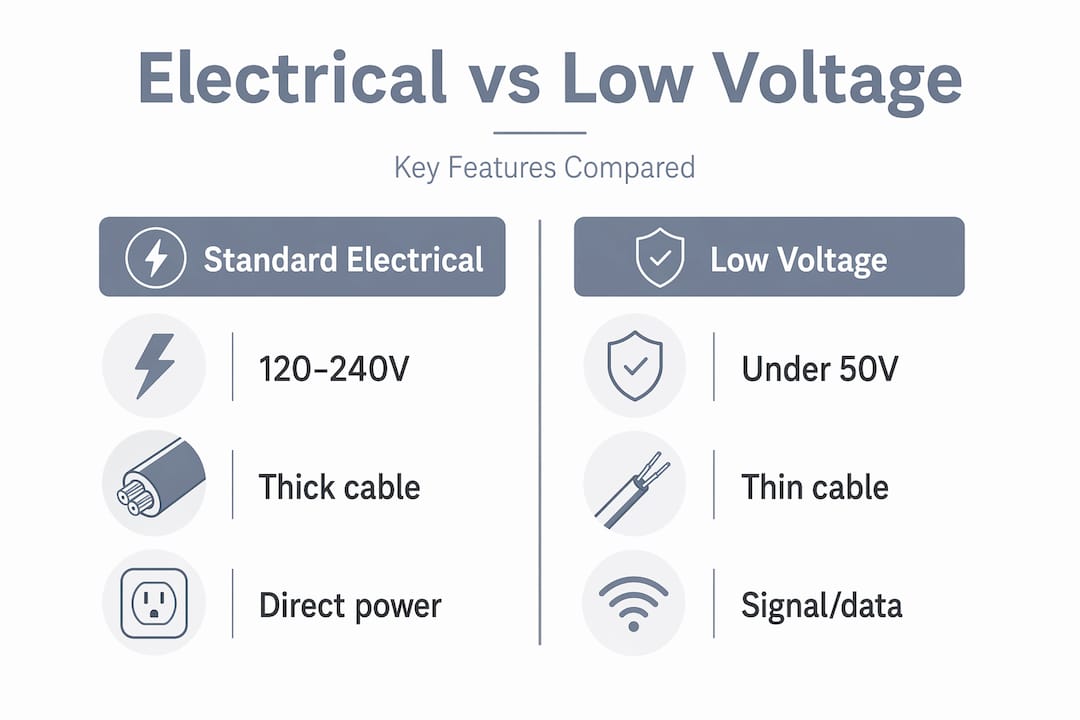
Standard electrical circuits in most residential and commercial properties run at 120 or 240 volts. Low voltage systems operate far below that threshold, generally under 50 volts, and often in the Class 2 range of 30 volts or less. That distinction matters in three ways: safety, cable type, and regulatory treatment. Low voltage wiring differs fundamentally from standard electrical wiring in all three categories, and treating them the same during planning is a common and costly mistake.
The cable itself is typically thinner and more flexible, designed for data or signal transmission rather than power delivery. The conduit requirements are different, the permitted routing paths are different, and in most jurisdictions the licensing requirements for installers are different. Low voltage circuits have lower shock hazards than standard wiring, but they require careful attention to grounding, shielding, and isolation to avoid interference and performance problems.
Here is a quick comparison that property managers should keep in mind:
| Feature | Standard electrical | Low voltage |
|---|---|---|
| Voltage range | 120V to 240V | Under 50V, often 12V to 48V |
| Common applications | Outlets, lighting, appliances | Cameras, networks, access control, sensors |
| Cable type | Heavy gauge copper in conduit | Coaxial, Cat6, fiber, speaker wire |
| Safety risk | High shock hazard | Lower hazard, but interference risks |
| Regulatory treatment | NEC Article 210/220 | NEC Article 725 / Class 2 or 3 |
| Installer licensing | Licensed electrician required | Varies by state; often low voltage license |
Pro Tip: If you are planning a property renovation, bring a low voltage specialist in at the design phase. Retrofitting cable paths after walls are closed adds significant cost and often compromises the quality of the final installation.
You can get a thorough grounding in the terminology and practical applications by reading this property manager’s guide from Lowvoltagecorp. It covers the concepts without drowning you in electrical engineering.
Low voltage systems also require coordination with electrical and mechanical trades to place transformers, power supplies, and distribution panels correctly. Getting that coordination right early saves significant headaches during inspections and tenant move-ins.
Security benefits that actually move the needle
The security case for low voltage systems is where the financial argument gets concrete fast.
Remote video monitoring is the clearest example. Remote video monitoring uses strategically placed cameras and real-time professional oversight to provide comprehensive coverage at a fraction of what onsite guards cost. The entire system runs on low voltage infrastructure: the cameras, the network switches, the network video recorder, and the fiber or Cat6 cabling connecting all of it.
Here is what that means in practice for the benefits of low voltage systems in a security context:
- 24/7 active coverage with no shift changes, no sick days, and no lapses in attention
- AI-powered analytics that identify potential threats without human fatigue, separating real incidents from routine activity
- Motorized gate access control that integrates with the same network infrastructure, allowing remote entry management
- Fire alarm and emergency lighting systems that run on low voltage circuits and provide code-compliant life safety coverage
- Backup power continuity through UPS devices and cellular failover, so video feeds stay active even when primary internet or power goes down
That last point matters more than most property managers realize. A security system that goes dark during a storm is not a security system. Redundant low voltage infrastructure keeps cameras and access controls running through outages, which is exactly when criminal activity tends to spike.
For property managers looking to review their current approach, Lowvoltagecorp’s resource on cost-saving security upgrades for property owners walks through the specific system components worth prioritizing.
Maintenance efficiency and operational savings
Security is the headline, but the operational efficiency gains from low voltage technology for property management run just as deep.
The core opportunity is integration. When your lighting, HVAC controls, energy meters, and occupancy sensors all run on low voltage infrastructure and feed data into a building management system, you stop reacting to failures and start preventing them. Here is how that plays out in practice:
- Occupancy sensors detect when spaces are vacant and automatically adjust lighting and climate, cutting energy waste without requiring any tenant behavior change.
- Real-time fault alerts notify your maintenance team the moment a system deviates from baseline, often before tenants even notice the issue.
- Energy monitoring at the circuit level shows you exactly where consumption spikes, making it possible to schedule load-intensive operations during off-peak rate windows.
- Predictive maintenance scheduling replaces expensive emergency repairs with planned interventions based on actual system data rather than calendar guesses.
Smart building technologies and advanced controls reduce energy use by 10 to 30 percent in commercial properties, according to U.S. Department of Energy data. On a property with $200,000 in annual energy costs, even a 10 percent reduction is $20,000 directly added back to net operating income.
Smart sensors for occupancy, lighting, and air quality feed this data into building management systems through low voltage wiring. The result is not just lower bills. It is a property that responds in real time to how tenants actually use it.

Pro Tip: Start with energy monitoring before adding controls. Knowing where your consumption is highest gives you a clear priority list and a measurable baseline to track your ROI as you add smart systems.
Lowvoltagecorp covers the overlap between security and efficiency gains in detail at their facility efficiency and security resource, which is worth reviewing if you are building a business case for an upgrade.
Tenant satisfaction and property value through connectivity
Connectivity has crossed over from amenity to utility. Tenants in both multifamily and commercial properties now evaluate internet reliability the same way they evaluate water pressure. If it fails consistently, they leave.
Low voltage cabling is the physical infrastructure that makes property-wide managed WiFi possible. You cannot deliver reliable, whole-building coverage by relying on tenants to manage their own routers in each unit. The solution is structured cabling, centrally managed access points, and a network architecture designed for the building.
This is where emerging standards matter. WiFi 8 offers 25% better effective throughput, reduced latency, and improved seamless roaming across multifamily properties. That improvement is not about bragging rights on speed tests. It is about the reliability and consistency tenants actually experience as they move through a building.
The advantages of low voltage for properties extend into specific tenant-facing wins:
- Managed WiFi as a service simplifies internet access for tenants and reduces service calls while creating an additional revenue stream for the property
- Tenant app integration for package delivery, amenity booking, and visitor access all depend on reliable low voltage network infrastructure
- Cell signal boosting solves dead zones that frustrate tenants and generate complaint calls, using low voltage distribution systems to extend carrier signals through thick concrete and steel
- Smart lock and access control systems that tenants manage from their phones require both low voltage wiring and a dependable network backbone
The compounding effect is real. A property with managed WiFi, smart access control, and a functioning security camera system is not just safer. It is more desirable, which means lower vacancy rates and stronger negotiating position on lease renewals.
For properties with connectivity challenges, Lowvoltagecorp’s guide on network wiring for property managers explains how structured cabling decisions made today set the ceiling on what your property can offer tenants in the next five years.
My take: stop treating this as an IT problem
I have worked on enough properties to know how low voltage projects get shelved. Someone puts it in the capital improvement budget, an HVAC replacement comes up, and suddenly cameras and cabling feel optional. That thinking costs more than the projects themselves.
What I have seen consistently is that property managers who treat low voltage as an operational priority rather than an IT line item make better decisions. They ask better questions when vetting vendors. They plan installations around tenant needs rather than around what is cheapest at the time. They end up with systems that actually work three years later instead of systems that are outdated before the lease cycle turns.
The ROI case is not complicated. Lower security staffing costs, fewer emergency maintenance calls, reduced energy bills, and higher tenant retention all have dollar values. Low voltage systems touch all four. The managers who are slow to adopt these systems are not saving money. They are deferring costs while competitors attract tenants with better infrastructure.
My practical advice: do not try to implement everything at once. Start with the system that addresses your biggest current pain point, whether that is security, connectivity, or energy waste. Get it installed correctly by a specialist who understands both the technology and property management realities. Then build from there. Phased adoption works. Half-installed systems done on the cheap do not.
— Aaron
How Lowvoltagecorp helps property managers get this right

Lowvoltagecorp works directly with property managers across South Florida to design, install, and maintain low voltage systems built for the realities of property management. That means security camera systems with remote monitoring capability, motorized gate access control that integrates with tenant management software, structured wiring for managed WiFi networks, and cell signal booster installations that eliminate dead zones tenants complain about.
If you are ready to look at energy-efficient security strategies that reduce costs without reducing coverage, that resource is a strong starting point. For properties dealing with system failures or spotty connectivity right now, Lowvoltagecorp also provides fast repair and troubleshooting for gates, cameras, and networks so you are not waiting on issues that affect tenant safety and satisfaction. Reach out to Lowvoltagecorp to talk through your property’s current setup and what a phased upgrade could look like.
FAQ
What does low voltage mean for property managers?
Low voltage refers to electrical systems operating under 50 volts, including security cameras, access control, managed WiFi networks, and cell boosters. Property managers rely on these systems for security, efficiency, and tenant connectivity.
How much can low voltage systems reduce energy costs?
Smart electrical systems integrated with low voltage sensors and controls can reduce energy consumption by 10 to 30 percent in commercial properties, according to U.S. Department of Energy reporting.
Why is managed WiFi important for multifamily properties?
Managed WiFi provides property-wide reliable internet coverage that tenants treat as a standard utility. It reduces tenant service calls, improves retention, and creates an additional revenue opportunity for the property.
Do low voltage systems require special licensing to install?
Yes. Low voltage installation requirements vary by state, but most jurisdictions require a separate low voltage license distinct from a standard electrician’s license. Always verify that your installer holds the appropriate credentials for your location.
How does backup power protect low voltage security systems?
Critical components like cameras and network devices connect to uninterruptible power supplies, and cellular failover keeps video feeds active if primary internet goes down. This maintains security coverage during the outages when incidents are most likely to occur.