Low voltage systems run nearly every building function you manage, from security cameras to network infrastructure, yet sustainability in low voltage rarely gets the attention it deserves. Most facility managers focus carbon reduction efforts on HVAC or lighting, while the electrical distribution layer quietly wastes energy through poor design, outdated wiring layouts, and zero monitoring. That’s a costly blind spot. This guide breaks down the standards, technologies, and practical strategies that make your low voltage infrastructure genuinely energy efficient, future-proof, and aligned with your building’s environmental goals.
Table of Contents
- Key takeaways
- Sustainability in low voltage: the standards that guide it
- Key technologies that reduce low voltage energy waste
- How low voltage efficiency cuts your building’s carbon footprint
- Putting it all together: practical implementation steps
- My honest take on where facility managers get this wrong
- How Lowvoltagecorp helps you build greener, smarter systems
- FAQ
Key takeaways
| Point | Details |
|---|---|
| Standards drive efficiency | IEC 60364-8-1 outlines 26 specific measures for minimizing energy losses in low voltage installations. |
| Design choices matter early | Center-feed wiring and pre-wired EV capacity reduce long-term waste and avoid expensive retrofits. |
| Controls beat equipment swaps | Upgrading smart controls and BMS can shift energy performance ratings before replacing any hardware. |
| Carbon reduction is connected | Low voltage efficiency gains compound when paired with LED lighting, VFDs, and renewable integration. |
| Monitor to manage | Sub-metering and digital energy tools turn invisible consumption into data you can actually act on. |
Sustainability in low voltage: the standards that guide it
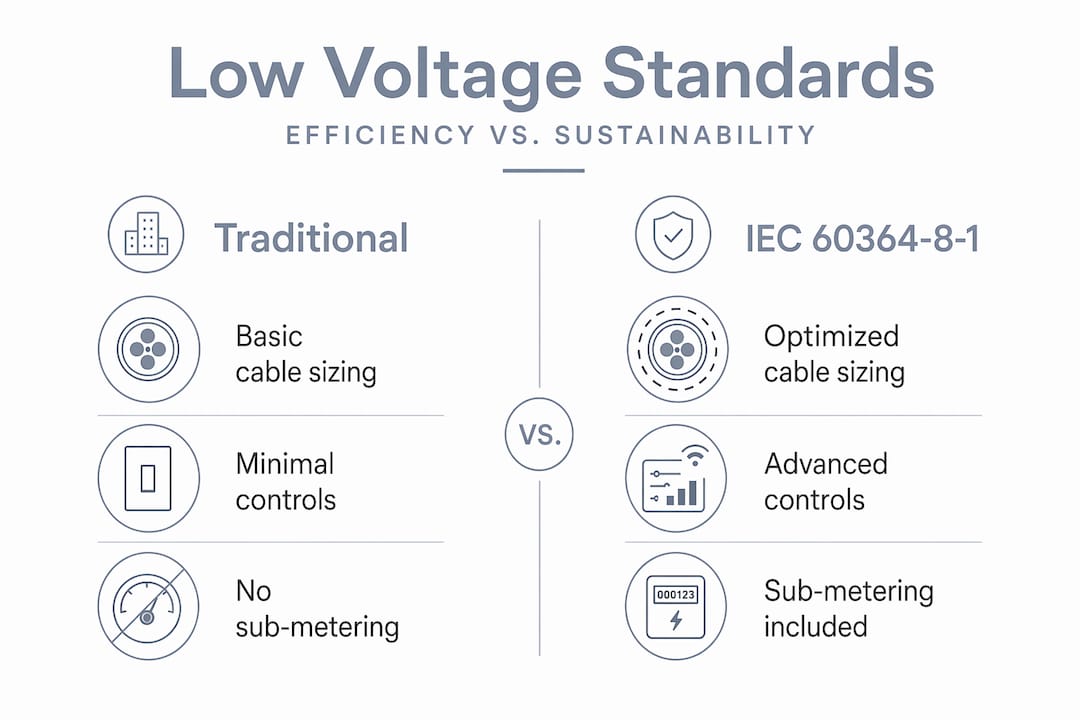
Most people assume sustainability in low voltage systems is just about switching to LED lighting or installing a smart thermostat. The actual framework goes much deeper. IEC 60364-8-1 requires a full planning approach that minimizes energy losses across the entire installation, not just at the point of consumption.
The standard covers 26 efficiency measures spanning planning, installation, daily operation, and ongoing measurement. These aren’t abstract guidelines. They include specifics like minimizing conductor lengths, sizing cables for efficiency rather than just safety, and building in metering from day one. The key insight from IEC 60364-8-1 is that energy efficiency in a low voltage installation is not just equipment-based. It requires integrated planning that balances technical and operational criteria at every stage.
Here’s what that looks like in practice for a facility manager:
- Holistic design reviews before any installation begins, not after problems appear
- Transparency through metrology, meaning real measurement points built into the system rather than estimated from billing data
- Coordination with building automation systems so the electrical layer talks to HVAC controllers, lighting zones, and occupancy data
- Operational procedures that define how staff interact with the system to preserve efficiency gains
| Approach | Traditional install | IEC 60364-8-1 aligned |
|---|---|---|
| Cable sizing | Sized for safety minimum | Sized to minimize resistive losses |
| Metering | Whole-building meter only | Sub-metering by load type and zone |
| Future loads | Not considered | Pre-wired for EV, heat pump capacity |
| Operation | Manual switching | Integrated BMS coordination |
Pro Tip: Request an energy efficiency schedule from your electrical contractor before any upgrade work starts. If they can’t reference IEC 60364-8-1 or similar standards, you’re likely getting a conventional install with no sustainability benefit built in.
Key technologies that reduce low voltage energy waste
Knowing the standards is one thing. Knowing which technologies actually deliver results is where facility managers can move from theory to real operational savings. These are the strategies that make the biggest difference.
-
Center-feed wiring layouts. Most commercial buildings wire from one end of a circuit to the other. A center-feed approach places the supply point in the middle of the load run. Center-feeding distribution shortens the average conductor travel distance, reduces voltage drop, and cuts resistive heat losses. It’s one of the most overlooked design choices in eco-friendly low voltage solutions.
-
Pre-wired capacity for EV chargers and heat pumps. Installing pre-wired capacity during initial construction is 3 to 5 times cheaper than retrofitting later. BS 7671 Amendment 4 now recommends separating circuits for high-energy loads like EV chargers and heat pumps to support energy monitoring and avoid disruptive future upgrades.
-
Smart building management systems (BMS) and zoned controls. A BMS coordinates your low voltage systems so lighting, HVAC, access control, and security cameras operate on occupancy-driven logic rather than fixed schedules. Paired with occupancy sensors and zoned circuit arrangements, this is where green power low voltage strategies pay off fastest.
-
Reactive power compensation and capacitor bank placement. This one surprises most facility managers. Strategic capacitor bank placement can reduce power losses by over 35% in commercial distribution feeders. One well-placed capacitor bank in a radial feeder network can deliver net present value benefits exceeding USD 16,000. That’s a direct reduction in energy waste with a measurable return.
-
Variable frequency drives (VFDs) on motors. VFDs control motor speed to match actual demand rather than running at full power continuously. They typically pay back within 1 to 3 years and can reduce motor energy use by 20 to 50%. On HVAC fans and pumps connected through your low voltage distribution, that’s a significant contribution to reducing carbon footprint in low voltage operations.
Pro Tip: When planning circuit arrangements, separate your high-energy loads such as EV chargers, heat pumps, and server rooms onto dedicated circuits from day one. This makes sub-metering simpler and sets you up for accurate energy reporting without expensive panel modifications later.
How low voltage efficiency cuts your building’s carbon footprint
The connection between low voltage energy management and actual carbon reduction is direct, but it requires understanding a few key relationships.

Intelligent HVAC controls can cut commercial building energy consumption by 10 to 23% on their own. HVAC dominates commercial building energy use, and those controls run entirely through your low voltage infrastructure. Every occupancy sensor, zone controller, and VFD signal is a low voltage circuit. When that infrastructure is designed for efficiency, the savings compound.
LED lighting delivers immediate carbon reductions of over 75% compared to older lamp types, but only when combined with effective low voltage controls does the full benefit materialize. A low voltage lighting control system that dims based on daylight and shuts off in unoccupied zones can double the savings that LED fixtures alone provide.
“Electrification’s carbon benefit depends heavily on the timing of power grid decarbonization. Buildings that electrify systems now while connecting to increasingly renewable grids will see compounding carbon benefits over the life of their infrastructure.”
Rooftop photovoltaic integration is another area where sustainable electrical systems depend on your low voltage layer. The inverters, distribution boards, and monitoring equipment that connect solar generation to building loads all operate at low voltage. A well-designed low voltage network reduces conversion losses and makes it easier to maximize self-consumption.
The broader picture looks like this:
- Well-designed low voltage distribution reduces baseline energy draw across all connected systems
- Smart controls on HVAC, lighting, and access equipment cut consumption during unoccupied periods
- VFDs on motors reduce peak demand charges and overall kWh consumption
- Pre-wired renewable integration points lower the cost of future solar or battery storage additions
- Sub-metering identifies which loads are actually responsible for energy waste
That’s how to achieve low voltage sustainability in practice. It’s not one technology. It’s a coordinated approach where each layer reinforces the others.
Putting it all together: practical implementation steps
Understanding the theory is straightforward. Applying it to a real building with existing infrastructure, budget constraints, and operational demands requires a structured approach. Here’s how facility managers can move from audit to action.
Start with an infrastructure assessment. Before spending anything, map your existing low voltage systems. Identify where circuits are oversized, where metering is absent, and where future loads like EV charging are likely. This audit becomes the basis for prioritizing upgrades based on return and sustainability impact. You can use low voltage system efficiency reviews as a starting point for this process.
- Locate all distribution boards and document their age, load capacity, and metering capability
- Identify circuits serving HVAC equipment, lighting zones, and high-draw equipment separately
- Note where reactive power issues may exist, particularly in buildings with significant motor loads
- Check whether any circuits are already pre-wired for future EV or renewable integration
Plan for monitoring from the start. BS 7671 Amendment 4 recommends circuit arrangements that separate high-energy loads specifically to enable energy monitoring and tariff optimization. If your current setup lumps everything onto a handful of circuits, you’re flying blind on consumption data.
Coordinate across disciplines. Low voltage energy management works best when electricians, building managers, and HVAC engineers share design information. A VFD installed without coordination with the BMS misses half its potential. An occupancy sensor wired on a circuit with no monitoring provides comfort benefits but no data.
Upgrade controls before replacing equipment. Controls upgrades alone can shift energy performance ratings significantly, even when the underlying mechanical systems remain unchanged. This means you can often achieve measurable sustainability gains at a fraction of the cost of full equipment replacement. Check energy-efficient security upgrades as a practical example of where controls improvements deliver fast results.
Pro Tip: Sub-metering individual load categories such as lighting, HVAC, plug loads, and EV charging gives you the granular data needed to validate energy savings after an upgrade. Without it, you’re estimating. With it, you’re managing.
My honest take on where facility managers get this wrong
I’ve worked on low voltage installations across office buildings, mixed-use developments, and industrial facilities. The pattern I keep seeing is the same everywhere. Facility managers treat low voltage as a utility layer, something to maintain when it breaks and forget about otherwise. That thinking costs real money.
What I’ve learned is that the biggest sustainability gains in most buildings aren’t waiting in a boiler room upgrade or a solar panel installation. They’re sitting inside electrical panels that were designed in the 1990s with no thought for monitoring, reactive power, or future load growth. When I walk a building and see a single meter feeding six mixed circuits with no sub-metering and conductors sized to the absolute minimum, I already know where a significant portion of that building’s energy waste is hiding.
The other thing I’d push back on is the idea that sustainability and reliability are in tension. Every property manager I’ve spoken to worries that energy-saving changes will create reliability issues. In practice, the opposite tends to be true. A low voltage system designed with proper cable sizing, reactive power compensation, and smart controls runs cooler, trips fewer breakers, and requires less reactive maintenance. The low voltage safety practices that protect your systems are the same ones that improve efficiency.
My advice: stop treating sustainability as an add-on. The next time a circuit needs upgrading, treat it as an opportunity to redesign that section with IEC 60364-8-1 principles in mind. That’s how you make progress without blowing the capital budget in one cycle.
— Aaron
How Lowvoltagecorp helps you build greener, smarter systems
Lowvoltagecorp works with facility and property managers who want low voltage infrastructure that actually performs on both reliability and energy efficiency. Whether you’re upgrading security camera wiring, adding network capacity, or pre-wiring for future EV chargers, every installation is designed with sustainable electrical systems principles in mind.
The team at Lowvoltagecorp specializes in installations that build in monitoring capability, reduce energy waste through smart circuit design, and keep future upgrade costs low. From motorized gate systems to structured cabling and cell boosters, the focus is always on getting the job done right the first time. Explore energy-efficient property solutions or get in touch directly to discuss a sustainability-focused assessment of your current low voltage setup.
FAQ
What is sustainability in low voltage systems?
Sustainability in low voltage refers to designing, installing, and operating low voltage electrical infrastructure to minimize energy losses, reduce carbon emissions, and support long-term efficient building performance. It covers everything from cable sizing and circuit layout to smart controls and sub-metering.
How do low voltage systems affect a building’s carbon footprint?
Low voltage infrastructure powers the controls for HVAC, lighting, and building automation systems. Inefficient low voltage design increases energy losses and limits the effectiveness of carbon-reducing technologies like VFDs, LED controls, and renewable integration.
What does IEC 60364-8-1 require for energy efficiency?
IEC 60364-8-1 sets out 26 measures covering planning, installation, operation, and measurement to minimize energy losses in low voltage systems. It requires facilities to go beyond equipment selection and address the entire installation as an integrated energy system.
Can I improve low voltage sustainability without replacing all my equipment?
Yes. Upgrading smart controls, adding sub-metering, and optimizing reactive power compensation can deliver meaningful energy savings without full infrastructure replacement. Controls upgrades alone can shift energy performance ratings on existing systems.
What is the fastest return on investment in low voltage energy efficiency?
Variable frequency drives on HVAC motors and smart occupancy-based controls typically offer the fastest payback, often within 1 to 3 years, while reactive power compensation through capacitor banks also delivers strong financial returns in buildings with significant motor loads.