If you oversee a commercial property or manage a building’s systems, common low voltage terms will come up constantly. Security cameras, access gates, wireless networks, fire alarms, and intercoms all fall under this category. Yet the terminology can feel inconsistent. The 2026 NEC edition retired “low voltage” in favor of “limited energy,” and if you haven’t kept up, conversations with contractors and inspectors can get confusing fast. This article gives you a working vocabulary for low voltage concepts used in modern facility operations.
Table of Contents
- Key takeaways
- Common low voltage terms: definitions you actually need
- Core terminology used in security, network, and communication systems
- Code and safety standards that govern low voltage wiring
- PoE explained for facilities professionals
- My take on why terminology matters more than most people think
- How Lowvoltagecorp can help you manage it all
- FAQ
Key takeaways
| Point | Details |
|---|---|
| “Low voltage” is changing | The 2026 NEC replaced “low voltage” with “limited energy,” shifting focus from voltage to power/energy capacity. |
| PoE powers modern devices | Power over Ethernet delivers both data and power through a single cable, supporting cameras, intercoms, and more. |
| Cable ratings are location-specific | CMR and CMP cable ratings determine where cable can legally be installed based on fire risk. |
| Separation from power wiring is mandatory | Low voltage cables must never share raceways or box openings with line voltage wiring without approved separators. |
| Pathway survivability goes beyond cable type | NFPA 72 compliance requires enclosures and installation integrity, not just rated cable. |
Common low voltage terms: definitions you actually need
Before getting into individual terms, it helps to understand what “low voltage” has traditionally meant and where the definition is heading. Historically, low voltage referred to circuits operating below 50V or 1,000V depending on which standard you referenced. That range created real confusion, since a fire alarm and a data cable might both be called “low voltage” even though they operate under completely different rules.
The 2026 NEC terminology shift to “limited energy” is designed to fix exactly that. Instead of grouping systems by voltage, the new framework classifies them by how much power and energy a circuit can deliver. That distinction matters when you’re approving permits, hiring contractors, or reviewing inspection reports.
Here are the three new definitions under NEC 2026 Article 100 you’ll see referenced going forward:
- Limited Energy Cable: A cable specifically listed and rated for use in limited energy circuits, replacing the old “low voltage cable” label in specifications.
- Limited Energy Circuit: Any circuit that operates within defined power thresholds, typically governed by NEC Articles 725, 760, 770, 800, 820, and 830.
- Limited Energy Power Source: A supply designed to keep voltage and current within safe limits, often used to power security cameras, intercoms, and control systems.
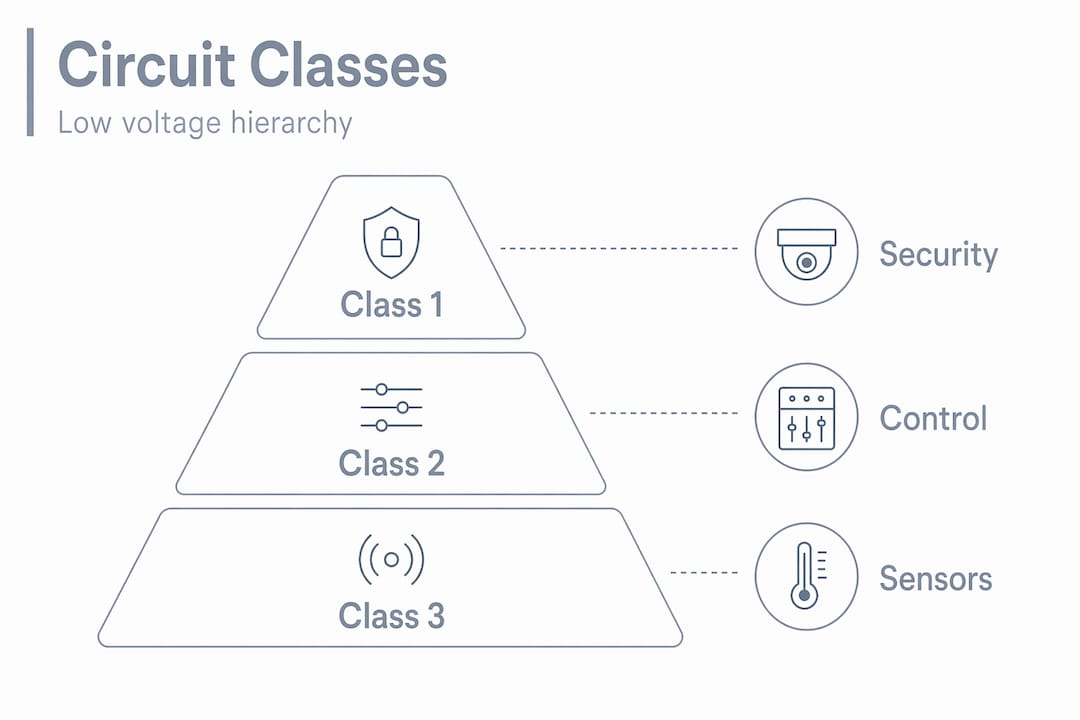
The circuit classification system uses three power classes that facilities managers encounter often. Class 2 circuits operate at 30V AC or 60V DC maximum with a 100VA power cap. These cover most security sensors, thermostats, and low power data systems. Class 3 circuits go up to 150V AC with a 100VA limit and appear in some audio and intercom systems. Class 4 is a newer category introduced with 2026 NEC, designed to accommodate higher power limited energy systems like PoE lighting, where faults are managed at the source rather than through conductor size alone.
Pro Tip: When a contractor hands you a spec sheet referencing “Class 2 wiring,” that tells you the circuit must stay within voltage and power thresholds. Any device being added to that circuit needs to be rated for it, otherwise you have a code violation and a potential inspection failure.
Core terminology used in security, network, and communication systems
Once you understand the classification framework, the individual terms start to make more sense. Here is the low voltage language you’ll run into most often across security, network, and communications work.
AWG (American Wire Gauge): This is how wire diameter is measured in the US. Lower AWG numbers mean thicker wire. Security camera power cables often use 18 AWG, while structured data cabling uses 23 or 24 AWG. Getting AWG wrong affects both performance and code compliance.

Ethernet: The physical and protocol standard used for wired data networking. In a facilities context, Ethernet is how your security cameras, access control panels, and VoIP phones connect to the network. It runs over twisted pair copper cables and can carry data up to 100 meters per run without a switch or booster in between.
Cat5e / Cat6 / Cat6A: These are cable categories for Ethernet. Cat5e supports speeds up to 1Gbps and is acceptable for most camera and access control installs. Cat6 handles 10Gbps at shorter distances with better interference resistance. Cat6A is the right choice for high power PoE runs and longer 10Gbps distances. Choosing the wrong category does not always cause an immediate failure, but it will limit your system’s future capacity.
PoE (Power over Ethernet): A method of delivering electrical power through an Ethernet cable alongside data. Cameras, wireless access points, intercoms, and door controllers all commonly use PoE. The switch or injector that sends the power is called a PSE (Power Sourcing Equipment). The device receiving it is called a PD (Powered Device).
Raceway: Any enclosed channel used to route and protect cables. Conduit, cable trays, and wiremold are all types of raceways. In low voltage work, raceways protect cables from physical damage and are required in exposed locations.
Pathway: In fire alarm and life safety contexts, a pathway refers to the complete route that wiring takes through a building, including cables, conduit, and connection points. Pathway survivability describes how long that route can maintain circuit integrity during a fire.
Power budget: The total amount of power a PoE switch can deliver across all its ports simultaneously. If your switch has a 250W power budget and you connect devices that collectively demand 300W, some devices will either not power on or will cycle off unpredictably.
Cable ratings (CMR, CMP, CMC): These designations tell you where a cable can be legally installed. CMR (riser) rated cable is required in vertical shafts between floors. CMP (plenum) rated cable is mandatory in air handling spaces like drop ceilings used for HVAC return air, because it burns with less toxic smoke. CMC is a newer designation for combined cables. Using the wrong rating in the wrong location is a fire code violation.
Code and safety standards that govern low voltage wiring
Knowing terminology is one thing. Understanding the rules around installation is what keeps your building compliant and your occupants safe.
The most common citation facilities managers receive during inspections involves physical separation. Low voltage cables and power wiring must never share raceways or box openings unless a listed separator is in place. That means separate drilled holes through studs and separate conduit runs. It seems obvious, but contractors working fast on large projects skip this step regularly.
Here is a quick checklist of the top compliance points inspectors look for:
- Low voltage cables must not share conduit or raceways with line voltage wiring.
- Any penetration through a fire-rated wall or floor assembly must be properly fire-stopped, typically with an intumescent material.
- Cable jacket ratings must match the installation location (CMR in risers, CMP in plenums).
- Junction boxes and pull points for low voltage must be accessible and labeled.
- Pathway survivability for fire alarm systems must reflect a system-level approach, not just the cable type.
On that last point, fire alarm system pathway survivability is widely misunderstood. Many managers assume that installing rated cable is enough to meet NFPA 72 requirements. It’s not. The standard requires a holistic approach: the cable, the enclosures, the installation method, and in some cases, the presence of sprinkler protection all contribute to whether a pathway qualifies as Level 2 or Level 3 survivability. A fire alarm circuit that loses integrity at 15 minutes into a fire because the junction boxes aren’t rated has failed regardless of the cable.
| Pathway survivability level | What it requires | Common application |
|---|---|---|
| Level 0 | No survivability requirement | Standard notification circuits |
| Level 1 | 2-hour rated cable and enclosures | Mid-rise commercial buildings |
| Level 2 | 2-hour rated cable, boxes, and installation | High-rise and large assembly buildings |
| Level 3 | Level 2 plus sprinkler protection | Critical mission facilities |
Pro Tip: When reviewing fire alarm contractor proposals, ask specifically which survivability level the design targets and get that documented before any cable is pulled. Changing this after installation is expensive.
You can also find detailed guidance on meeting fire and code requirements specifically for low voltage systems, which is worth reviewing before any major system upgrade.
PoE explained for facilities professionals
PoE is one of the most important low voltage concepts for facilities managers today, and also one of the most misunderstood. At its core, PoE allows a single Ethernet cable to carry both network data and electrical power to a device. That eliminates the need for a separate power outlet at every camera, access point, or intercom location.
The IEEE 802.3 standards define how much power can be delivered:
| PoE standard | Max power to device | Recommended cable |
|---|---|---|
| 802.3af (Type 1) | 12.95W | Cat5e |
| 802.3at (Type 2) | 25.5W | Cat5e or Cat6 |
| 802.3bt (Type 3) | 51W | Cat6 |
| 802.3bt (Type 4) | 71.3W | Cat6A |
Most IP security cameras and wireless access points run fine on Type 1 or Type 2. PTZ cameras and high-resolution multi-sensor units often need Type 3. PoE lighting and some advanced access control panels may require Type 4.
One thing that trips up facilities teams is power budget planning. A 24-port switch advertised as “PoE capable” does not necessarily deliver full power on all 24 ports simultaneously. You need to calculate total expected draw across all devices and verify the switch’s power budget covers it with room to spare.
PoE injectors and splitters are accessories worth knowing. An injector adds PoE capability to a run connected to a non-PoE switch. A splitter takes incoming PoE and separates the power from the data, which allows older devices without PoE support to be powered without swapping out hardware. These tools add flexibility, especially in retrofit situations where replacing switches or rewiring is cost-prohibitive. The shift toward PoE infrastructure has made network administrators a key part of electrical planning conversations that previously involved only licensed electricians.
For properties managing their own network infrastructure, understanding wiring for network connectivity is increasingly part of the job.
My take on why terminology matters more than most people think
I’ve seen facility projects get delayed, over-budget, and flagged by inspectors for reasons that trace back to terminology confusion. Not bad contractors necessarily, just miscommunication about what was actually being installed and to what standard.
In my experience, the shift to “limited energy” language represents something bigger than a labeling update. It reflects the reality that the wall between IT infrastructure and electrical systems has collapsed. When your network switch is powering cameras, access doors, and ceiling-mounted sensors through Ethernet cables, the network team is making electrical decisions whether they realize it or not.
What I’ve found works in practice is getting IT, facilities, and the licensed low voltage contractor in the same room before any significant project starts. Not after bids are accepted. Before. The terminology they each use for the same systems is often completely different, and that disconnect creates costly change orders and rework. I’ve watched a perfectly competent contractor pull the wrong cable rating through a plenum because nobody caught that the ceiling space was used for HVAC return air. The drawings didn’t call it out clearly, and nobody asked.
Stay current on NEC and NFPA updates. The 2026 NEC changes are not just semantic. They affect permits, licensing, and inspection outcomes in real, measurable ways.
— Aaron
How Lowvoltagecorp can help you manage it all

Lowvoltagecorp specializes in installation, repair, and maintenance of the systems this article covers: security cameras, motorized gates, wired and wireless networks, and cell boosters. If terminology in low voltage wiring feels like a foreign language when contractors walk you through a proposal, that’s exactly where Lowvoltagecorp’s team adds value. They communicate clearly, pull permits correctly, and install to current code.
For property managers looking at energy-efficient security integration or dealing with cameras, gates, or networks that aren’t performing, Lowvoltagecorp offers direct solutions. You can also get help resolving system failures fast across all the common low voltage systems found in commercial and residential properties. Real expertise, no guesswork.
FAQ
What does “limited energy” mean in the 2026 NEC?
The 2026 NEC replaced “low voltage” with “limited energy” to classify circuits by power and energy capacity rather than nominal voltage. It covers cables, circuits, and power sources under a unified framework across NEC Articles 725, 760, and 800 among others.
What is the difference between CMR and CMP cable ratings?
CMR (riser) rated cable is required in vertical runs between floors, while CMP (plenum) rated cable is required in air-handling spaces. Using the wrong rating in the wrong location is a fire code violation and an inspection failure.
What is a PoE power budget and why does it matter?
A PoE switch’s power budget is the total wattage it can supply across all active ports at once. If connected devices collectively demand more power than the budget allows, devices will fail to power on or will drop off the network unpredictably.
What are Class 2 and Class 3 circuits?
Class 2 circuits operate at up to 30V AC or 60V DC with a 100VA maximum, covering most security sensors and control systems. Class 3 circuits allow up to 150V AC at the same power cap and are used in some audio and intercom installations.
Why can’t low voltage cables share conduit with power wiring?
NEC and IRC 2024 requirements mandate physical separation between low voltage and line voltage wiring to prevent interference and safety hazards. Shared raceways or junction box openings require a listed separator, and most installations must maintain completely separate pathways.