Most people hear “low voltage” and assume it means weak, barely-there electricity that doesn’t really matter. That assumption causes more problems than almost any other misconception in building management. What is low voltage, really? It’s the category of electrical systems powering your security cameras, Wi-Fi network, intercoms, motorized gates, and smart building controls. Low voltage usually carries 50 volts or less, but its role in keeping a modern property functional and secure is anything but minor. If you manage a residential building or commercial facility, understanding low voltage is not optional. It’s fundamental.
Table of Contents
- Key takeaways
- What is low voltage, exactly?
- Where low voltage wiring actually shows up
- Low voltage safety and code compliance
- Wiring methods, voltage drop, and reliability
- Why this matters to facility managers
- My perspective: low voltage is the infrastructure people forget until it breaks
- How Lowvoltagecorp can help
- FAQ
Key takeaways
| Point | Details |
|---|---|
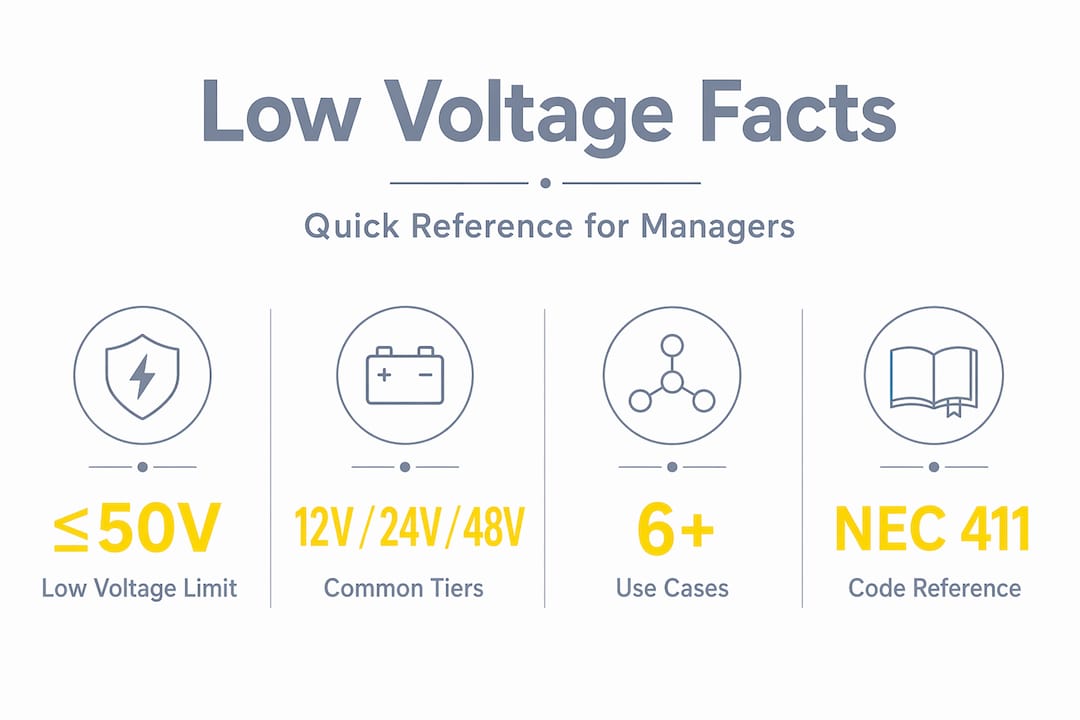
| Low voltage means 50V or less | Systems at 12V, 24V, and 48V power most modern connectivity and security in buildings. |
| It’s not just wiring, it’s infrastructure | Low voltage systems control your cameras, networks, gates, and automation, making them critical to facility operations. |
| Voltage drop is a real performance issue | Undersized wire or long runs reduce system performance; wire gauge selection must match distance and load. |
| Code compliance is not optional | NEC standards govern cable type, burial depth, GFCI protection, and separation from high voltage lines. |
| Professional installation saves money | DIY errors frequently lead to code violations, signal failures, and costly rework. |
What is low voltage, exactly?
The low voltage definition starts with a number: generally, any electrical system operating at 50 volts (V) or below. In practice, the most common voltages you’ll encounter in residential and commercial settings are 12V, 24V, and 48V. Each serves a different class of device.
To put that in context, standard household outlets run at 120V in the United States. That’s what powers your lights, appliances, and HVAC equipment. High voltage systems, sometimes called line voltage, operate at 120V, 240V, or higher. Low voltage is a completely separate tier of electrical infrastructure, governed by its own codes and requiring its own wiring, connectors, and installation practices.
The National Electrical Code (NEC) addresses low voltage systems across several articles, depending on the application. Article 411 covers lighting systems at 30 volts or less. Article 725 governs remote-control and signaling circuits. Article 800 covers communication wiring like telephone and data cabling. Each category has its own rules around wire type, routing, and protection requirements.
Here’s a quick comparison of where these voltage tiers fall in real-world applications:
| Voltage tier | Typical range | Common examples |
|---|---|---|
| Low voltage | 12V, 24V, 48V | Security cameras, Ethernet, landscape lighting, intercoms |
| Line voltage | 120V, 240V | Outlets, light fixtures, HVAC, kitchen appliances |
| High voltage | 480V and above | Industrial machinery, utility grid distribution |
Pro Tip: Never assume a low voltage wire is safe to handle while live. Even at 24V, improper contact with certain circuits can damage sensitive equipment or cause unexpected failures in connected systems.
Where low voltage wiring actually shows up
If you’ve ever wondered what is low voltage wiring in practice, walk through any modern building and look at every system that isn’t a light switch or power outlet. Chances are it runs on low voltage.
PoE systems commonly use 48V to deliver both power and data through a single Ethernet cable. That single detail powers IP security cameras, wireless access points, VoIP phones, and intercom systems in thousands of commercial buildings without a separate power run to each device. That’s a massive reduction in installation cost and complexity.
Here are the most common examples of low voltage wiring you’ll find across residential and commercial properties:
- Security cameras: IP cameras receive power and transmit video data over a single Cat5e or Cat6 cable using Power over Ethernet (PoE).
- Motorized gates and access control: Gate operators, keypads, and card readers typically run on 24V DC circuits.
- Structured data networks: All Ethernet (LAN) cabling, including the wiring for Wi-Fi access points, operates at low voltage.
- VoIP phone systems: Office phone infrastructure runs over data cabling, not traditional telephone wire.
- Smart building automation: Thermostats, occupancy sensors, and lighting controls all communicate via low voltage signal wiring.
- Landscape and security lighting: Outdoor low voltage lighting systems commonly run at 12V from a transformer.
- Cell signal boosters: Distributed antenna systems (DAS) and signal repeaters use low voltage for both operation and control.
The distinction between low voltage wiring and standard electrical wiring matters beyond just voltage. Low voltage wiring is generally more flexible to run, easier to modify, and less disruptive to install after construction is complete. That flexibility is part of why it’s become so central to facility efficiency and security in modern buildings.
Low voltage safety and code compliance
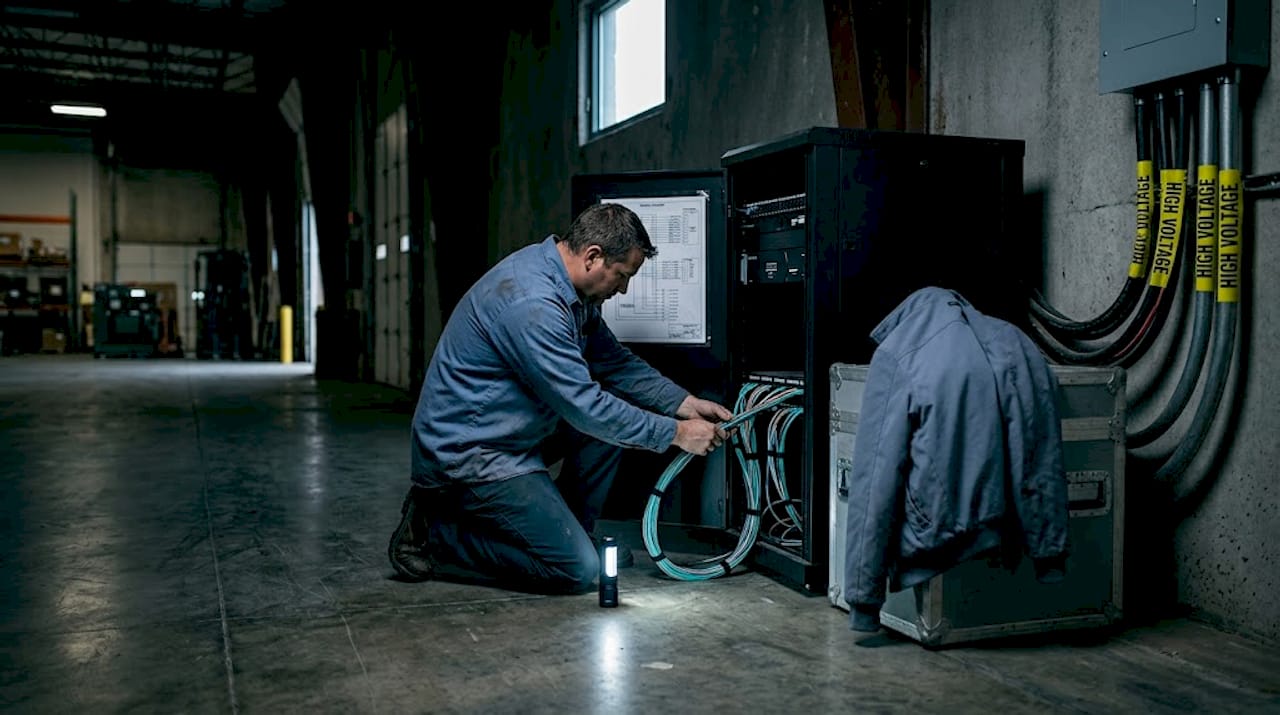
Here’s where property and facility managers need to pay close attention. Low voltage does not mean low risk. The safety standards are different from high voltage systems, but they are still standards, and violations carry real consequences.
GFCI protection is required by NEC 411.4(A) for low voltage landscape lighting transformers. That GFCI breaker protects the entire circuit from ground faults, which can develop even in 12V systems when moisture gets into connectors or junction boxes. Outdoor installations add another layer of requirements: burial depth for direct-burial cable must meet a minimum of 6 inches per NEC standards.
One of the most overlooked hazards is cable routing. Running low voltage data cables parallel to high voltage lines without proper separation causes interference and data corruption. The recommended minimum separation is 6 to 12 inches. In commercial environments where conduit runs are dense, this spacing becomes harder to maintain and easier to ignore. When it’s ignored, you end up with degraded camera footage, intermittent network drops, or access control systems that behave unpredictably.
Common low voltage safety mistakes that facility managers should watch for include:
- Skipping surge protection on outdoor camera and lighting circuits
- Using the wrong cable type for the environment (e.g., indoor-rated cable buried outside)
- Mixing Class 2 signal wiring with Class 1 power wiring in the same conduit
- Overloading a low voltage transformer beyond its rated wattage
- Neglecting weatherproof enclosures for outdoor terminations
DIY low voltage installations often lead to code violations and safety hazards including electrical fires, primarily because homeowners and unqualified contractors underestimate the surge protection requirements and wiring separation rules. Professional installation is the only reliable path to NEC compliance and long-term system reliability.
Pro Tip: Before any renovation or addition to your property’s low voltage systems, request a complete as-built wiring diagram from your installer. This single document will save hours of troubleshooting later and is often the first thing a technician needs when something fails.
For a practical overview of how to handle common failures, review this guide on fixing low voltage issues across gates, cameras, and networks.
Wiring methods, voltage drop, and reliability
Understanding low voltage wiring explained properly means understanding voltage drop. This is the single most common cause of performance problems in low voltage systems, and it’s almost always underestimated during planning.
Voltage drop occurs when resistance in the cable reduces the voltage that actually reaches the device at the end of the run. Voltage drop causes dimming and uneven brightness in low voltage landscape lighting and degrades performance in other devices too. The NEC recommends a maximum 3% voltage drop on branch circuits. For a 12V lighting circuit, that means the device at the end of a long run should receive no less than 11.64V.
The fix is straightforward in theory: use heavier gauge wire over longer distances, or break long runs into shorter segments fed from a central point.
| Run distance | Recommended wire gauge | Notes |
|---|---|---|
| Up to 50 feet | 16 AWG | Suitable for light loads |
| 50 to 100 feet | 14 AWG | Standard for most landscape lighting runs |
| 100 to 150 feet | 12 AWG | Required to stay within 3% voltage drop |
| Over 150 feet | 10 AWG or hub-and-spoke layout | Consider splitting the run or adding a second transformer |
Two common wiring layouts serve different situations well. The home-run method connects each device back to the transformer individually, giving precise voltage control and making troubleshooting simpler. The daisy-chain or series method connects devices along a single cable, which uses less wire but creates larger voltage drops for devices at the far end.
Proper planning during construction can future-proof infrastructure, and that planning starts with deciding your wiring topology before you pull a single cable. For existing properties, a hub-and-spoke layout from a central patch panel or termination point gives you the most flexibility for future upgrades.
Why this matters to facility managers
Low voltage systems are the nervous system of any building that operates with modern automation, security, or connectivity. Treating them as an afterthought during construction or renovation creates compounding problems that are expensive to fix after the walls are closed.
The benefits of well-planned low voltage infrastructure include:
- Lower energy costs: Low voltage devices draw significantly less power than their high-voltage equivalents, which adds up across hundreds of devices in a large facility.
- Scalability: Adding a new camera, phone, or access control reader to a properly designed low voltage network requires no new electrical work, only a cable pull and device configuration.
- Safety: Operating at 50V or below, these systems present far less shock hazard to maintenance staff working on them during routine service.
- Integration: Modern building management systems (BMS) rely entirely on low voltage communication wiring to connect HVAC controls, lighting sensors, and access control into a single platform.
- Reduced downtime: Systems with documented, properly installed wiring can be diagnosed and repaired in a fraction of the time compared to improvised installations.
Low voltage wiring delivers the intelligence and communication that high-voltage power lines cannot. A building can have perfect electrical power and still be completely blind, uncommunicative, and uncontrolled if its low voltage infrastructure is absent or failing. That’s the real stakes of getting this right. For managers thinking ahead, reviewing low voltage trends in 2026 is worth the time.
My perspective: low voltage is the infrastructure people forget until it breaks
I’ve been working with low voltage systems long enough to see the same pattern repeat itself across property after property. During construction, the budget conversation focuses on finishes, fixtures, and mechanical systems. Low voltage gets a line item, someone pulls cable, and then nobody thinks about it again until a camera goes offline, the gate stops responding, or the Wi-Fi won’t reach half the building.
What I’ve learned is that most of these failures were decided months or years earlier, usually by one of three choices: wrong wire gauge for the run length, no documentation of what was installed and where, or routing that put data cable too close to power conduit. None of these are exotic problems. They’re the predictable result of treating low voltage as an afterthought.
My honest take is that property managers who understand even the basics of what is low voltage electricity and how their systems are wired are in a completely different position than those who don’t. You don’t need to be an electrician. You need to know enough to ask the right questions, recognize when something looks wrong, and hold your installer accountable to a documented, code-compliant result.
The buildings that run best aren’t the ones with the most technology. They’re the ones where the low voltage infrastructure was planned first and installed correctly.
— Aaron
How Lowvoltagecorp can help
Lowvoltagecorp specializes in the installation, repair, and maintenance of the low voltage systems that property and facility managers rely on most: security cameras, motorized gates, wired and wireless networks, and cell signal boosters. Whether you’re dealing with a camera that won’t connect, a gate that’s stopped responding, or a network that can’t keep up with your building’s demands, the solution starts with a proper diagnosis from someone who knows these systems inside and out.
If you’re troubleshooting existing problems, start with this practical resource for resolving gates, cameras, and network issues fast. For managers planning a new installation or upgrade, Lowvoltagecorp can assess your property’s current infrastructure, recommend the right wiring approach, and install everything to NEC standards with full documentation. Reach out at lowvoltagecorp.com to discuss your property’s specific needs.
FAQ
What is the low voltage definition in electrical terms?
Low voltage refers to electrical systems operating at 50 volts or below, with common values of 12V, 24V, and 48V. These systems power security cameras, data networks, intercoms, and building automation controls.
What is the difference between low and high voltage?
Low voltage systems operate at 50V or below and power communication, security, and data devices. High voltage and line voltage systems run at 120V or higher and power lights, outlets, and heavy equipment.
What are common examples of low voltage wiring?
Common examples include Ethernet (LAN) cabling, security camera wiring, VoIP phone lines, smart thermostat wiring, motorized gate control circuits, and 12V landscape lighting systems.
Is low voltage wiring safe to handle without an electrician?
Low voltage presents less shock risk than line voltage, but it is not risk-free. Improper installation can cause equipment damage, code violations, and in some cases fire hazards, particularly in outdoor or surge-exposed circuits. Professional installation is strongly recommended.
What causes voltage drop in low voltage systems?
Voltage drop results from cable resistance over long runs. Undersized wire gauge and ignoring voltage drop are the most common causes of uneven lighting and device failures in low voltage installations. Selecting the correct wire gauge for your run length prevents most issues.