Commercial properties in South Florida are sitting at an inflection point. The assumption that upgrading low voltage systems is mostly about swapping out old cameras or adding a new access reader is exactly the kind of thinking that creates costly gaps in security and operations. In 2026, identity and security work is shifting heavily toward unified platforms that merge physical access, digital credentialing, and automated responses into one managed system. For property and facility managers, this means the real decisions are no longer about hardware specs but about integration strategy, data management, and long-term operational resilience.
Table of Contents
- Why integration, not just upgrades, dominates 2026 low voltage trends
- Unified identity platforms: The shift toward total access integration
- AI at the edge: How video analytics is reshaping surveillance and bandwidth
- The real-world impact: Navigating data quality, alarms, and site realities
- Our perspective: What most low voltage guides overlook in 2026
- Get hands-on help with your next low voltage project
- Frequently asked questions
Key Takeaways
| Point | Details |
|---|---|
| Integration first | Managing integration complexity is more important than just upgrading devices in 2026. |
| Unified access | Unified identity platforms are becoming standard for both physical and digital access in commercial properties. |
| Edge AI efficiency | Edge AI in surveillance can dramatically reduce data costs and boost real-time responsiveness. |
| Data quality matters | Proper calibration and trusted data environments are key to avoid pitfalls like false alarms with new analytics. |
Why integration, not just upgrades, dominates 2026 low voltage trends
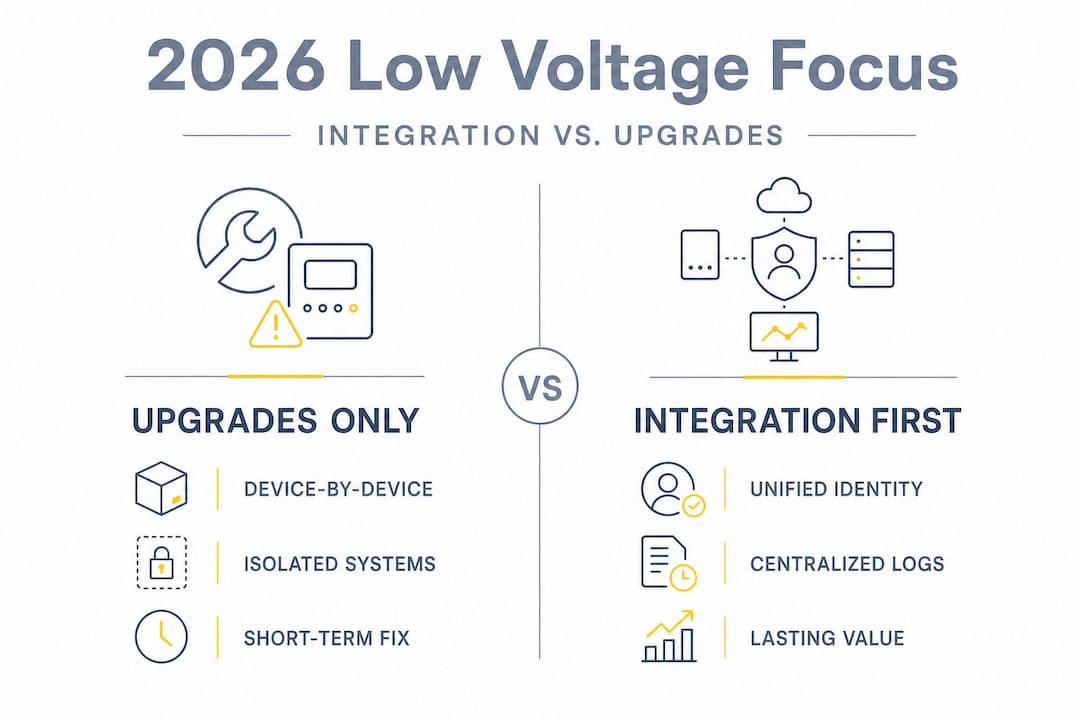
Most managers come to us with a list of devices. A new camera here, a gate reader there, maybe an upgrade to the wireless network. The problem is that treating each project as a separate purchase misses what’s actually changed. Low voltage work in 2026 is fundamentally about how systems talk to each other, not just what they do individually.
Integration in this context means connecting your security cameras, access control, motorized gates, network infrastructure, and automation layers so they share data and respond together. Device replacement, by contrast, is just swapping hardware without rethinking the communication layer. The difference in outcomes is significant. A facility that replaces cameras without integrating them into a unified management platform is still running a fragmented operation, just with newer equipment.
The industry is responding to this reality. HID’s 2026 report confirms that security and automation are being treated as a single integration problem rather than separate project categories. That convergence has direct implications for how you plan budgets, manage vendors, and phase deployments across a commercial property.
Treating security and automation as separate line items is the fastest path to an expensive integration failure. Plan them together or plan to redo the work.
Here’s what a proper integration-first approach looks like in practice:
- Audit existing infrastructure before specifying new equipment
- Identify where access control, surveillance, and network systems share data paths
- Phase deployments around integration milestones, not hardware delivery dates
- Assign a single point of accountability for the full low voltage stack
Pro Tip: When evaluating contractors for a low voltage project, ask specifically how they handle integrating new low voltage trends across systems. A contractor who only discusses device specs is likely thinking about installation, not integration.
Change management is also part of this equation. Your facility staff, security team, and IT department will all interact with integrated systems differently than they did with standalone devices. Building time for training and workflow adjustment into the project plan avoids the common scenario where a well-installed system gets bypassed because users don’t understand it.
Unified identity platforms: The shift toward total access integration
If there’s one trend that defines 2026 for commercial low voltage, it’s the move toward unified identity. This term refers to platforms that manage both physical and digital access through a single system. Instead of a separate badge reader database and a separate IT network login system, a unified identity platform handles both. An employee credential works for the front gate, the server room door, and the internal network.
The adoption numbers are hard to ignore. 73% of respondents in the 2026 HID report identify identity management as a top organizational priority, and 75% are actively deploying or evaluating unified identity solutions. These aren’t early adopters. This is mainstream commercial real estate and facility management acknowledging that fragmented identity systems create security gaps and administrative overhead.
| Traditional access model | Unified identity platform |
|---|---|
| Separate physical and digital credentials | Single credential for all access points |
| Manual updates across multiple systems | Centralized provisioning and de-provisioning |
| Siloed audit logs | Consolidated access history and reporting |
| Higher administrative overhead | Reduced IT and security management time |
| Slower response to terminated employees | Instant access removal across all systems |
The practical impact for a commercial property manager is real. When an employee leaves, a unified platform lets you remove their access instantly across every door, gate, and network resource. With fragmented systems, that same task might require three separate administrators touching four different software platforms. The risk of a missed step is high, and the liability is real.
Here’s how to approach a migration toward low voltage trends in automation and unified identity:
- Inventory all current credential systems, including key fobs, PIN pads, smart cards, and network logins.
- Map access points to risk levels, identifying which doors, gates, and systems require the most stringent control.
- Select a platform with open API support so it can connect to your existing security cameras and network infrastructure.
- Run a pilot in a single building or zone before full deployment to catch integration issues early.
- Train your security and HR teams together, since both will manage credential lifecycle from hiring to termination.
The shift toward unified identity also changes what you should look for in a low voltage contractor. You need a partner who understands both the physical installation side, pulling cable and mounting hardware, and the logical side of how credentials are provisioned and managed at the platform level.
AI at the edge: How video analytics is reshaping surveillance and bandwidth
Edge AI sounds technical, but the concept is straightforward. Instead of sending all video footage to a central server or cloud for analysis, edge AI puts the processing power inside the camera itself or in a local device at the site. The camera identifies motion, people, vehicles, or specific events on the spot and only sends relevant data upstream.
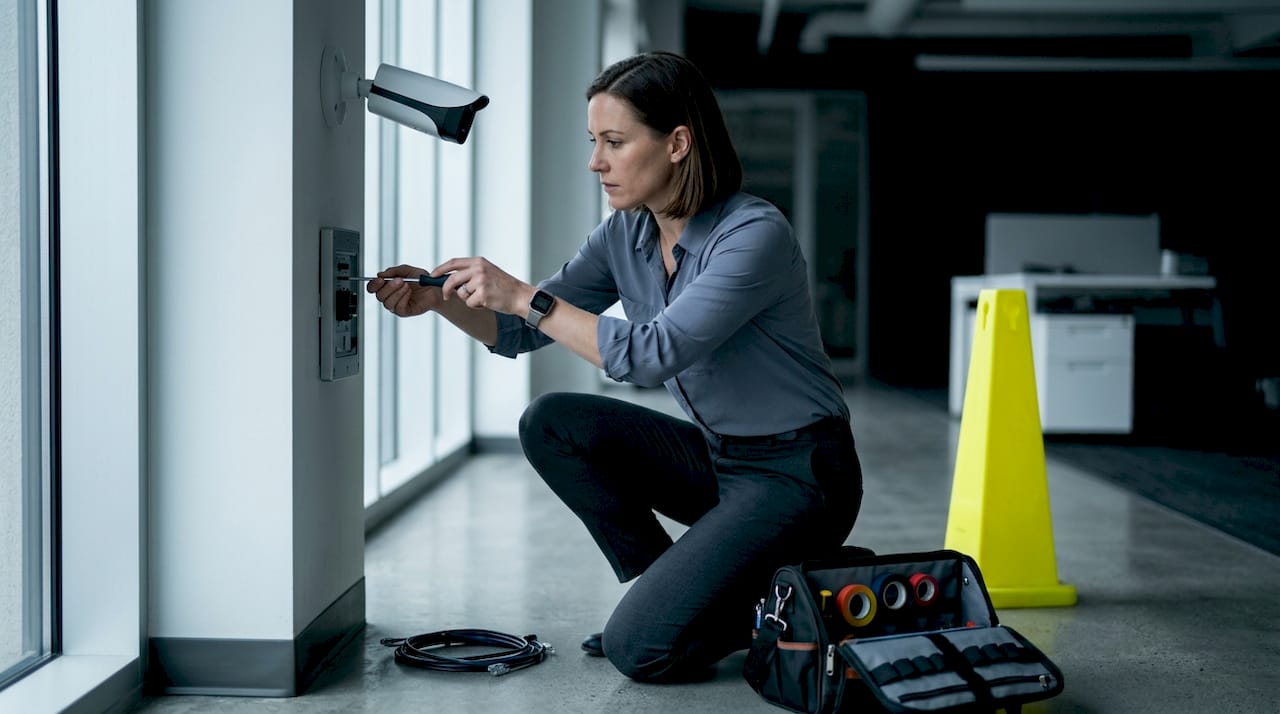
For a commercial property in South Florida, the bandwidth implications alone make this worth understanding. A single 24/7 camera without edge processing generates roughly 1.5 TB of upload data per month. The same camera with edge AI running local analysis sends approximately 30 GB per month. That’s a 98% reduction in outbound data for a single camera. Scale that across a 20-camera deployment and you’re looking at eliminating roughly 29 TB of monthly bandwidth consumption.
| Metric | Cloud-only processing | Edge AI processing |
|---|---|---|
| Monthly upload per camera | ~1.5 TB | ~30 GB |
| Real-time alert speed | Seconds to minutes | Near instant |
| Dependency on internet connection | High | Low |
| Cost scaling as cameras increase | Significant | Moderate |
| On-site processing hardware needed | No | Yes |
Beyond bandwidth, edge AI enables faster alerts. When a camera detects a perimeter breach, an edge-processed alert fires in milliseconds rather than waiting for footage to travel to a cloud server and back. For motorized gate control and real-time security responses, that speed difference is operationally significant.
When deciding between edge and cloud for your strategies for edge AI, consider the following factors:
- Large multi-camera deployments favor edge because bandwidth savings compound quickly across every camera added
- Bandwidth-limited sites like older commercial buildings or those with shared infrastructure benefit most from local processing
- Properties requiring centralized management across multiple sites may find cloud still wins for simplified administration
- Sites with frequent model updates may prefer cloud because updating edge firmware at scale requires additional coordination
Pro Tip: Before specifying edge AI cameras, confirm that your existing network switches can handle the local traffic between edge devices and your video management system. Underpowered switching infrastructure is one of the most common reasons an edge AI deployment underperforms after installation.
The real-world impact: Navigating data quality, alarms, and site realities
Here’s where a lot of technology conversations skip ahead too fast. Edge AI and unified identity sound clean and efficient in a product brochure. On an actual commercial property in South Florida, conditions are messier. Heat shimmer, insects near exterior cameras, lighting transitions at dawn and dusk, and vehicle reflections from parking lots can all create noisy sensor inputs that trigger unwanted alerts.
Hanwha Vision’s research confirms what we see in the field: false alarms spike when environmental conditions produce low-quality or inconsistent video inputs. This isn’t a reason to avoid edge AI. It’s a reason to plan for calibration before you finalize your deployment.
A system that generates 40 false alarms per night doesn’t get used. Staff learns to ignore it, and you’ve spent significant capital on equipment that’s effectively turned off. Calibration is not optional.
Here are the practical planning steps that separate a successful deployment from a frustrating one:
- Conduct a site walkthrough during different lighting conditions, including evening and early morning, to identify environmental variables.
- Establish detection zones carefully, excluding areas like parking lot entrances where headlight glare consistently triggers motion events.
- Start with conservative sensitivity settings and tune upward based on real performance data from the first two weeks of operation.
- Document your baseline false alarm rate within the first month so you have a benchmark for future tuning adjustments.
- Schedule quarterly reviews of analytics performance with your low voltage contractor to catch model drift or new environmental conditions.
Data quality also matters for unified identity systems. Access logs are only useful for audits and investigations if they’re clean and complete. When systems are integrated, a misconfigured data field in one platform can create gaps in the audit trail across all connected systems. This is why the planning for site realities has to happen before installation, not after.
Calibration and tuning are not one-time tasks. South Florida’s seasonal changes, new landscaping, added vehicles, and modified building access patterns all require periodic adjustments. Building this into your facility’s maintenance schedule, rather than treating it as a post-installation afterthought, keeps systems performing at the level you need.
Our perspective: What most low voltage guides overlook in 2026
Most upgrade articles stop at the technology layer. They explain what edge AI does or what a unified identity platform is, and then leave you with a feature list. What they skip is the operational change that these integrations require from the people managing them.
We’ve worked on commercial properties where a perfectly installed system failed to deliver value because no one revisited workflows. The security staff was still calling the front desk to verify visitor identity instead of using the integrated platform. The facility team was still pulling separate reports from the camera system and the access control system for incident reviews, even though both systems were capable of generating a single consolidated log. New hardware was installed. Nothing actually changed operationally.
The uncomfortable truth is that expert perspective on low voltage integration points to workflow design as the factor that separates high-performing deployments from expensive shelf-warmers. Before you finalize any project scope, ask your team how they’ll use the system differently than they do today. If the answer is “the same, but faster,” you may have a change management problem that no amount of technology will solve.
We also see managers get caught up in the edge vs. cloud debate as if it’s a permanent decision. It isn’t. The right answer today depends on your site’s current bandwidth, camera count, and staff capacity for on-site management. That answer will likely change as your property portfolio grows or as cloud processing costs continue to shift. Build flexibility into your contracts and infrastructure choices so you aren’t locked into a configuration that stops making sense in two years.
Finally, calibration is where most deployments either succeed or quietly fall apart. The properties that get consistent value from AI-driven surveillance treat sensor tuning the same way they treat HVAC maintenance: scheduled, documented, and reviewed on a regular cycle. It’s not glamorous, but it’s what keeps the investment performing.
Get hands-on help with your next low voltage project
Navigating these decisions across a commercial property portfolio is genuinely complex. Unified identity platforms, edge AI surveillance, structured cabling, motorized gate integration, and cell signal enhancement all interact with each other in ways that require experience to manage well.

If you manage facilities across South Florida and want guidance grounded in real installation and integration experience, Low Voltage Corp solutions cover the full spectrum of what your property needs, from security camera systems and motorized gates to wired and wireless networks and cell boosters. We work with property managers who want a contractor that thinks about integration first, not just hardware. Reach out to discuss your next project and get a practical assessment of where your current systems stand and what the upgrade path actually looks like.
Frequently asked questions
What is a unified identity platform in commercial low voltage?
A unified identity platform manages both digital and physical access by integrating credentials for doors, networks, and services into one system, eliminating the need for separate databases for badge access and IT logins. This shift toward unified platforms is being driven by the need to reduce administrative gaps and improve security response times.
How does edge AI video surveillance reduce costs for property managers?
Edge AI processes video locally on the camera or a nearby device, dramatically cutting the data sent to the cloud and reducing both bandwidth and storage costs. Edge AI reduces upload volume from roughly 1.5 TB per month to about 30 GB per month for a single 24/7 camera.
What are common pitfalls when deploying edge AI analytics?
False alarms are the most common operational problem, and they typically spike when environmental conditions like glare, heat shimmer, or insects create noisy or low-quality inputs for the analytics engine. Proper zone configuration and regular calibration are the primary tools for managing this issue.
Should property managers choose edge or cloud for video analytics?
Choose edge for large camera fleets and bandwidth-constrained sites where upload cost scaling becomes a major factor, but cloud remains a strong option for smaller properties or where centralized model management and updates are the priority. The right choice depends on your site count, camera volume, and IT management capacity.